
CollegeHumor:
Ca$hing In On Comedy
For my ethnographic research, I focused on what I considered the two most important aspects of CollegeHumor’s advertising campaign: whom they were advertising to and how they were doing it. For this part of my research, I tried to find general knowledge about advertising techniques and apply it specifically to my CollegeHumor project. No one has studied CollegeHumor before, so I relied heavily on my own observations. Throughout my ethnography section, I tried to incorporate my analysis in order to understand what I observed.
Who is CollegeHumor advertising to?
CollegeHumor has a very specific audience that they advertise to. The site acts almost as a personal narrative that takes on its own persona and has those values. This persona would be CollegeHumor’s target demographic, young men 18-34 years old. By targeting a certain group of viewer, CollegeHumor definitely reflects certain cultural codes. “Cultural codes are symbols and systems of meaning that are relevant to members of a particular culture” (Mead). In this situation, CollegeHumor recognize that these codes can be utilized to facilitate communication within the “inside group”, in this case the typical male college student.
CollegeHumor uses a combination of demographic, contextual and affinity advertising. “Demographic targeting is, arguably, the longest-running, most widely used concept for targeting advertising” (Barocci 8). With this technique, the advertiser defines audiences according to their age, gender, income, occupation, and household size and then uses this information to appeal to the consumer’s wants and needs. Contextual advertising “places ads on web pages that have a relationship to the content of the page,” so there would, for example, be advertisements for baseball bats on a sports website. (Barocci 9). Contextual advertising is a straightforward method because the ads are “seen in places where large numbers of shoppers go to catch up on events or news and look for information about a specific product category or activity” (Barocci 9). It is especially efficient because it concentrates buyers and sellers onto one website, so although the advertiser still must impress the consumer, the consumer almost comes to them for the information. Affinity advertising explains that when visitors have a high affinity to the site and are frequently on it, “they’re interested, and therefore more likely to notice and read ads and agree that ‘ads interfere less’” (Barocci 11). These high affinity users have greater brand recognition on their favorite websites than they do on other websites and when compared to low affinity users (Barocci 12). CollegeHumor’s combination of these factors result in greater purchase/behavior intent of their viewers.
CollegeHumor picks advertiser that can capitalize on an advertising opportunity by playing off the male, sometimes immature, college student demographic they know that CollegeHumor attracts. The ads conform to the stereotypical male gender code: young men like food, video games, girls, etcs… CollegeHumor assumes that these young men do not have a lot of spending money, so there are no advertisements for high quality, expensive products because often college students can’t afford these items. There are no advertisements for jewelry or makeup because not enough girls go to the site (CollegeHumor estimated that 70% of users are male). However, there are plenty of ads for comedy TV shows, condoms, deodorant, cell phones and video games among other things that guys are interested in.
The featured companies are previous sponsors of CollegeHumor. All of them target a young demographic, most notably college students.

CollegeHumor and their advertisers understand that although their entire audience does not fit their stereotypical mold of a young, immature male, they still must cater solely to this demographic. There are two reasons for this. Firstly, the opportunity cost of catering to a different demographic is way too high. It would be much too expensive to advertise to a minority demographic because not enough ad revenue would be made to compensate for the ads. Secondly, even if a viewer is not a male college student, it is possible that this viewer, although female or a different age, shares the same cultural codes because after all, the viewer is voluntarily on CollegeHumor. There is a good chance that these ads will appeal to whomever sees them, even me. Furthermore, even in the case when ads do not pertain to a viewer like me specifically, I can understand and appreciate why an ad about a video game (bottom) would follow a video game talk show (top).



This type of correspondence shows that there is definitely a high level of thinking at work. Although the ads themselves change, there is a recurring theme and concept behind the types of ads and sponsors. Online advertisers often spend a good percentage of their money on research and development to make sure their ads will be effective. Although spending all this money on research is expensive, having a mixture of demographic, contextual and affinity advertising pays off. “Richer targeting criteria increase the potential for reaching consumers with better-aimed brand advertising,” meaning that the better suited the aid is, the better it will do (Barocci 8). Furthermore, matching website content and ad content, which the different types of targeting do, puts “shoppers in receptive frames of mind, increasing the potential impact of the brand’s message” and therefore CollegeHumor’s ability to profit (Barocci 13).
How does CollegeHumor advertise?
When the Internet first became a business tool, not all companies took full advantage of its global influence. Online advertising started and “the first sites ran the gamut from ‘brochureware,’ which was nothing more than print material reproduced online” (Aaronson). Then, as companies profited, online advertising became a more sophisticated business. “Consumers’ appetite for immersive online experiences is limitless as technological innovation and creativity give rise to new forms of entertainment and information in the digital age,” said Randall Rothenberg, President and CEO, IAB. As more markets adopted interactive media to build up their brands, “nearly all types of ad formats [showed] positive movement...[in] increasing their investment in digital media” (Aaronson).
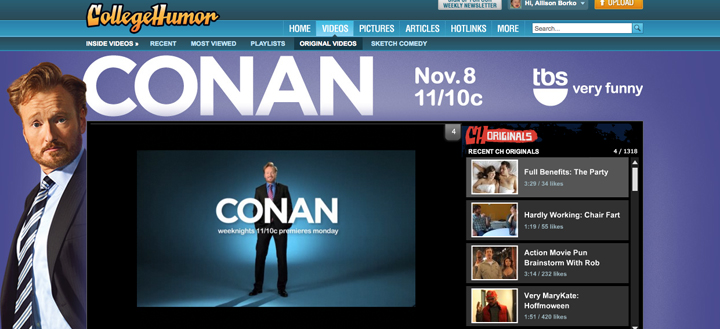
CollegeHumor is a perfect example of this. Once having just ads and banners along the top of the website, CollegeHumor’s advertisements now dominate the website. There are wallpaper advertisements in the background of the site. This “background”, however, does not seem like any plain old advertisement that fades into the back of the screen. “The first Web advertising models were banners and buttons with…clearly defined borders,” but now the advertisements frame the videos in an odd, asymmetrical way (Aaronson). The ads are big and bold and hard to ignore, but normally not shown as complete as they were created. Normally, one would think that an ad would be designed around a video or an article so that it is constructed to fit where the video does not. In this case, it is as if the ad was designed first, by itself, and then the video or article was placed on top of it. It looks as if often the video is cutting off the ad. Even though the video is the main attraction, the spacing of the ad makes it seem as if the video is almost in the way, rudely putting itself in front of a well designed ad that is now being compromised. The ads definitely surround the video, but they do not evenly frame it. Words are often cut off and the white space is definitely not symmetrical. One might think that this is bad advertising technique because the ad that sponsors spent so long making is not shown to its fullest. However, on the other hand, this could be seen as a new innovative method because it makes the viewer consider the ad in a different light; instead of a bother, the ad is now the main attraction and since it is being cut off, the viewer must learn more and seek out the real ad and potentially the product.

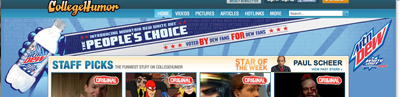
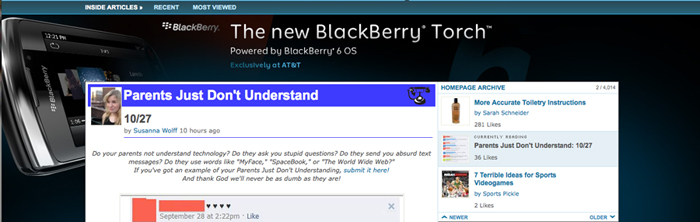
Additionally, another way CollegeHumor prevents the wallpapers from fading into the background is to create an image of the advertisements watching you. Whether it is Conan, Jon Stewart, or the guys from Hot Pursuit, there is often a representative image of a brand staring you in the face. These advertisements are almost daring you to look away, to ignore them, because they know it is impossible to ignore such a blatantly intrusive ad. By being so intrusive and obvious, the ads seem almost paradoxically well hidden. They are hidden in the sense that when I personally see them I do not feel like I’m seeing an ad because I focus instead on the face. These forms of advertisements accustom the viewer to seeing that person as an iconic image of the company. In real life, the more times you see a person, the more comfortable you feel with them. Even if you don’t actually know that person, you might feel like you do. The same concept applies online. For example, the more I see Conan, the more I get to know and like him. Although there has been no change in our relationship, I slowly become accustomed to his face and the idea of him being around. In these situations, although there is not strong brand name advertising, there is an overwhelming facial recognition aspect. By consciously becoming familiar with the face of the brand, the viewer unknowingly becomes familiar with the brand and for advertisers this is half the battle.


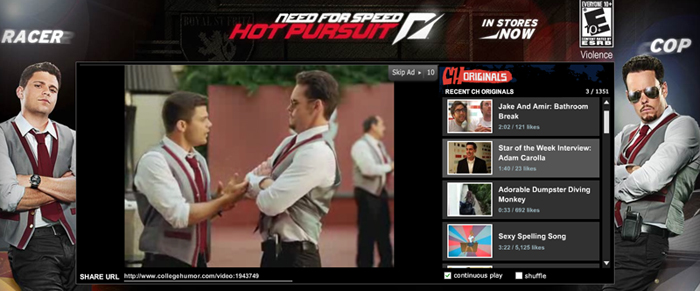
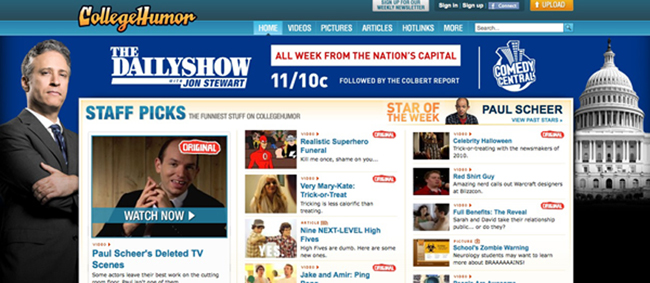
In the aforementioned case as well as other instances (when your not being watched), images are doing the work, not words. Although there are some words on the wallpapers, these are just details. The most important information on the ad is the brand name, not the specific time or date it comes out. Occasionally, the text enhances the picture, such as Conan written in huge, big bold letters next to his name. In these cases, however, the text itself acts as a carefully designed and placed imaged, not as words that are part of a sentence. Rather than try to sell details, companies advertising on CollegeHumor want to sell an overall product and idea, so they give their viewers literally “the big picture” of what is most important and worth remembering.
Even in terms of the videos, the images seem more important than any spoken advertisement as well. For example, in the Condom POV video, the narrator never verbally says that he wants Trojan condoms specifically, yet this is obvious from the excess product placement of Trojans on the screen.
Additionally, I would prefer to see Pat use a blackberry in a video without mentioning the phone’s features. I believe the ads are more effective if they do not compromise the integrity of the video and make the video completley about the product rather than the storyline.
Lastly, even during the video advertisements in between videos, the image still dominates over the verbal part. Often, to take a break from listening to videos, I mute the advertisements. Regardless, I always want to know when the next video will start, so I watch the ads. In this case, the images and words work together to create a holistic advertising experience. The images entice me, set up the background story, and then the words at the end explain what I just watched. Overall, this creates a successful and powerful advertisment.