
"It's so good to see you!" What is it about a Skype video call that elicits such strong emotions from so many people? On the contrary, what is about a Skype call that makes some people feel uncomfortable? This page examines Skype through an anthropological lense in order to find answers to these questions.
This website is one of a collection of individual projects relating to a wide varity of media and media technologies created by students for the Anthropology of Media class offered at the Johns Hopkins University in the fall semester of 2010. Please visit our homepage at http://www.jhu.edu/anthmedia/ to learn more about us and to view other students' projects.
Introduction
This is an exploration into the VoIP (Voice over Internet Protocol) and video chat program Skype (visit Skype's homepage http://www.skype.com/). It was constructed as a project for the Anthropology of Media class offered at the Johns Hopkins University in the fall semester of 2010.
At the time this webpage was published--December 2010--the Skype client is free to use for Skype-to-Skype calls and has several Skype-to-Phone, national, and international calling options that require a subscription. Skype's current beta version features a premium multiple video chat (Nuttall 2010). It is downloadable to computers running Windows, Mac, and Linux operating systems and has versions available for many smart phones.
This is not a full ethnographical study into Skype, though some of the resources are used in an ethnographic manner. It is more precisely an exploration of how certain anthropologic theories and ideas may relate to the study of Skype and other related software. I will offer suggestions throughout this page for topics that would benefit from full ethnographic research.
VoIP Background
VoIP is a technology that converts voice information created by a telephone, an analog signal, into digital data which is then transmitted over the Internet. The digital data are cheaper to transfer than traditional phone signals, allowing VoIP services to offer lower rates for local and international calls (Hallock 2004; "What is Residential VoIP").
The first Voice over IP software was developed by Vocaltec in 1995 for PC-to-PC communication. Later, VoIP technology was developed to allow for cross platform communication (Hallock 2004). VoIP had limited quality in its early stages because of the scarcity of broadband internet connection. However, once broadband become widely available VoIPs became hugely more effective ("The History of VoIP"). Due to their relatively low cost and high quality, VoIP services are becoming popular alternatives to traditional phone services and will likely continue to displace so-called "legacy" connections.
The Uses of Skype
Skype is a unique program among other VoIPs in that its Skype-to-Skype feature is free to download and use, making it very popular. At any given time, one is likely to find upwards of 10 million people logged onto Skype. Its video-chat feature, which is highly advertised and to the casual user synonymous with Skype, is also free to use and is the subject of this project. Skype's current beta version was not used for this project.
Skype was chosen for this project because of its popularity and self-proclaimed ease of use and also for its integral video option. The following video, entitled "Skype Explained Visually," is a short animation that advertises several aspects of Skype.
SayItVisually's YouTube channel
Skype has a wide range of social and business uses (see Kiviat). Through my research, I found many of the most excited people used Skype for business purposes because of its ability to facilitate relationships at a distance. However, I will chiefly discuss the use of Skype's video chat feature as a social medium. I believe a further study into the power structures that Skype and other VoIP software create could be conducted, especially as it relates to geographic and economic spaces.
Research Topics
The goal of this project is to analyze the social use of Skype's video chat feature. I hope to examine how and with whom people use Skype to interact, drawing on a small array of linguistic theories, anthropological studies, lectures from the class, my own experience, and opinions from the public sphere to explore what happens to social dynamics and identities from the interactions that occur over Skype. I particularly wish to explore the ideas of "presence" and the "fragmentized self" and how Skype's visual environment creates a virtual sense of presence for the parties involved. Aspects of a Skype call will be compared to other forms of communication with the intent of finding similar trends between mediated communications.
Methods
As I have stated before, this is an investigation into the social interactions that take place on (or "within") a video Skype call. Throughout this project, it can be assumed that when I speak of a Skype call, I mean a video call, specifically one between two desktop and/or laptop computers captured by microphones and webcams. I will use my personal experience as a way of contextualizing some of the theoretical content which I use to analyze Skype. I will also use publicly expressed opinions and my own experience with the medium to try and draw broader conclusions about Skype. Because my observations were made on the Johns Hopkins campus and the opinions I read from the public sphere were published in Western countries, my analysis will apply specificly to undergraduate students in Western universities and to people who live in Western cultures, particularly the United States, more generally.
During the course of my project, I discussed Skype with people around campus and I used Skype to communicate with some of my friends and family members who I was away from. I also observed people using Skype and people around people using Skype. I refer to some of the most general statements or reactions that I observed in this project. I also refer to how I saw people acting around people using Skype, since they seemed to act similarly and not specifically towards any given situation.
Specific examples from my research are provided in the Analysis section of this page. The blog event from the Skype Journal called "What Skype Means to Me," where many people expressed their experiences and opinions about Skype, is referenced often. Several videos and references to editorials can also be found here.
I used Skype to talk to distant friends and family, and I predict that an extensive study would find this to be very common on college campuses and probably for people in general. It certainly seems to be one of the general uses from the "What Does Skype Mean to Me" blogs and opinions I heard while discussing Skype with people.
It would be interesting, however, for a study to examine exactly who uses Skype to keep in touch with family and friends. Interesting conclusions about the digital divide could be made by examining exactly who uses Skype or other related software. The digital divide is traditionally defined as the gap between those who have access to computer and internet technology and those who do not. This definition is still strikingly relevant (see the video from Parkes 20 May 2010) however, an article by Michael Meyen et al. (2002) argues that the digital divide should be redefined to include the way the internet is used (see also Warchauer 2002 for further discussions of an expanded definition).
Theoretical Background
Herbert H. Clark's theories on language use (Clark 1996) and their application to mediated communications (Monk 2009) offer important theoretical background with which to look at Skype as a social medium. Clark's central ideas of "common ground" and "copresence" are especially illuminating becase they provide useful language for describing conversations (and, incidentally, "copresence" coincides neatly with the idea of "presence" from studies of virtual worlds).
Clark defines common ground as being built upon "joint perceptual experiences" and "joint actions," as being the "reflexive" (Clark 1998: p.120) knowledge of shared knowledge. It includes the cultural background, social background, and perceptual "awareness" (ibid.) that is shared by two or more people which allows them to facilitate discussion.
Clark uses a description of he and his son looking at a conk shell on a beach as an example. He and his son share extensive personal common ground and extensive cultural common ground. Between them, there is a conk shell and they are both capable of perceiving the conk shell, perceiving that the other perceives the conk shell, perceiving that the other perceives himself perceiving the conk shell etc. This reflexive logic can be carried out et infinitum, but it is important to note that people do not think like this. It simply illustrates that people are capable of being aware of that which other people are aware.
Central to Clark's theory on common ground is the argument that all communication is derived from face-to-face communication. He writes "the principles of language use may divide mainly into two kinds--those for face-to-face conversation and those that say how the secondary uses are derived from, or depend on it, or have evolved from it." (Clark 1996: p.8). Clark provides a table which defines aspects of face-to-face conversation. It is provided below:
| Features Defining Face-to-Face Conversation* | |
| Immediacy: | |
| 1. Copresence | The participants share the same physical environment |
| 2. Visibility | The participants can see each other |
| 3. Audibility | The participants can hear each other |
| 4. Instantaneity | The participants perceive each other's actions |
| Medium: | |
| 5. Evanescence | The medium is evanescent - it fades quickly |
| 6. Recordlessness | The participants' actions leave no record or artifact |
| 7. Simultaneity | The participants can produce and receive at once and simultaneously |
| Control: | |
| 8. Extemporaneity | The participants formulate and execute their actions extemporaneously, in real time |
| 9. Self-determination | The participants determine for themselves what actions to take when |
| 10. Self-expression | The participants take actions as themselves |
*Clark 1996: p.9-10
A video-conference only approximates face-to-face conversation, sharing, to varying degrees, the characteristics 2, 3, 4, 7, 8, 9, and 10 but lacking 5 and 6 (Skype calls can be recorded and also allow for textual communication, commonly called IM or Instant Messaging, which is logged). It is the very first characteristic, copresence, which is most notable about Skype. Because of the unique copresence created by Skype, I argue that Skype functions as a virtual world, or, more specifically, a virtual environment. This is derived from the notion of a phone conversation existing within a virtual world (Boellstroff 2008). I examine two studies (Boellstroff 2008; Schroeder 2002) of virtual worlds and compare them to similarities within a Skype call. Particularly, using the language of "presence" leads to important analyses of how Skype connects people over broad, spatial separations.
It is appropriate to refer to a Skype call as a virtual world since it is mediated by technology and exists in a space that is produced by that technology. Schroeder defines a virtual environment as one with "a computer generated display that allows or compels the user (or users) to have a feeling of being present in an environment other than the one they are actually in and to interact with that environment." (Schroeder 2002: p.1) A "shared VE [virtual environment]," he continues, can be defined as one "in which users can also experience other participants as being present in the environment and interacting with them" (ibid. p.2). This point, that the space in which that interaction exists, the VE, is an important paradox which makes Skype distinct from other virtual environments. It is paradoxical because the virtual space that Skype creates through the camera feed is a real world space and an image of a real person. For example, look at the picture of myself, taken in a reading corral in a library, and think about how the camera virtualizes the contents of the frame. The background seems to fall away, as most of the time during a call, the camera is stationary.

A picture of myself looking at the computer screen, taken using the "Snapshot" feature in Skype. Note the downcast gaze, background, foreground, and picture quality.
The picture does not do full justice to the effect, which is especially strong when it is a live video. The video referenced below, a professional discussion from TIME on how to alter appearances over Skype to facilitate a job interview, helps to show how what lays in the frame of the camera and the person's gaze both play important roles in a conversation.
Video by Barbara Kiviat, TIME.com.
A Skype call, then, has an interesting virtualizing affect. It at once virtualizes the self and the enivornment, which is distinct from other virtual platforms. Other virtual worlds are spaces which are created by computer renderings or text-based descriptions and so are purely 'virtual' in that they are disjunct from the actual (Pandian 30 November 2010). Phone conversations can be argued to exist purely within the wires, created with microphones and loudspeakers, which is more similar to Skype's audio function, but the video of Skype brings about interactions with real world environments.
This paradox leads to arguments about presence. Presence is most simply defined, by people discussing reproductive aesthetics and studiers of virtual worlds, as the sense of "being there" (Milner 2009; see also Becker 2002; Boellstroff 2008; and Schroeder 2002). By extention, "copresence" can be thought of as "being with." A phone conversation does not virtualize a space, since the conversation does not take place within a space. Due to the fact that the participants can see the room in which their partner is speaking, even if it is a highly moderated view, it can be argued that they feel as if they are in the room, and act with a certain amount of presence. The flipside is that people on the other end of the call, who are actually in the real world space of the room, feel as if the person has presence in the room. This is one of the general observations I made over the course of my research and is discussed more below.
Analysis
Copresence, 'Being With...'
This short video from a Vimeo user named JH is of his/her toddler watching his father play peekaboo with him over a video chat program.
webcam from JH on Vimeo. JH posts many of her videos as "a way of letting them [her family] see [their little boy] grow."
This kind of activity appears to be very common. Professor Anand Pandian, the course's instructor, mentioned that his son's relationship with his grandparents is mediated over Skype (Pandian 28 October 2010), and Joel Stein (Orenstein 2010; Stein 2010) both say that they allowed their parents to interact with their grandchildern via Skype, and nearly every single "What Skype Means to Me" blogger I found who didn't use Skype solely as a facilitator for business used Skype to keep in touch with family members. I talked to my parents over Skype, and many of my friends, particularly international students, talk to their families over Skype. Peter Parkes blogs about how Skype is used "to support the health and well-being of patients," particularly pediatric patients (Parkes 28 July 2010). The members of the Plastiki blogged about how one of their crew members, Vern, watched the birth of his child over Skype ("A New Arrival"). The video is below.
"A New Arrival" from The Plastiki Blog.
What all of these have in common is the deconstruction of spatial boundaries to engage in "relationships at a distance," but this has already been accomplished by other media such as the telephone and earlier by the written word. Clark's theory on common ground and face-to-face communication would seem to predict that people would be drawn to technologies that simulated face-to-face communication. Relationships at a distance, Professor Pandian argued, are not a new concept (Pandian 4 November 2010). The first statement in "Skype Explained Visually" is the natural hypothesis: "Let's say you have a friend, we'll call him Jack, who is some where else." Not only are distant relationships not a new phenomenon they are also so common that they are taken for granted. So what makes Skype so special?
All of these examples of the use of Skype have something that a phone call and a letter lack: live, moving visualizatoin of the person. This is obvious, and it would be be simple to call it a natural evolution of telecommunication. But having a visual image of somebody is very important to us. I open this page by saying "It's so good to see you!" I heard this, or something similar, many times when talking on Skype or about Skype. But that isn't the only thing that makes the Skype image special to us. Look again at the picture of me. I'm very, very close. I dominate the foreground and the entire frame. It's seems pretty intimate. Skype "brings the world touch-close to you," as Dimitry Korolkov wrote for "What Skype Means to Me".
Now listen again to "Skype Explained Visually" at around 40 seconds. "Telephone calls sound like this… But Skype calls sound like this." It's a bit of digital audio trickery, but the difference they're trying to illustrate relates to presence. My image dominating the webcam's field of view relates to presence. Skype makes people feel close to somebody in a way that is different from a phone call or a letter.
Here are some excerpts from the blog discussion "What Skype Means to Me", from the Skype Journal blog.
Andrew wrote:
"So what Skype means to me [sic]? It means staying closer to my closest friends and family, it means saving cost while running my own consulting practice, it means getting things done and collaborating effectively." http://skypejournal.com/blog/2008/08/25/andrew-y-ng-what-skype-means-to-me/
Michael Bartlett, Skype's Director of Windows Product Management at the time he wrote this, wrote about his girlfriend and her sisters talking to their father via Skype:
"Well… [my girlfriend] was, quite literally, in tears after her first call with him [her father]." "So I was sitting in their lounge, it was quite late at night (those pesky time zones) and there were the three daughters kneeling on the floor huddled, around the laptop in their dressing gowns having a video conversation with their father and their two half-sisters who were getting ready to go to school in Australia. If you could see the smiles on their faces and hear the laughter, the giggling and the excitement then you'd know how amazing I felt sitting on the sofa watching this, knowing that I've played a part in bringing these emotions to millions of people around the World every day." "I can picture that scene clear as day, and that is what Skype means to me." http://skypejournal.com/blog/2008/08/29/michael-bartlett-what-skype-means-to-me/
Wesley Fryer wrote:
"Skype is the lifeline which connects us as conveners for our weekly meetings as well as many others in our K12Online learning communities. [...] In addition to these professional uses of Skype, I frequently use it to videochat with my family when I am traveling, and to connect my own children with their grandparents who live in other states." http://skypejournal.com/blog/2008/08/28/wesley-fryer-what-skype-means-to-me/
Granted, the kind of people who would participate in a blog event called "What Skype Means to Me" are probably going to be people who had positive experiences on Skype. The editorials by Joel Stein and Peggy Orenstein were negative evaluations. But the above quotes are illuminating. Everyone feels closer to families, friends, and business partners. The people that wrote about using Skype for business purposes expressed how it was more effective and cheaper than using phones. Some people even used language of breaking down boundaries. Maren Hogan wrote that "Skype should be called Bridge". Note how people use the language of "bridge," "pesky timezones," "lifeline," Peggy Orenstein even describes how Skype "[topples her boundaries] by the click of a mouse" (Orenstein 2010). They all give the sense that Skype does something almost monumental, that the intimacy it elicits can evoke tears and joy. What is happening during a Skype call that causes these sentiments?
If Skype is a bridge, then it is a different bridge from the cellphone. "The cellphone is no longer a telephone linked to a space (my office, my house, etc.) in which a person is inserted; it is a person's instrument of communication independent of any specific space." (García-Montez 2006: p.69). When people call a cellphone they are effectively calling the person who owns that cellphone directly, rather than hoping that the person they hope to contact is in the vicinity. It is a bridge between people rather than a bridge between spaces. This is not exactly the case with Skype.
When people make "Skype calls," they are calling a computer, and this is very similiar to calling a landline. It has some notable differences, however. The computer is not necessarily fixed since many people use Skype on their laptops, so in this sense calling someone on Skype is similar to the calling a cellphone. In my experience, however, a Skype call does not work well on the move like a cellphone call would. Most people I observed using Skype used it while sitting down while their computers remained stationary. If they were moving, they would carry the laptop but would not interact much with their partner while in transit. On other occasions, they would leave the computer in its place and go somewhere else before returning, much like someone would set down a landline receiver to fetch a pad of paper.
I noticed that when someone left the frame of his or her webcam to, for example, bend over to pick something up, I hesitated to speak, even knowing they were nearby. I cannot conclude that everyone feels this way when someone leaves the webcam's frame, that conclusion would require more research. The picture below may help demonstrate something either similar to my hesitance or a lack of hesitance once someone exits the frame.

Imagine one moment, on the left, I was listening to you talk, then the next I search for something in my desk.
Leaving the frame is comparable to the phenomenon in virtual worlds known as "afk," short for "Away From Keyboard." Tom Boellstorff gives an example of this in his book about his ethnographic work in Linden Lab's virtual world Second Life, Coming of Age in Second Life:
One day in Second Life, I was dancing at a club with my friend Denny when we saw a mutual acquaintance, Jeff, at the other end of the room. We walked over and said "hello"; Jeff did no reply, but there was no apparent lag in the club. Neither of us took offense; Denny typed "looks like he's afk" and we continued to dance. About five minutes later Jeff suddenly turned to face us: "I'm back, was afk on phone." "No problem, wb [welcome back]," Denny replied. (Boellstorff 2008: p.106)
Afk demonstrates the disjunction between virtual worlds, the actual world, and on occasion, other virtual worlds. People go afk to engage in activities other than the virtual world in which they were previously engaging, like Jeff did in the above example. Since a Skype call functions as a virtualization of the actual world, however, afk has different social implications. Most importantly, it is not a person's avatar that becomes a phantom when someone goes afk from Skype, it is the person his self who disappears. Someone does not necessarily have to leave the computer to be afk, however, a striking similarity to other virtual worlds. For instance, someone could be playing a video game or surfing the Internet while on a video chat with someone else and still appear to be looking at the person because of the nature of the webcam. The pictures below demonstrate this.

What it would look like I'm doing...
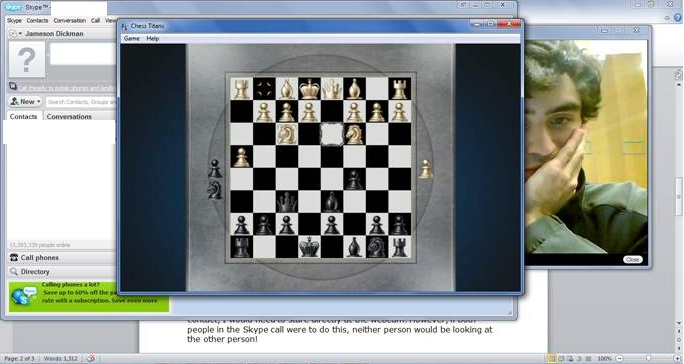
and what I am actually doing.
Webcam mediated vision is key to establishing Skype's sense of presence. It presents some limitations. Look at the pictures of myself again, and notice that I'm looking down. This is because during a Skype call, the image of the person in the frame is below the webcam. This is precisely the issue that is brought up in the video from Barbara Kiviat. In order to simulate actual eye contact, I would need to stare directly at the webcam. However, if both people in the Skype call were to do this, neither person would be looking at the other person!
Andrew Monk uses "mutual gaze," "knowing whether someone is looking at you ... more commonly known as eye contact" (Monk 2009: p.24) for his discussion of this phenomenon. The impossibility of mutual gaze limits the sense of copresence two people share over Skype because mutual gaze is central to face-to-face communication. I noticed early on during my research that I focused as intensely on a Skype call as I do for a phone call, and I noticed that other people were often engrossed in their Skype calls, this could be an attempt to make up for the lack of copresence. In Joel Stein's editorial on Skype, he writes that Skype requires "full-contact listening" (Stein 2010). This also explains my hesitation to speak when people left my video frame--we lost the contact we were focusing to maintain.
This phenomenon is in stark contrast to the simply phrased "It's so good to see you!" sentiment I've set out to explain, which is described further by Dean McGuire Jr from "What Skype Means to Me": "[Skype]'s a true gift for me because I am an American who now lives in Thailand. I have four kids back in the U.S. It gives me a chance to talk and look at my kids every day and that is worth more to me than another program or email out there!!" It seems there is a problem that is difficult to reconcile. Some people express great joy over Skype and some people express rejection. [As of 8 December 2010, Dean McGuire Jr's post has an issue loading.]
Dmitrii from "What Skype Means to Me" can reconcile this dilemma. He wrote "You talk with them [your friends] for free, you can see them, it's virtual of course, but it's not a big deal. :)" The Plastiki video can shed further light on this discussion. The first portion of the video shows the crew both joking about and a little worried about the impression Skyping the birth of Vern's child will have. The concern isn't great enough to prevent Vern from Skyping in, however. The excitement and joy of seeing his child's birth out-weighs his mild concern. His wife, the grandmother, and the doctors are all also comfortable enough with the occasion to allow the call to go through. This all indicates that the unique copresence of Skype is not as intimate as some people hope but is a small price to pay for the intimacy that they can, never the less, experience. It can be both good to see someone and a little disappointing at the same time.
Unbalanced Presence and the Fragmentized Self
During a few of my Skype conversations, someone would rotate the laptop to give me a view of their room or someone who was not a primary participant in the discussion. Conversation was a little awkward while the camera was pointed away because the focused connection compensating for a lack of mutual gaze was broken, but the action established common ground in that I got a better perspective of my friend or family member's environment. This helped to enhance my imagined presence in the room.
The mediated sense of presence and common ground relates to a phenomenon that is not always experienced consciously. This is referred to as the fragmentized self, which is argued to be part of living with a mediated identity. It entails identifying with one's media artifacts and identifying those artifacts with their representations (Pandian 5, 14 October 2010). In the case of Skype, the fragmentized self was that which the other person saw--i.e. the pictures of me I have scattered throughout this page. It also included the sounds which that person heard--i.e. the woman's voice in "Skype Explained Visually". It could also include any IMs or documents shared over Skype. The power of that image and that sound is not fully grasped at my end, which leads to an imbalance in the conversation.
The most poignant example I have for this was when my roommate was on Skype with a friend and I had to change clothes. I asked if he would turn his computer away so that I could have some privacy. His friend commented on that request, saying s/he couldn't see me anyway, so what did it matter. I felt like my roommate's friend had more presence in the room than s/he felt s/he had. I experienced this from my roommate's friend's perspective several times as well.
Presence and fragmentation can also be seen in the video posted by JH, particularly when one takes into account the fact that the father is only covering his own webcam, yet he disappears entirely from the room. It is likely that he doesn't feel like he disappears entirely from the room because the webcam in the room remains unblocked, though his son certainly thinks he does.
Though these are personal examples, I feel that this is a profoundly unique aspect of a Skype call that is distinct from other media. I feel it deserves mention if only in the hope that the hypothesis it poses may be of interest to someone who wishes to investigate it further.
Conclusion
In this project I discussed how Skype calls affect relationships at a distance, particularly those of families in Westernized cultures, in a positive way for many people by creating a feeling of copresence that requires focused attention to maintain. I began by using the idea of Skype as a virtual world or environment and using this to arrive at arguments about presence. However, I also hypothesized that the presence that is created by Skype is not experienced equally on both sides of the call and this may explain some of the discomfort people express towards Skype. In short, I concluded that Skype allows for an environment in which it is both a great joy to see someone while at the same time a little discomforting.
Skype is built upon the long existing notation that people can maintain relationships at a distance and that telecommunications facilitate this process. Of course, many of the ideas presented here would benefit from more in depth ethnographies and analyses. Further studies could lead to more precise conclusions about mediated relationships, power structure, and selfhood which were beyond the scope of this project.
