SRPL
|
The JHU/ECE Software Radio Prototyping Laboratory |
|
|
The Concept |
The Laboratory |
|
|
Opportunities Facilities Accomplishments People |
|
What is (a) software radio? |
|
|
Consider a radio receiver.
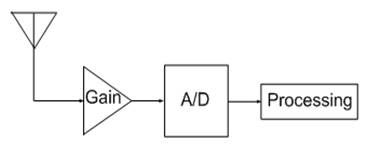
It performs two kinds of operations on received signals: (1) conditioning the signals into a form suitable
for conveying them to a destination, and (2) processing the signals to extract information.
Signal conditioning is performed by hardware that filters the signal to remove extraneous
noise; amplifies it; and
digitizes it for
subsequent computer processing. These are necessary, but preparatory,
to the extraction of information. Processing the signals in
a software radio system is performed by computer software, typically on a
standard computer running a widely available operating system.
Everything done in any kind of radio receiver which helps to extract
information (i.e., play
music) is performed in computer software. |
|
|
Why is software radio useful? The goal of a Software Radio is to implement nearly all components
typically found in a radio in software by �getting code as close to the
antenna as possible�. This allows for near limitless communications schemes
to be implemented on a single radio hardware platform. Additionally, it
allows for rapid prototyping by eliminating much of the costs traditionally
involved in radio design. Some tasks are unsuitable for software implementation due to their
requisite computational complexity or physical constraints, and a tradeoff
must be made based on the desired level of system flexibility.� (Patrick Mulligan, 2006) Who uses software radio? Software radio is an efficient platform for
prototyping a family of radio sets built upon a common hardware
architecture. Such applications are important in both defense and
commercial applications.
Users of SW radio
technology include 1.
The DoD 2.
Ham
radio experimenters 3.
Wireless system
designers a. Aspex b. FPGA 4.
There are
more. Stay "tuned!" |
|