 The adsorption process between gas phase molecules, A, vacant
surface sites, S, and occupied surface sites, SA, can be
represented by the equation,
The adsorption process between gas phase molecules, A, vacant
surface sites, S, and occupied surface sites, SA, can be
represented by the equation,
For molecules in contact with a solid surface at a fixed temperature, the Langmuir Isotherm, developed by Irving Langmuir in 1916, describes the partitioning between gas phase and adsorbed species as a function of applied pressure.
The adsorption process between gas phase molecules, A, vacant
surface sites, S, and occupied surface sites, SA, can be
represented by the equation,

assuming that there are a fixed number of surface sites present on the surface.

q = Fraction of surface sites occupied (0 <q< 1)
Note that
Thus it is possible to define the equilibrium constant, b:

Rearranging gives the expression for surface coverage:
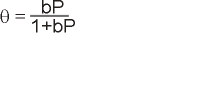
The rate of adsorption will be proportional to the pressure of the gas and the number of vacant sites for adsorption. If the total number of sites on the surface is N, then the rate of change of the surface coverage due to adsorption is:

The rate of change of the coverage due to the adsorbate leaving the surface (desorption) is proportional to the number of adsorbed species:

In these equations, ka and kd are the rate constants for adsorption and desorption repectively, and p is the pressure of the adsorbate gas. At equilibrium, the coverage is independent of time and thus the adorption and desorption rates are equal. The solution to this condition gives us a relation for q:
where b=ka/kd.
Note b is only a constant if the enthalpy of adsorption is independent of coverage.
As with all chemical equilibria, the position of equilibrium will depend upon a number of factors:

where b3 > b2 > b1