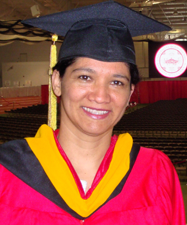
Irma
Duenas Pacheco- El Salvador
Irma Dueñas grew up in the El Salvadoran
countryside with eight brothers and sisters, a father who managed
a farm, and a mother who was a housekeeper. When her father lost
an eye in an accident and couldn’t work anymore, the family
moved to the city. There Dueñas made and sold cheese with
her mother and helped in the family’s convenience store.
Unlike the Dueñas family, many Salvadorans facing tough
situations choose to leave the country. An estimated 2 million
Salvadorans—or about 20 percent of the population—now
live in the United States. Dueñas, director of market regulation
for El Salvador’s Superintendencia de Valores (the equivalent
of the U.S. Securities and Exchange Commission), would like to
change that.
“The stock market can help create new projects and more productivity
in the country and build the sort of country where people want to stay and
grow up,” Dueñas says. “I think we can do something here
in this country to encourage people not to go away.”
Dueñas studied public accounting as a college student at
the University of El Salvador. Though she began
her studies hoping to help her family, she soon realized that she
could use those skills to transform the economy and help many more
people. After graduating in 1996, she began working the following
year as an analyst and inspector for the Superintendencia de Valores.
She earned a master’s degree in management and public policy
from the University of Chile in 1999, and was promoted two years
later to her current job as head of the market regulation and studies
department.
As director, she began researching markets in other
countries to see what best practices could be applied in El Salvador.
In 2005, the U.S. embassy invited her to participate in a three-week
trip to visit U.S. financial institutions from New York to San
Francisco. Inspired by that experience, Duenas applied for and
received a Humphrey Fellowship to study at Boston University in
2007.
“My experience in the U.S. helped me know more about financial problems
and different risks,” Dueñas says. “I learned different
techniques in market supervision and the different problems faced by foreign
stock markets.”
While on a trip to the U.S. Securities and Exchange Commission,
she described Central America’s challenges in creating and
supervising a regional stock market. The SEC offered her technical
and financial assistance to organize a regional training program
for market regulators.
Jeanne Balcom, a senior director at the Financial
Industry Regulating Authority, an independent regulating firm where
Dueñas performed
one of her internships, says that Dueñas’ initiatives
can bring about critical results. “I knew that what she did
would impact and help El Salvador,” Balcom says. “A
key part of securities markets is confidence. . . . There need
to be regulations to inspect firms and discipline firms that are
in violation.”
Back in her home country, Dueñas launched the first “Latin
America and Caribbean Capital Market Development and Oversight
Training Program” in December 2008. The seminar brought together
more than 100 participants from markets in 11 countries. Dueñas
has also developed a supervision model for small and underdeveloped
securities markets. She hopes ultimately to help build a well-regulated
regional stock market that will attract investors and business
to Central America.
“The stock market in El Salvador is really small. We cannot grow up alone,” Dueñas
says. “With globalization it is necessary to look for partners around
the world, and your natural partners are your neighbors. Together we can build
an attractive market for investors.”
|