F� Window

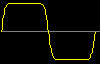 |
The 12 Term Fourier Series of a Square Wave with a F� Window N=12 |
||
| Amplitude | Frequency (rad/sec) | Phase (degrees) | |
| (12-1)/12 � 1 | 1 | 0 | |
| (12-3)/12 � 1/3 | 3 | 0 | |
| (12-5)/12 � 1/5 | 5 | 0 | |
| (12-7)/12 � 1/7 | 7 | 0 | |
| (12-9)/12 � 1/9 | 9 | 0 | |
| (12-11)/12 � 1/11 | 11 | 0 | |
The overshoot is decreased. Including more harmonics further decreases the overshoot.
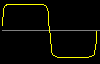 |
The 24 Term Fourier Series of a Square Wave with a F� Window N=24 |
||
| Amplitude | Frequency (rad/sec) | Phase (degrees) | |
| (24-1)/24 � 1 | 1 | 0 | |
| (24-3)/24 � 1/3 | 3 | 0 | |
| : | : | : | |
| : | : | : | |
| (24-21)/24 � 1/21 | 21 | 0 | |
| (24-23)/24 � 1/23 | 23 | 0 | |
 Previous Page