Blast Injury Biomechanics

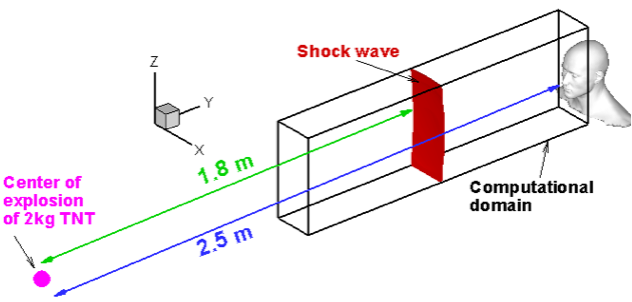
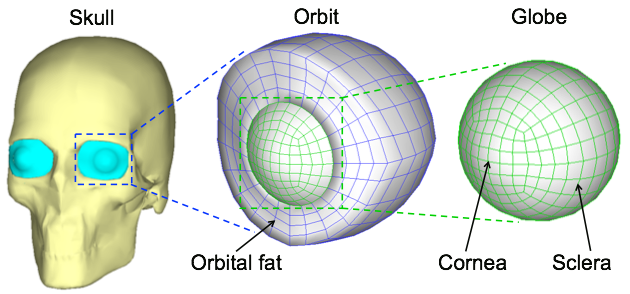
The overall goal of this project is to develop an experimentally validated computational model of the eye and apply the model to evaluate the stresses and deformations incurred by the eye-wall and critical ocular components from blast overpressures, and to investigate the interaction between the standard issue eye armor and the blast wave, and its effect on the mechanical loading of the eye. The model will be developed based on the following working hypotheses. 1) The anisotropic mechanical properties of the cornea and sclera as derived from the collagen structure, are critical to modeling the interaction of the blast wave and the globe. 2) The mechanical behavior of the cornea and sclera under dynamic (high-rate) loading is significantly different than the under quasistatic (slow-rate) loading. 3) The surrounding environment of the globe, including the extraocular tissues of the orbit and bony facial features is important in determining the effects of blast loading on the eye.
Students
Kimberly Ziegler, Kevin Parsons
Collaborators
Assistant Professor, Department of Mechanical Engineering, IIT Bombay
Alonzo G. Decker Jr. Professor of Science & Engineering, Department of Mechanical Engineering, Johns Hopkins University
Burton E. Grossman Professor of Ophthalmology
Director, Comprehensive Eye Service
Cornea and Anterior Segment Service
Johns Hopkins Medical School