Rate-Dependent Fracture
The goal is to study the effects rate-dependent inelastic material behavior (e.g., viscoelasticity, viscoplasticity, and continuum damage), and rate-dependent failure mechanisms (e.g., crazing, chain pull-out) on the fracture behavior of soft materials. We pursue this using a cohesive approach which partitions the energy dissipation rate of crack growth into inelastic processes of the bulk and failure processes of a cohesive zone of finite size. Our work focuses on developing mechanism-based cohesive models of rate-dependent failure mechanisms and numerical methods for finite element analysis of fracture and failure.
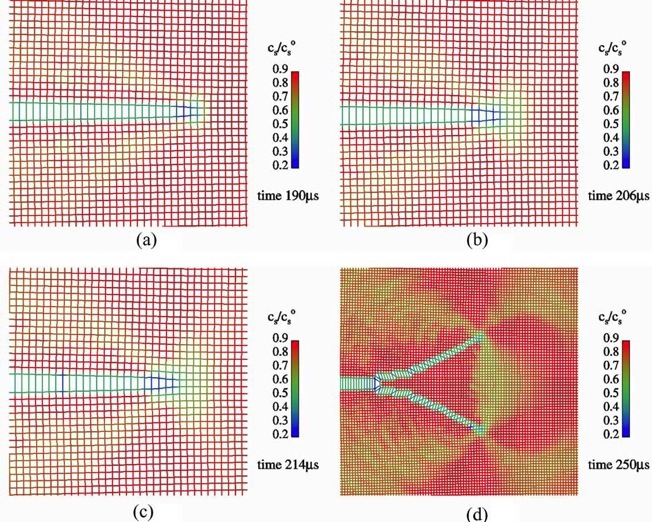
Evolution of slow zone (region of reduced wave speed) for crack propagating at terminal speed3
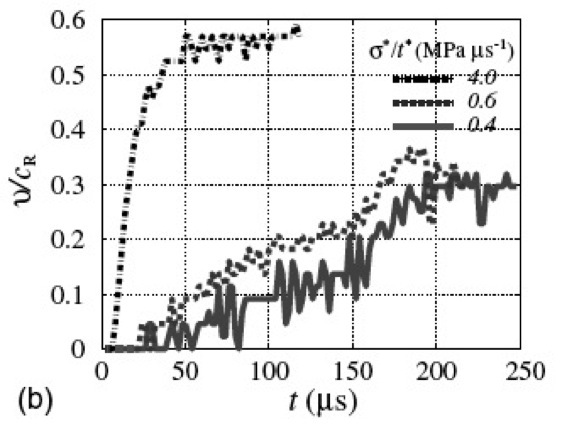
Dependence of terminal speed on loading rate3

Modeling Viscoelastic Fracture
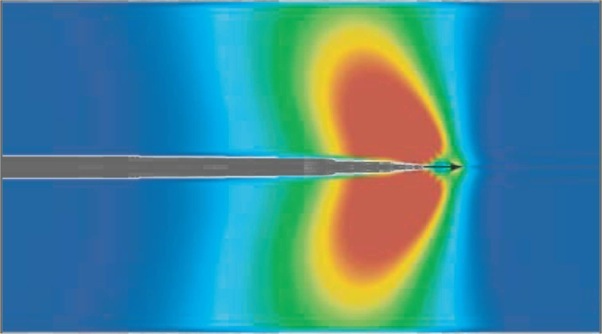
Viscous dissipation zone for steady-state crack growth in a thin elastomeric strip1
Viscoelastic dissipation material forces opposing crack growth2
Modeling Rate-Dependent Cohesive Effects on Dynamic Crack growth