
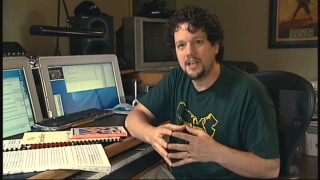
Michael Giacchino: A Reactive Storyteller
Music is the shorthand of emotion. – Leo Tolstoy
A phrase that often gets tossed around when discussing a film or television show is that something “made the scene.” Typically the phrase implies that someone believes one specific element of a scene, whether it is the acting, the writing, the backdrop, or the music, has turned an ordinary scene into an extraordinary one. LOST has won awards for both its acting and its writing and its Hawaiian jungles and mountains have given the show some incredible backdrops, but my investigation has shown to me that nothing can truly “make a scene” on LOST better than Michael Giacchino’s music.
Consider the scene at the end of season one when some of the survivors set out to sea on the raft. Now try to imagine it without any music. Do you still have any kind of emotional response to the action on screen? Giacchino, as a viewer of the show, believes that you should. He believes that the emotional undertones are already in place but that they need a way to be amplified so that the viewer can experience them while still feeling as if they are a natural response. In comes the music. Damon Lindelof, one of the creators of the show, had this to say on a DVD extra: "I think bad music tells you how to feel, and good music takes what you are already feeling and enhances it. And Giacchino is always clearly in the latter category." Lindelof’s assertion certainly supports what my investigation has led me to believe, but how can one prove this to be true? How can one prove that the music in a scene is not forcing them to feel a certain way? How can one prove that they would feel that way regardless of whether there was any music or not?
Unfortunately, there doesn’t seem to be any way to unequivocally prove this assertion true without the use of certain technical devices like a neuroimaging scanner. Would the same parts of the brain light up when watching a scene both with and without music? Would they light up brighter when watching the scene with music? While this would be a fascinating study if one had the funding to do so, I must try to assess Lindelof’s claim without the use of neuroimaging tools.
Remember the video in which Giacchino discusses his specific process for creating music on LOST. Above all else, he is a fan of the show. He watches an episode when it is given to him and when he feels that there should be music, he’ll write it. Giacchino practices what I call reactive storytelling. He feels an emotion while watching the show and then writes some music to join that emotion on screen as an auditory accompaniment. This is how I know Lindelof’s claim is true. Giacchino is not telling the viewers how to feel because he is the viewer. The music you hear while watching LOST is the direct manifestation of his emotions. Granted, not everyone feels the exact same way when watching a scene, so in a way you are hearing his emotions and not your own – but in most cases those emotions are likely one and the same. At the very least there will be overlap. Thus, the music you hear is what he was feeling without any music. And what better way to “enhance” those emotions, as Lindelof puts it, than the musical expression of your deepest thoughts and feelings?
Therefore, Giacchino’s music does “make” scenes. At least, it does for me. The concept of “making” a scene is entirely subjective. Someone with a background in theater might say that acting has a better ability to “make” a scene for them. But the overwhelming majority of fans, as I’ve gathered from Youtube comments, message board posts, and fan podcasts, attribute most “made scenes” to Giacchino. Perhaps it’s that most viewers just have an innate affinity for sound. Perhaps it’s just easier to separate music from the scene as a whole because it does not exist on a visual level. Or perhaps, as Tolstoy said, music is just the “shorthand of emotion.”
--
I’ve established that Giacchino a reactive storyteller. I focused on the “reactive” aspect of that, but now I would like to call attention to the fact that Giacchino is indeed a storyteller – just as much as any of the writers or actors on the show are. Giacchino does something that most other composers do not: he writes specific themes for individual characters. On television, this technique is unprecedented. With each character theme, Giacchino is telling a story. A story of that character’s background, of his/her emotional state, and of his/her’s past, present, and future. Giacchino’s addition of an innovative auditory dimension in scoring characters has truly revolutionized music on television.
What can we gather about the character Ben by listening to his theme “Dharmacide” in season three? One part of the piece is vicious, overriding, angry, manipulative. Another part uses the same exact notes but is presented much softer, sadder, tragic, haunted. His theme is not just a reflection of the character’s emotions (though it is that) but it is also a reflection of our emotions for the character. Giacchino scores his characters the same way he scores everything else – by watching the show as a viewer and then writing what he’s feeling. But he’s not only reacting just as we are, he is storytelling. Ben’s whole life history – from growing up as a child with an abusive father and no mother, to his reign as a calculating, controlling, mischievous, morally ambiguous leader of a mysterious group known as “The Others,” is reflected in this piece “Dharmacide.” The music is part of the character, and the character is part of the music. Giacchino’s work therefore not only enhances emotions but it tells stories like no other television music ever has.