
Research
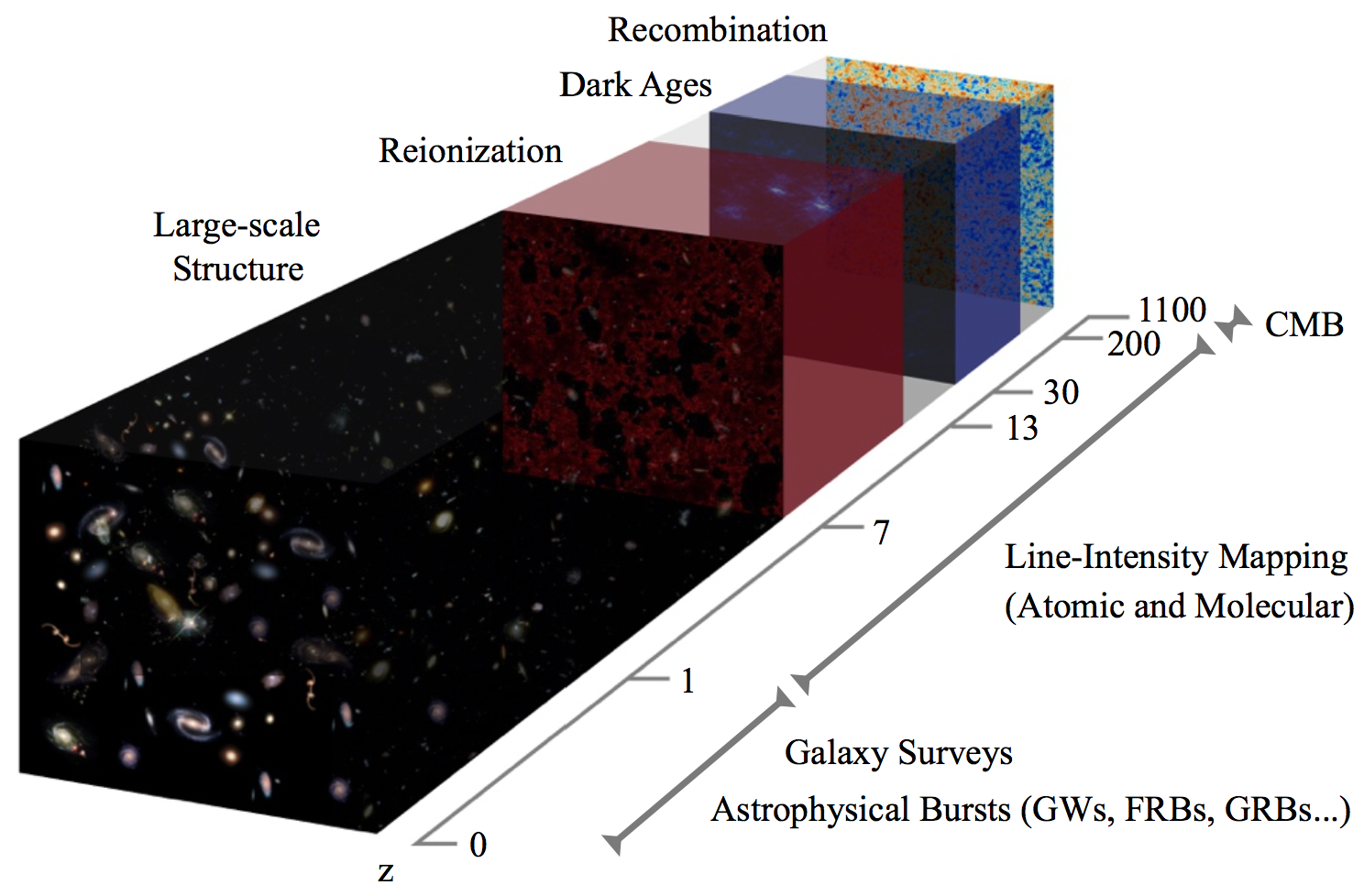
The Observable Universe: probes of different epochs in its history.
Opening Up New Windows to Study the Universe
The Standard Model of Cosmology aims to explains the cosmic
evolution from a fraction of a second after the Big-Bang
singularity to the current period of accelerated expansion
with only a handful of parameters. Over the past decade, it
has withstood a wide series of observational tests. Yet
several gaping holes remain in the theory:
- How did inflation begin and come to an end?
- What makes up the dark matter in the Universe?
- What is the nature of dark energy?
- How did galaxies and clusters of galaxies form and evolve
to make up the large scale structure we observe today?
Going forward, we must develop new ways to probe these
fundamental questions by accessing the full volume of the
observable Universe. This is the focus of my research.
The Cosmic Microwave Background: Exploring the Early Universe
Line-Intensity Mapping: Astrophysics and Cosmology at High Redshifts
Why am I interested?
Line-Intensity Mapping
Line-Intensity mapping is an invaluable method to study the universe in between the regimes accessible to galaxy surveys and the CMB. It consists of low-resolution measurements of the fluctuations in the integrated emission of atomic and molecular spectral lines. As reviewed in Kovetz et al. (2017), a Status Report composed following a workshop I organized at JHU, this is an emerging field, expecting a flood of new data from upcoming surveys. I have proposed a wide range of uses of this method, from probing dark matter to measuring star-formation, and continue to explore new ways to exploit its vast potential.
The 21cm HI Transition
Dark Matter-Baryon Scattering: With J. Muñoz, a JHU grad student at the time (now @Harvard), I set out to explore how models in which dark matter interacts with baryons can be probed through their imprint on the 21-cm global temperature and its fluctuations. Naively, one would expect the baryon fluid to cool down as it driven to equilibrium with the colder dark matter fluid. However, we found that a crucial ingredient to include is the relative velocity between the baryons and dark matter, which leads to a heating effect due to the friction between the two fluids, which in some cases is more dominant than the cooling. It also leads to a new large-scale component of fluctuations, on top of the standard 21cm power spectrum. We showed that future experiments can constrain interacting dark matter in mass ranges inaccessible to direct detection experiments, providing excellent motivation for ongoing follow-up works.
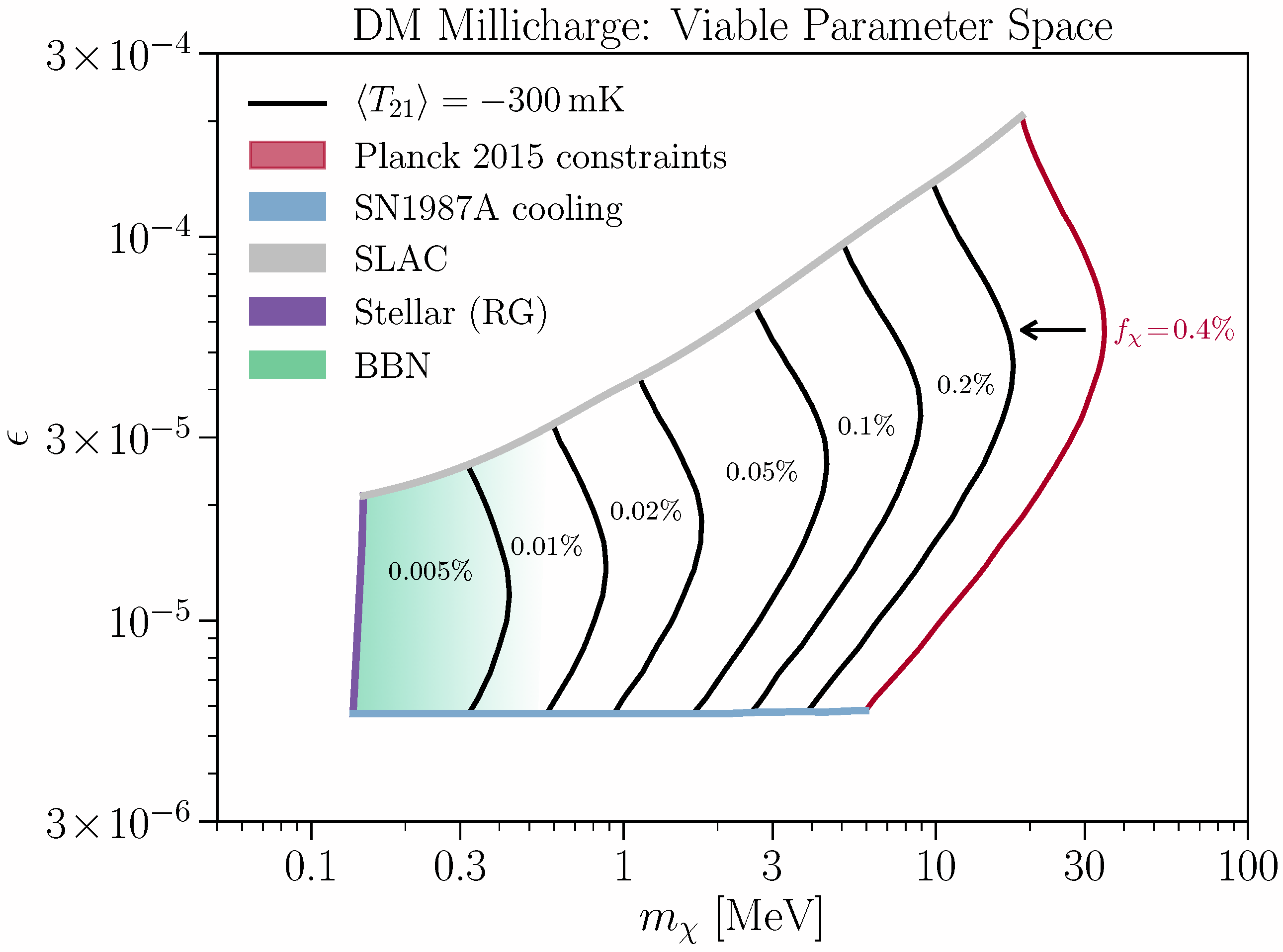
Recently, following the EDGES detection of an anomalous 21cm absorption profile at z~17, we investigated in detail the viable parameter space for millicharged dark matter to explain the EDGES signal. We provided a thorough analysis of the effect on the CMB and the 21cm in the strong coupling regime, and derived the most stringent constraints on this model.
Ultra-Light Hidden-Photon Dark Matter: Ultra-light hidden photons provide an appealing candidate for dark matter. These are (light) massive vector bosons that arise naturally in many theoretical setups, and which generically interact with the Standard Model through kinetic mixing with the ordinary photons. Ultra-light hidden-photon dark matter produces an oscillating electric field in the early Universe plasma, which in turn induces an electric current in its ionized component whose dissipation results in heat transfer from the dark matter to the plasma. This will affect the global 21cm signal from the Dark Ages and Cosmic Dawn. In work with Ilias Cholis and David E. Kaplan, we focused on the latter, in light of the reported detection by EDGES of an absorption signal at frequencies corresponding to redshift z∼17. By measuring the 21cm global signal, a limit can be placed on the amount of gas heating, and thus the kinetic mixing strength ε between the hidden and ordinary photons can be constrained. We showed that 21cm at cosmic dawn can place the strongest bounds to date on ε across more then ten orders of magnitude in mass, down to 1e-22 eV.
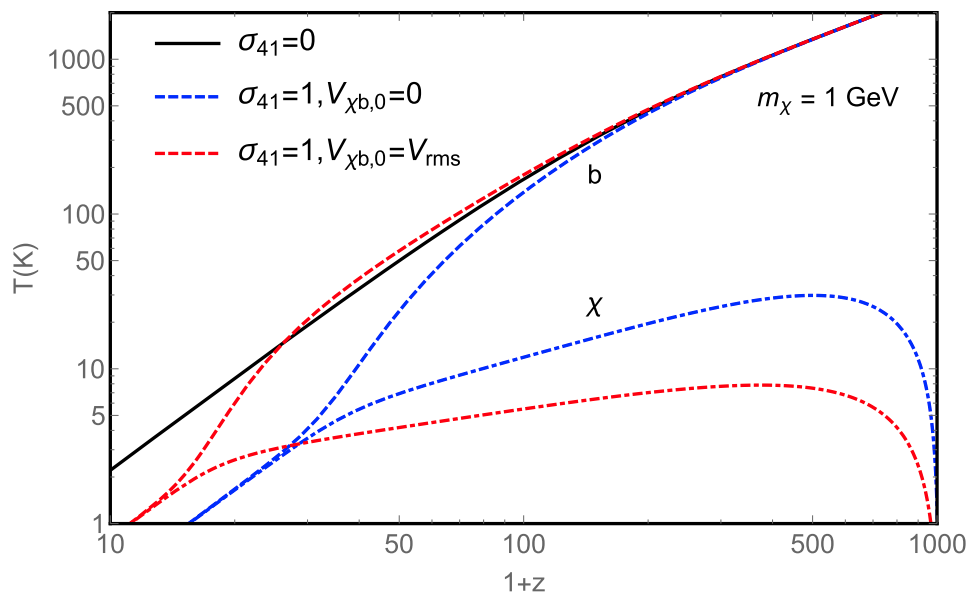
Left: Baryon temperatures (three upper curves) without interactions (solid curve) and when adding interactions (dashed-blue curve for the case where the relative velocity between baryons and dark matter is not taken into account, and red curve when it is), as well as dark-matter temperatures (two lower curves, same scenarios). At late times and for DM mass mχ below a GeV, our prediction was cooling of the baryon gas temperature, which would generate a deeper 21cm absoprtion profile (interestingly matching what EDGES measured a few years later). From Muñoz, Kovetz and Ali-Haïmoud (PRD, 2015).
Right: The viable parameter space for millicharged DM to explain the anomalous EDGES 21cm signal. The allowed region is bound from above by SLAC constraints (gray), from the left by stellar cooling (purple), from below by SN1987A cooling (blue), and from the right by the requirement to cool the baryons enough to yield a 21cm brightness temperature consistent with the EDGES 99% upper bound (black). Contours are shown for several values of the fraction fχ of the total DM that is millicharged; each yields an upper bound on the mass mχ. The rightmost limit is from Planck 2015 (red). A portion ruled out by the Neff limit at BBN, valid below mχ∼me, is sketched (light green). From Kovetz et al. (PRD, 2018).
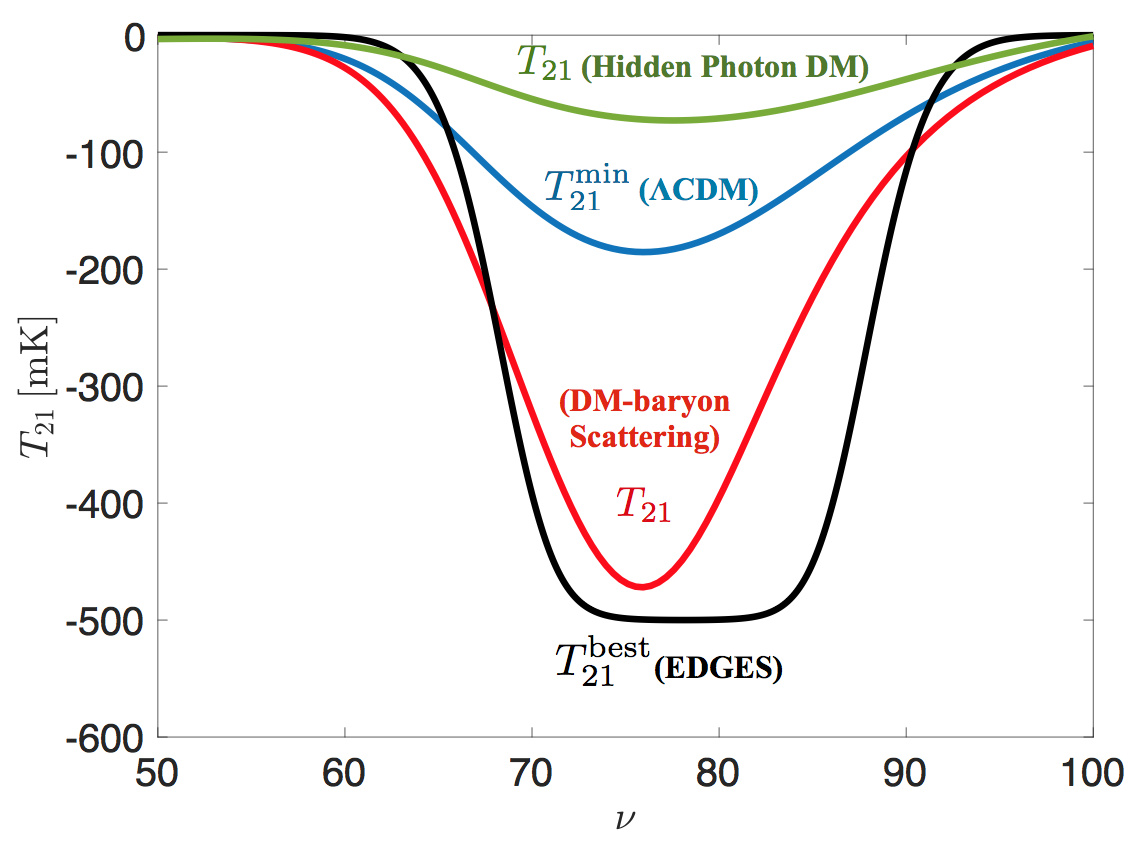
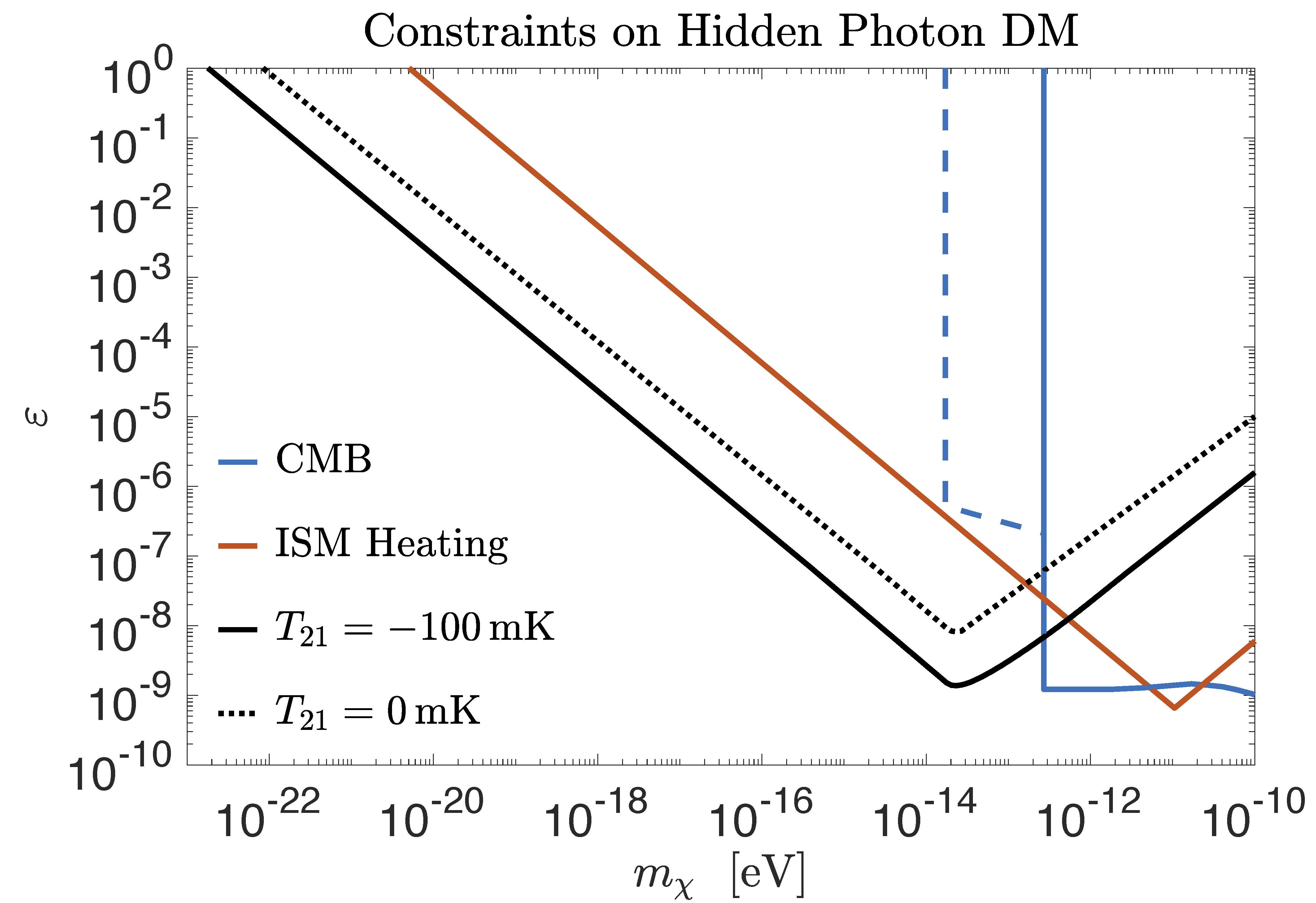
Left: The EDGES Cosmic Dawn 21cm signal (Bowman et al., Nature 2018) is in 3.8σ disagreement with the maximum absorption allowed by ΛCDM. In Kovetz et al. (2018) we present the viable parameter space of the millicharged DM model suggested to explain this anomaly by Barkana (Nature, 2018), based on the calculation in Munoz, Kovetz and Ali-Haımoud (2015). Meanwhile, in Kovetz, Cholis and Kaplan (2018) we show that a robust 21cm detection can place the strongest bounds yet on ultra-light hidden-photon DM (see right panel).
Right: Predominant bounds on the kinetic mixing parameter ε for different hidden-photon DM masses mχ. We show constraints from Milky-Way ISM heating (red) and from the CMB (blue). Our inferred 21cm bounds from requiring that T21 = −100 mK or T21 = −50 mK (black and dashed-black) are two orders of magnitude stronger over ten orders of magnitude in mass and the only ones to penetrate the fuzzy-DM mass range. From Kovetz, Cholis and Kaplan (Submitted to PRL, 2018).
- BCCP Workshop (2013):
"Probing localized structures using weak-lensing of 21cm
fluctuations”
- Harvard Particle Physics Seminar
(invited, 2016):
"Cosmological Probes of Dark Matter off the Beaten Path”
- University of Maryland HEP
Seminar (invited, 2018):
"Dark Matter in Light of the 21cm EDGES Signal”
- "Beyond the Standard Model"
Workshop, GGI, Florence, Italy (invited, 2018):
"New Cosmological Probes of the Lightest and Heaviest Dark”
- Kovetz and Kamionkowski, PRD
2013:
"Galaxy-Cluster Masses via 21st-Century Measurements of
Lensing of 21-cm Fluctuations"
- Kovetz and Kamionkowski, PRL
2013:
"21-cm Lensing and the Cold Spot in the Cosmic Microwave
Background"
- Muñoz, Kovetz and Ali-Haïmoud, PRD 2015: "Heating
of baryons due to scattering with dark matter during the dark
ages"
- Kovetz, Poulin, Gluscevic, Boddy, Barkana and Kamionkowski,
PRD 2018:
"Tighter Limits on Dark Matter Explanations of the Anomalous
EDGES 21cm Signal"
- Kovetz, Cholis and Kaplan (submitted to PRL, 2018):
"Bounds on Ultra-Light Hidden-Photon Dark Matter from 21cm at
Cosmic Dawn"
Carbon-Monoxide (CO) Intensity Mapping
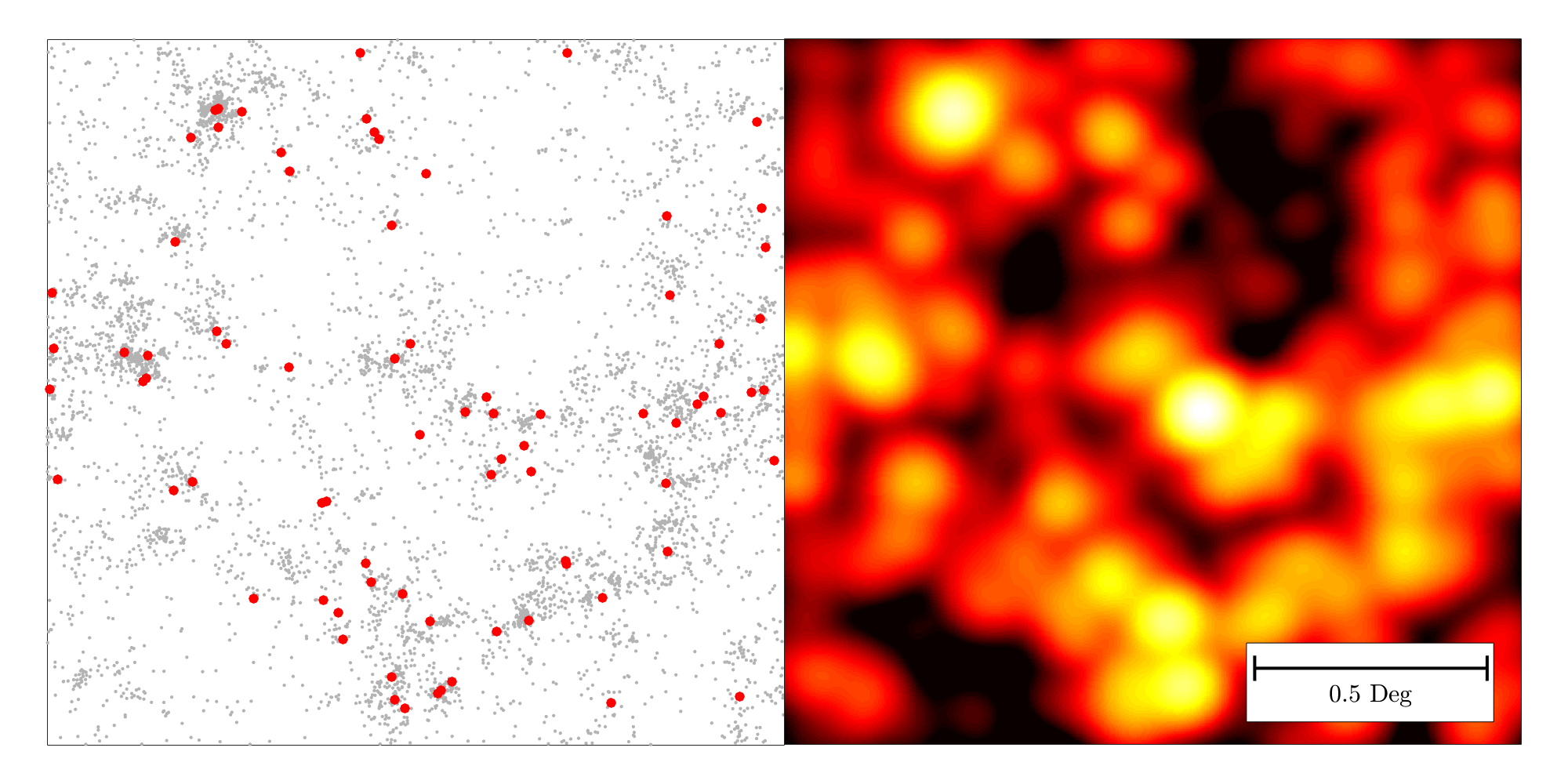
Left: Demonstrating the power of intensity mapping - a simulated 2.5 deg^2 field with galaxy positions (left side) and the corresponding CO intensity map (right side). Luminosities were drawn from a Schechter function model (Breysse, Kovetz and Kamionkowski, 2016). Sources bright enough to detect with 1hr of VLA time are marked in red. In the same 3000 hours of integration over this field required for the VLA detections, a low-cost experiment like COMAP can provide the intensity map on the right. From Kovetz et. al (Physics Reports, in review 2017) .
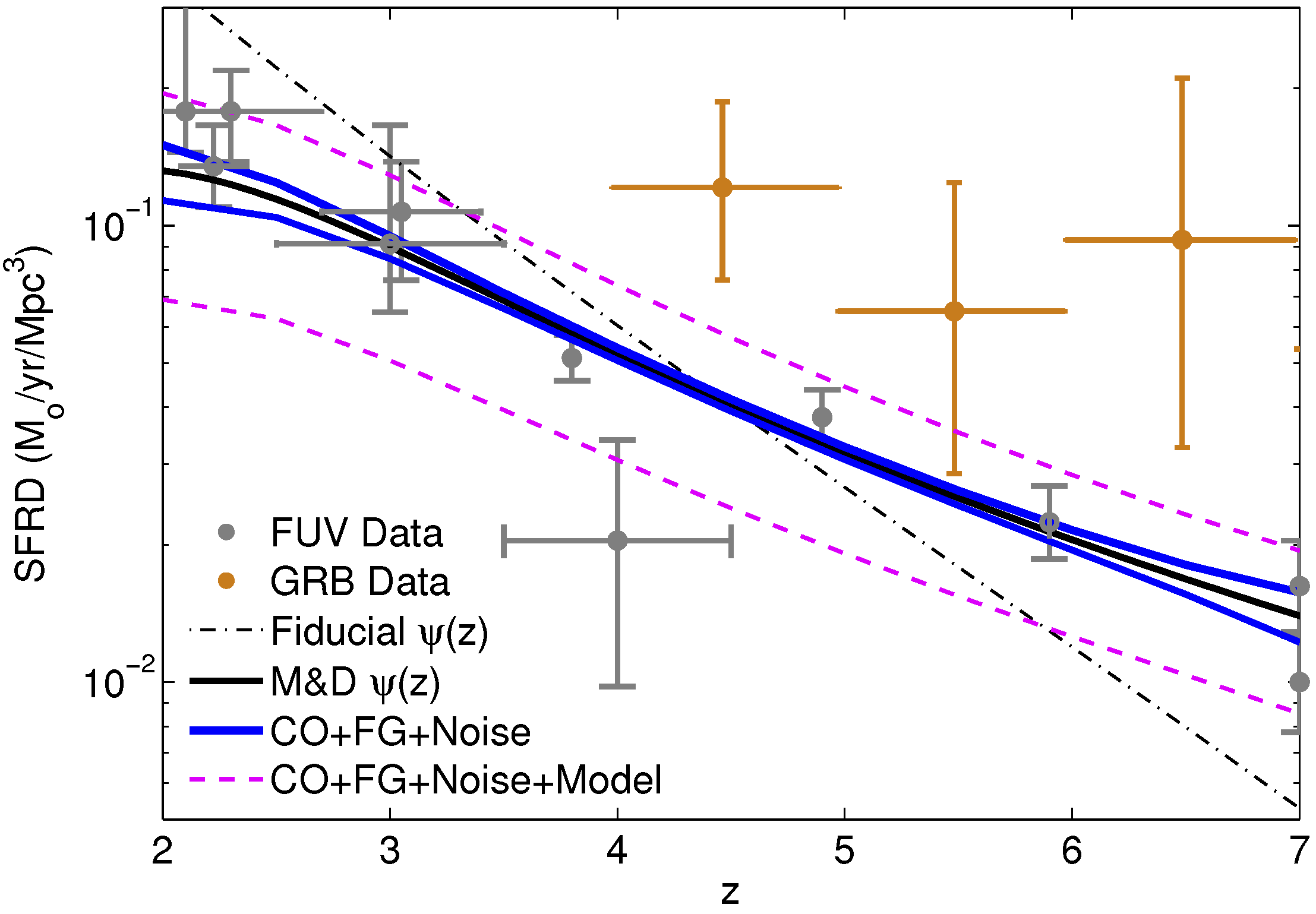
Right: Comparison between predicted constraints on star formation rate density from CO intensity mapping and from existing FUV (grey points) and GRB (orange points) data. Solid black curve ψ(z) shows fit to FUV data. Blue curves show ±1σ SFRD uncertainty forecast with CO intensity mapping, taking into account foregrounds and noise. Dashed magenta lines encompass a 10% model uncertainty band in the adopted CO-FIR and FIR-SFR relations. From Bryesse, Kovetz and Kamionkowski (MNRASL, 2016) .
- Weizmann Institute (invited,
2016):
"Signals and Interlopers: Exhausting Cosmological Information
from the Depths of the Observable Universe ”
- Conference, “Cosmological
Signals from Cosmic Dawn to the Present”, Aspen, CO (invited
review talk, 2018):
"Line-Intensity Mapping: (Bird’s-Eye) Theory Review”
- Breysse, Kovetz and Kamionkowski,
MNRAS 2014:
"Carbon Monoxide Intensity Mapping at Moderate Redshifts"
- Breysse, Kovetz and Kamionkowski,
MNRAS 2015:
"Masking Line Foregrounds in Intensity Mapping Surveys"
- Breysse, Kovetz and Kamionkowski,
MNRAS Letters 2016:
"The High Redshift Star-Formation History from Carbon-Monoxide
Intensity Maps"
- Breysse, Kovetz, Behroozi, Dai
and Kamionkowski, MNRAS 2017:
"Insights from Probability Distribution Functions of Intensity
Maps"
Collaborations
I then led an effort to develop a document presenting a status report of the line-intensity mapping field following the two workshops. In between, during and after these two workshops, through their presentations, personal writing assignments and feedback on drafts, over 45 scientists (from over 25 institutions) contributed to the 2017 Status Report, while a small writing group was responsible for editing, combining and integrating the individual contributions. The next community workshop will take place in February 2018, at the Aspen Center of Physics.
- Kovetz et al. (Physics Reports,
in review 2017):
"Line Intensity Mapping: 2017 Status Report”