
Research
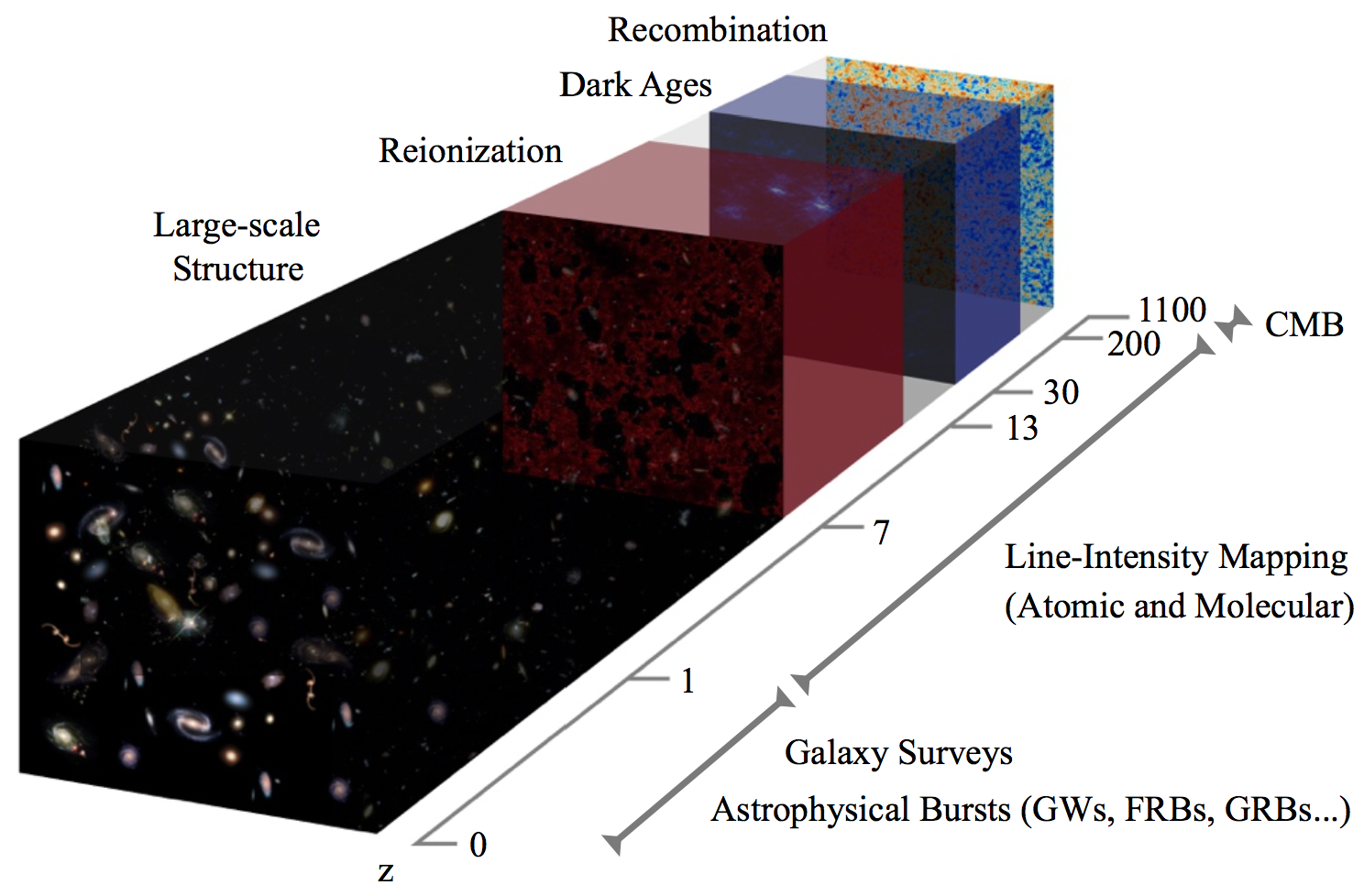
The Observable Universe: probes of different epochs in its history.
Opening Up New Windows to Study the Universe
The Standard Model of Cosmology aims to explains the cosmic
evolution from a fraction of a second after the Big-Bang
singularity to the current period of accelerated expansion
with only a handful of parameters. Over the past decade, it
has withstood a wide series of observational tests. Yet
several gaping holes remain in the theory:
- How did inflation begin and come to an end?
- What makes up the dark matter in the Universe?
- What is the nature of dark energy?
- How did galaxies and clusters of galaxies form and evolve
to make up the large scale structure we observe today?
Going forward, we must develop new ways to probe these
fundamental questions by accessing the full volume of the
observable Universe. This is the focus of my research.
The Cosmic Microwave Background: Exploring the Early Universe
Why am I interested?
The Cosmic Microwave Background
My interest in the CMB has been focused on cosmological Inflation, our best theoretical framework to explain why the Universe is flat, homogenous and isotropic, and most importantly how tiny quantum fluctuations are imprinted onto cosmic scales to provide primordial seeds for structure formation. The anisotropies in the CMB temperature can be used to test inflationary scenarios in various ways. Above all, the curl component (or B-mode) of the CMB polarization, a unique imprint of inflationary tensor fluctuations (or primordial gravitational waves), is a key prediction of many models of Inflation and is widely considered the holy grail of cosmology, as I reviewed in Kamionkowski and Kovetz (ARAA, 2016).
Theory
I then explored their possible imprints in the CMB (as well as on the large-scale peculiar velocity field) and analyzed WMAP and Planck data in search for them, identifying possible connections between these models and various large-scale CMB anomalies.
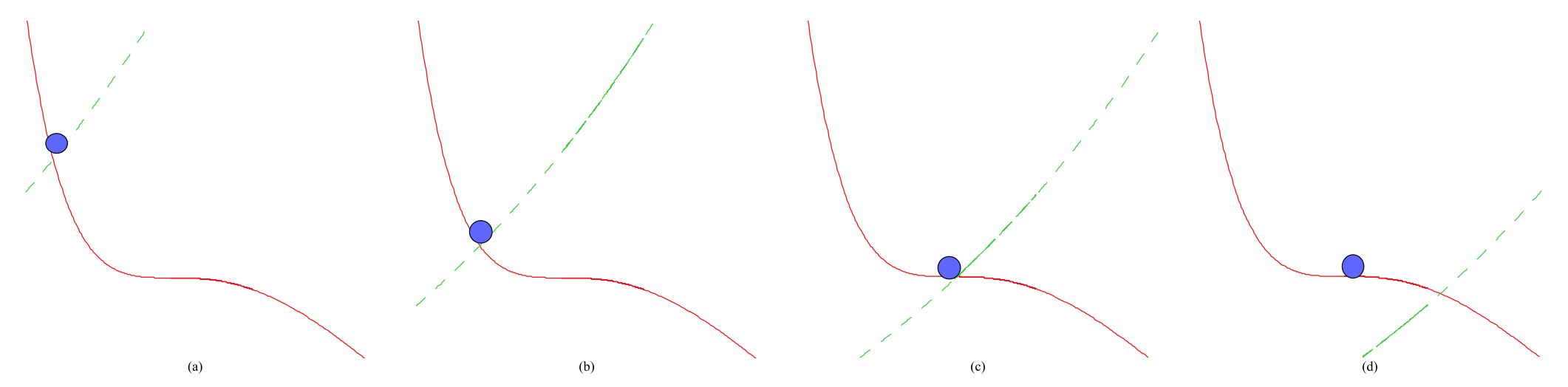
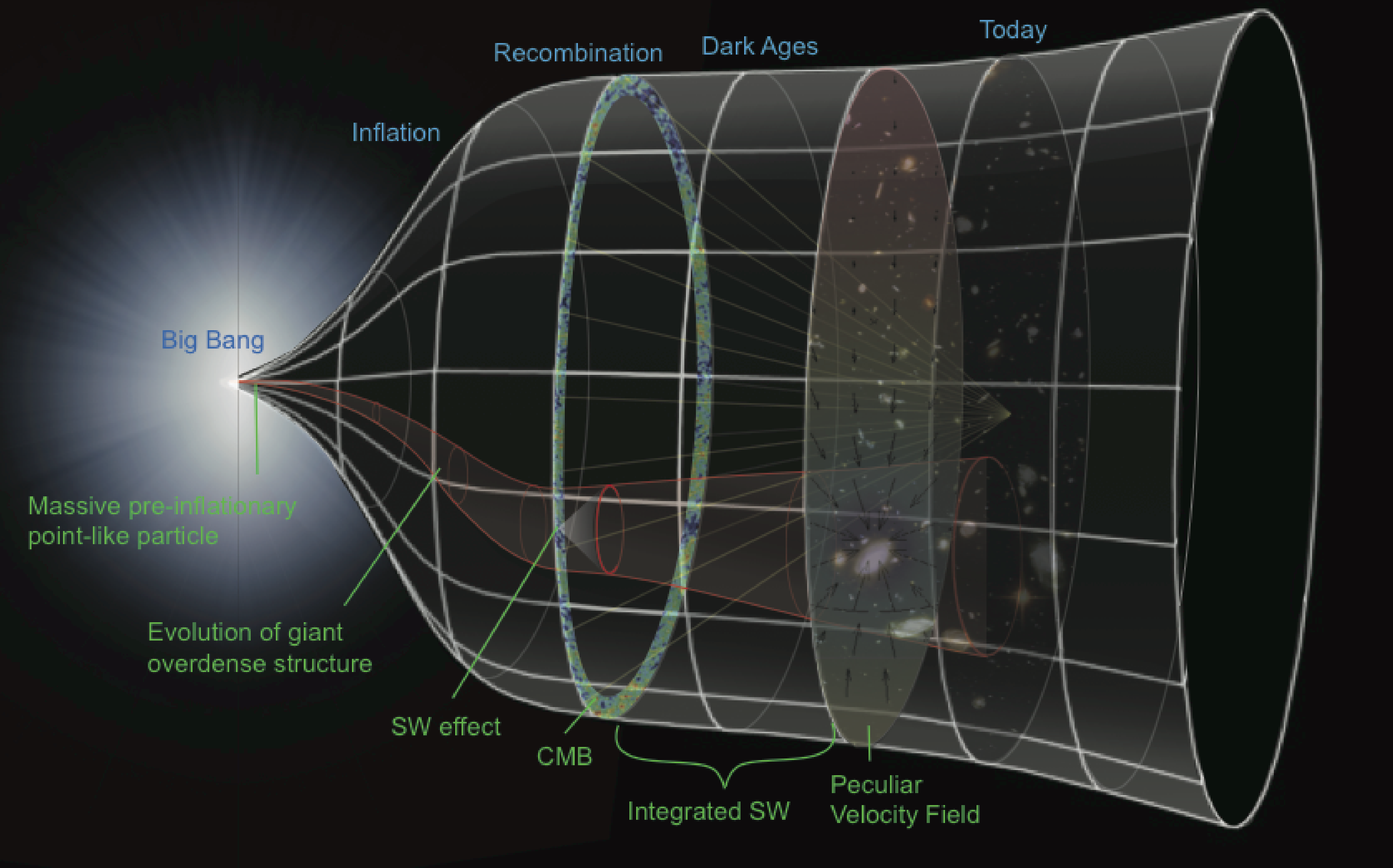
Top: A heuristic demonstration of how a time dependent potential, that scales like 1/a^3(t), can resolve the overshoot problem of IPI. The static piece of the potential is denoted by the red/solid line and the time dependent piece of the potential by the green/dashed line. In (a),(b) the static potential is steep, but since there has not been significant expansion the time-dependant potential is able to balance it, preventing φ(t) from acquiring a large velocity. Heuristically, φ(t) (denoted by the blue/filled circle) follows the dilution of the time-dependent potential. In (c) φ(t) enters the shallow region (where the slow roll parameters are small) where inflation takes place and the time-dependent potential starts to slow down exponentially. In (d) φ(t) is dominated solely by the static potential but its velocity is now low enough to allow prolonged inflation. Bottom: The history of the Universe in the presence of a pre-inflationary particle (PIP). The PIP seeds an overdense region, which can affect the CMB and imprint a peculiar-velocity bulk flow, measurabele by Type-1a SNe. From a poster presented at COSMOS09, CERN 2009.
- Joint High-Energy Seminar at
Newe Shalom, Israel (invited, 2008):
"Phase Transition between Small and Large Field Models of
Inflation”
- Aspen Winter Conference on
Inflation (selected, 2012):
"Pre-Inflationary Relics and Large Scale Anomalies”
(talks on this also given at Cambridge/PASCOS2011, Oxford, UT Austin, TAU, HUJI) - High-Energy Seminar, Texas
A&M (invited, 2012):
"Inflection Point Inflation: Before and After"
- Inflation Workshop, Cook's
Branch, TX (invited, 2012)
"Probes of Pre-Inflationary Relics: From Theory to Data
Analysis”
- Itzhaki and Kovetz, JHEP 2007:
"Inflection Point Inflation and Time Dependent Potentials in
String Theory"
- Itzhaki and Kovetz, Class. Quant.
Grav. (2009):
"A Phase Transition between Small and Large Field Models of
Inflation"
- Fialkov, Itzhaki and Kovetz, JCAP
(2010):
"Cosmological Imprints of Pre-Inflationary Particles"
- Kovetz, Ben-David and Itzhaki,
Apj (2010):
"Giant Rings in the CMB"
- Ben-David, Kovetz and Itzhaki,
MNRAS (2012):
"Parity in the CMB: Space Oddity"
- Rathaus, Kovetz and Itzhaki,
MNRAS (2013):
"Studying the Peculiar Velocity Bulk Flow in a Sparse Survey
of Type-Ia SNe"
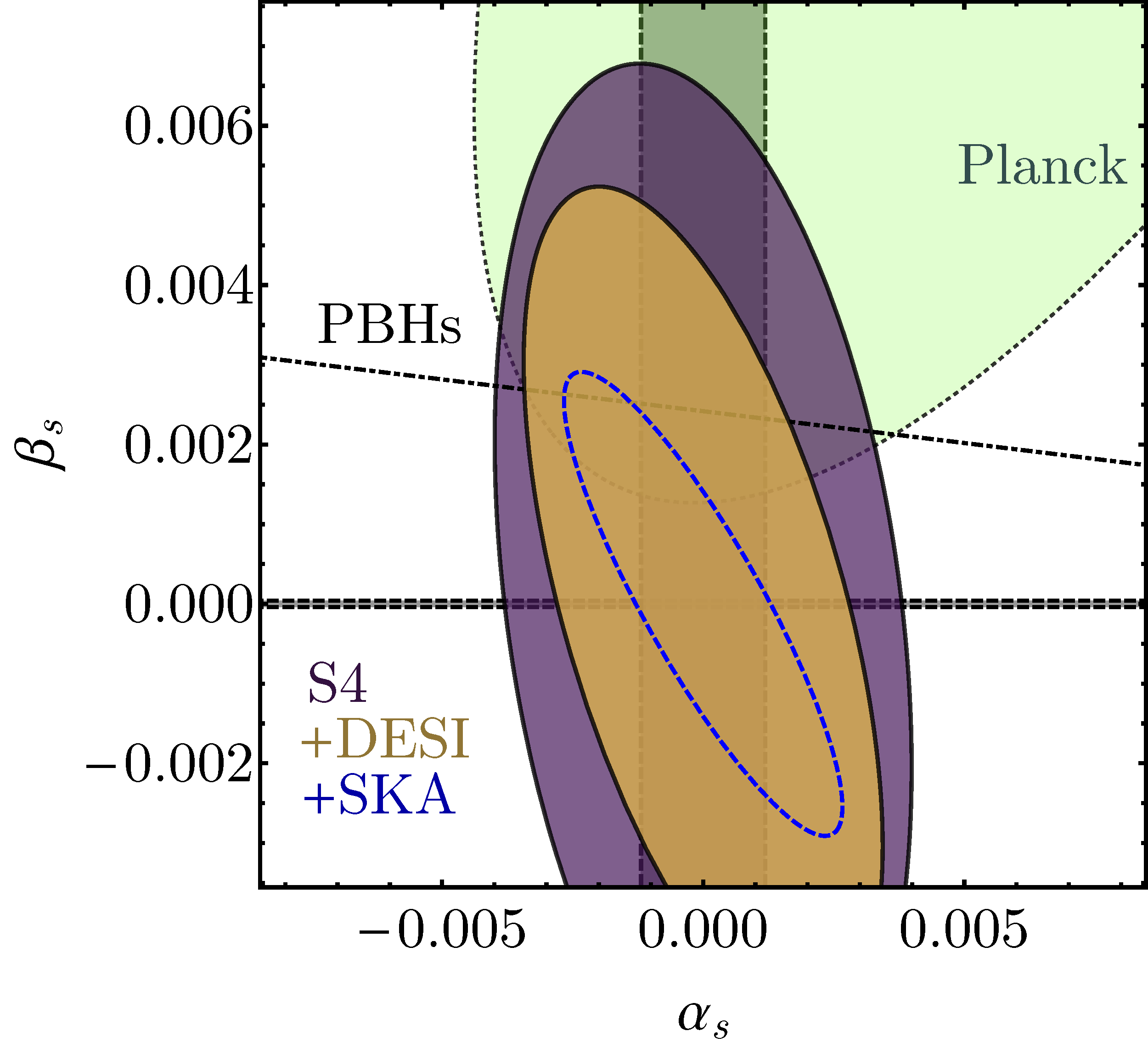
With J. Munoz and colleagues, we laid out a novel second-order estimator of compensated isocurvature perturbations (Munoz et al. 2016) and investigated how well the running of the spectral index can be constrained (Munoz, Kovetz et al. 2017). Recently, with colleagues at JHU, IAS and Tel-Aviv, We performed an improved CMB analysis to search for dark matter–baryon scattering with a Rutherford cross section (a velocity dependence of v^-4) corresponding to a Coulomb-type interaction. In particular, we developed a new and robust prescription for incorporating the relative bulk velocity between the dark matter and baryon fluids into the standard linear Boltzmann calculation. Using an iterative procedure, we self-consistently include the effects of the bulk velocities in a cosmology in which dark matter interacts with baryons. Furthermore, we investigated how these constraints change when only a subcomponent of dark matter is interacting, with important implications for the dark-matter explanation of the recent anomalous 21cm absorption profile detected by the EDGES experiment at z~17.
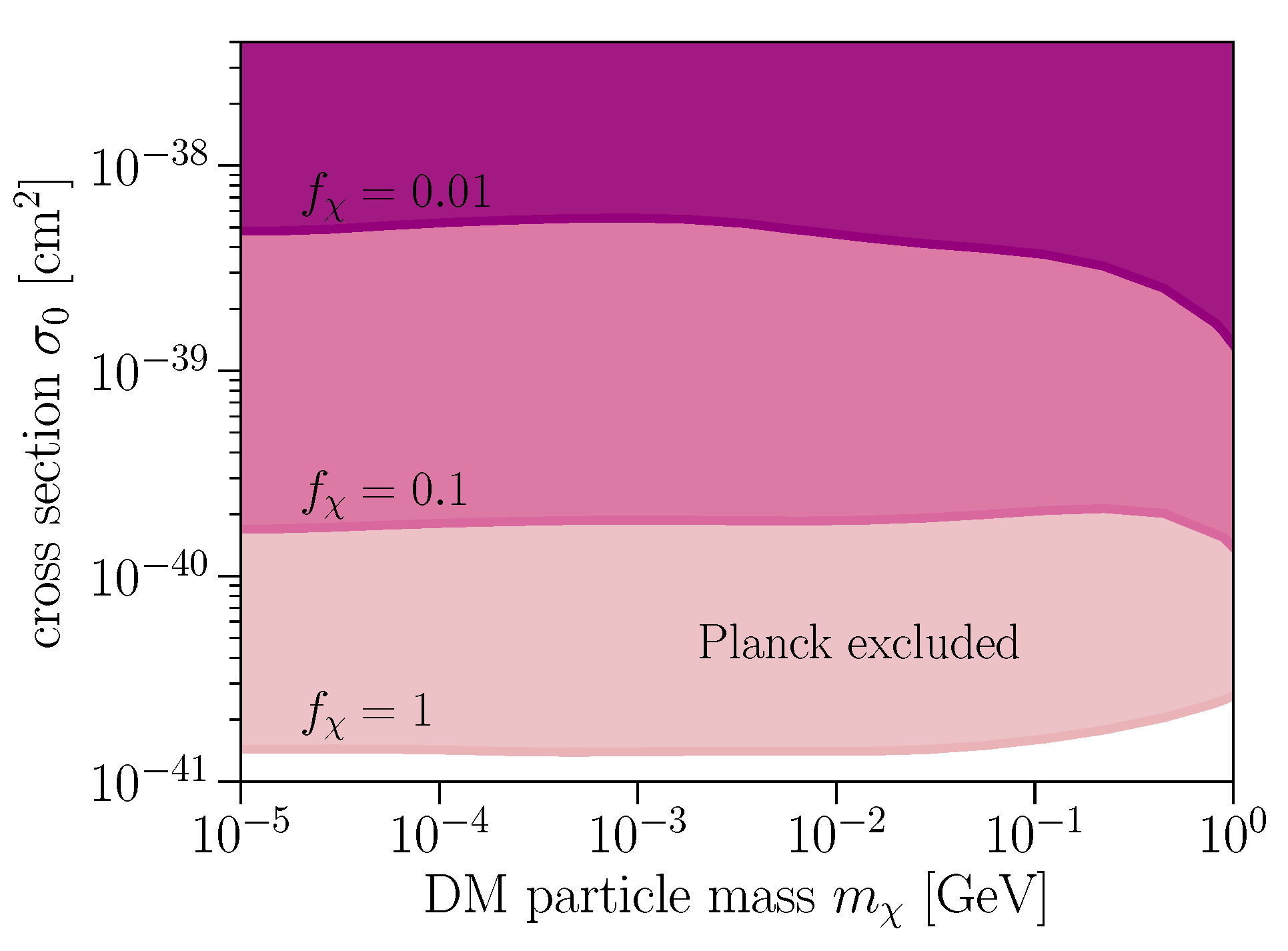
Left: The 95% C.L. excluded region for the coefficient of the DM–proton momentum-transfer cross section as a function of DM mass, obtained by analyzing Planck 2015 data, when the interacting fraction fχ of the total DM energy density is fixed to (from the lightest to the darkest pink): 1, 0.1, and 0.01. From Boddy, Gluscevic, Poulin, Kovetz, Kamionkowski and Barkana (PRD, 2018).
Right: 68% confidence ellipses in the αs − βs plane for the S4 CMB experiment (purple), S4+DESI (yellow), and S4+SKA (blue). We show the current Planck constraint in green. In gray we plot the range predicted by slow-roll single-field inflation. The region above the dash-dotted black line could produce PBHs with masses Mpbh > 1e15 gr, if extrapolated to the smallest scales. From Munoz, Kovetz, Raccanelli, Kamionkowski and Silk (JCAP, 2017).
Observation
An alternative approach to locating low-contamination sky patches beforehand is to develop means to identify the presence of Galactic dust contamination in CMB maps after they are generated. I introduced a unique such tool which uses tailored estimators to detect statistical anisotropy of the polarization orientation due to the large-scale coherence of the Galactic magnetic field.

- Harvard ITC (invited, 2013):
"Cosmic Bandits: Exploration versus Exploitation in Cosmological
Surveys”
(talks on this also given at Caltech/OBSCOS, CWRU, Columbia, NYU, Berkeley LBNL, JHU, CITA, IAS/Princeton) - Institut d'Astrophysique, Paris
(invited, 2015):
"Dealing with Dust Foregrounds in CMB B-mode Observations"
- Kamionkowski and Kovetz, PRL
(2014):
"Statistical Diagnostics to Identify Galactic Foregrounds in
B-mode Map"
- Kovetz and Kamionkowski, New
Astronomy (2015):
"Cosmic Bandits: Exploration versus Exploitation in CMB B-Mode
Experiments"
- Kovetz and Kamionkowski, PRD Rapid
Comm. (2015):
"Strategy to Minimize Dust Foregrounds in B-mode Searches"
Collaborations
- N. Abazajian et al. (2016):
"CMB-S4 Science Book, First Edition”
- F. Finelli et al. (2017): "Exploring Cosmic Origins with CORE: Inflation”