CONTACT INFORMATION
CLIMATE IN ANNAPOLIS
The dynamics of the Maryland General Assembly will be dramatically
different for the 2003 Session, as the first Republican Governor will be
in office since 1966 while the House and Senate remain predominantly
Democratic.
In the Senate, all four Standing Committee Chairs have either retired
or were defeated in the elections. The four new Chairs are as follows:
* Senator Thomas "Mac" Middleton (Charles County)- Finance
* Senator Ulysses Currie (Prince George's County) - Budget and Taxation
* Senator Paula Hollinger (NE Baltimore) - Education, Health, and Environmental Affairs
* Senator Brian Frosh (Montgomery County) - Judicial Proceedings
Senator Nathaniel McFadden (Baltimore City) will serve as the new Senate Majority Leader.
In the House of Delegates, there have been significant changes as well. Speaker Casper Taylor, Jr.
lost to his opponent in the General Election, leaving the highest-ranking House position vacant.
Chairman Mike Busch (Anne Arundel County, Economic Matters Chair) was elected Speaker of the House
and promptly reorganized the House leadership and Committees. Delegate Adrienne Jones was elected
Speaker Pro-Tem, the first African-American woman to hold the post.
Speaker Busch altered the Committee structure in the House for the 2003 Session. The Commerce and
Government Matters Committee was eliminated and replaced with a new Health and Government Operations Committee,
while the other committees remained the same. There have been Committee Leadership changes in the
House as well. The Committee Chairs are as follows:
* Delegate Pete Rawlings (Baltimore City) - Chair of Appropriations
* Delegate Maggie McIntosh (Baltimore City) - Chair of Environmental Matters
* Delegate John Hurson (Montgomery County) - Chair of Health & Government Operations
* Delegate Dereck Davis (Prince George's County) - Chair of Economic Matters
* Delegate Joseph Vallario (Prince George's County) - Chair of Judiciary
* Delegate Sheila Hixson (Montgomery County) - Chair of Ways & Means
Changes from redistricting and the recent election have altered some of the representation
for the Johns Hopkins Institutions. The East Baltimore Campus was part of the 45th District represented
by Senator McFadden, and Delegates Talmadge Branch, Hattie Harrison, and Clarence Davis. The campus is now
part of the 44th District and will be represented by newly elected Senator Verna Jones, and Delegates
Jeffrey Paige, Ruth Kirk, and Keith Haynes.
Finally, the Homewood campus was part of the 42nd District, which was represented by
Senator Barbara Hoffman, and Delegates Jim Campbell, Maggie McIntosh, and Samuel Rosenberg.
Due to the court's redistricting plan, the 42nd District was moved out of Baltimore City.
As a result, the Homewood campus is now part of the 40th District represented by Senator
Ralph Hughes, Delegate Pete Rawlings, Delegate Tony Fulton, and Delegate Salima Marriott.
[ Go to top]
OPERATING BUDGET
One issue will dominate the 2003 session of the Maryland General Assembly - how to
address the State's projected budgetary shortfall. Maryland's Constitution requires a
balanced budget and according to the General Assembly's budget office, the State is facing
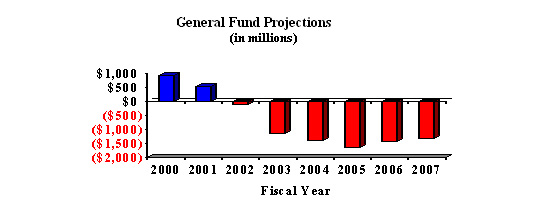
a $9.6 billion shortfall over the next six years (see chart below). The current budget year,
FY 2003, has a projected $590 million shortfall that is the result of lower revenues and more
than $100 million in deficiencies. Meanwhile, the projected FY 2004 shortfall totals more
than $1.2 billion or 12%. Lower revenues and projected increases for education, mental health,
and Medicaid drive the FY 2004 baseline budget deficiency.
In an attempt to address the shortfall, the Spending Affordability Committee has recommended
limiting the growth in the State's FY 2004 budget to only 2.5%, or $355.5 million over the
FY 2003 appropriation. This modest increase in spending will require the Governor and General
Assembly to make difficult decisions regarding the State's spending priorities.
To address the State's long-term structural budget imbalance will require extensive spending
retrenchments or revenue enhancements. During the campaign, Governor-elect Ehrlich has stated
that income and sales tax increases are off the table. However, the new administration has not
ruled out the possibility of user fee or gasoline tax increases. Meanwhile, the Department of
Legislative Services has developed a list of recommendations to reduce spending. These reductions
include: reducing State salaries by 1%, eliminating 1,000 State positions, and reductions in various
health and education programs.
[ Go to top]
CAPITAL BUDGET
While the operating budget will have its challenges, the State's Capital Budget will be just as vexing.
The State's Spending Affordability Committee has recommended that $740 million in spending be authorized
for the State's Capital Budget for fiscal year 2004, an additional $200 million over fiscal year 2003. The additional
$200 million in bonding capacity gives the Governor and the legislature considerable flexibility to structure
capital financing in the context of the total budget needs of the State. However, the State will face difficulty
in funding new capital projects this year as there are many projects from last year that were not funded and this
will cause a ripple effect in the State's 5-year Capital Improvement program for years to come.
This year, in fiscal year 2004, Johns Hopkins is requesting a total of $17.15 million in State assistance for
capital projects as follows:
* $2.15 million in FY 2004 to support the construction of the new Chemistry Building
on the Homewood campus. Last year, Johns Hopkins volunteered to defer this project until FY 2004 to
allow other projects to move forward.
* $5.0 million to complete the State's final commitment to the Broadway Research Building and
* $10.0 million to begin construction of the Cancer Research Building II.
[ Go to top]
CIGARETTE RESTITUTION FUND
The State's budget crunch will likely translate to woes for a multitude of programs
receiving State funds. At this point, no program is guaranteed to continue receiving
funds at their existing levels. Although the Cigarette Restitution Funds (CRF) are
separate from the State's General Funds they too are a revenue source that can be reappropriated
in Fiscal Year 2004 by the Governor and Maryland General Assembly. Current Maryland law requires
that at least 50 percent of the CRF annual appropriation be expended for health and tobacco-related
priorities. Presently this includes a portion of Medicaid funding as well as the Statewide Academic
Health Center Grants for Cancer Research and Public Health awarded to Johns Hopkins Institutions (JHI).
The Johns Hopkins Cigarette Restitution Fund Program anticipates receiving $2 million in FY2004 to
continue the established Public Health Grant to provide prostate cancer education, prevention,
screening and treatment to Baltimore City's underserved men. In addition, in the upcoming fiscal year,
Johns Hopkins is slated to receive $13 million for cancer research. Although a total of $15 million
for the JHI CRF program is in the Department of Health and Mental Hygiene's projected budget for the new
fiscal year, the challenge will be to escape the budget ax and retain funds for these vital programs.
[ Go to top]