Johns Hopkins Institutions


Legislative Hotline

2003 SESSION OF THE
MARYLAND GENERAL ASSEMBLY


Volume 11, Number 3 January 22, 2003


Here are some of the hot issues as the 2003 Legislative session develops:
FY 2004 Budget Allowance
Ehrlich Taps More Members for his Cabinet
Trauma Centers
CareFirst


STAFF CONTACT INFORMATION

FY 2004 Budget Allowances

Governor Ehrlich has released his FY 2004 operating budget and the capital budget is expected to be released towards the end of January. The FY 2004 budget totals $22.8 billion, or 1.8% over the FY 2003 appropriation. It should be noted that the budget was submitted $35 million below the 2.5% increase recommended by the Spending Affordability Committee. Furthermore, if aid to education and Medicaid were excluded, the FY 2004 budget would be $100 million less than the adopted FY 2003 budget. Other key points of the FY 2004 budget include:

* PAYGO (General Fund) capital projects will be reduced from $50 million to $13 million, General Obligation Bonds will be used to fund these projects to reduce pressure on the General Fund budget
* $395 million in additional revenue is estimated from slot machines
* Scholarship assistance ($82.6 million, a reduction of 8.2% from FY 2003) will target new awards for teacher education and financial need
* $325 million or 9.4% increase for Medicaid
* $106.6 million will be transferred to Medicaid from the Cigarette Restitution Fund
* For Mental Health, a $30 million deficiency is funded, and an additional $36 million is included in the FY 2004 budget
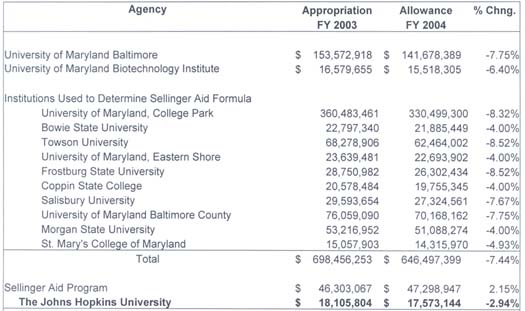
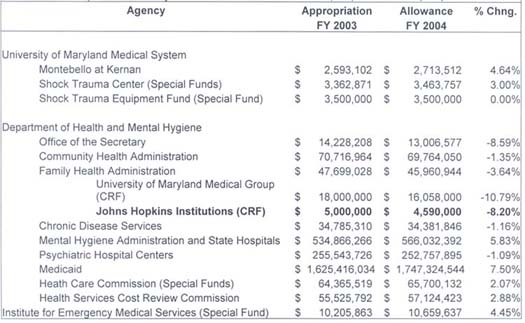
While additional details on the budget will be forthcoming during upcoming budget hearings, below is a table comparing the FY 2003 working appropriation to the FY 2004 allowance for select agencies. Please note, the totals reported on this table are General Funds only, unless otherwise noted.


[ Go to top]

Ehrlich Taps More Members for his Cabinet

Governor Ehrlich has made further appointments to his new cabinet. In addition to last weeks' appointments are the following nominees, which require confirmation by the Maryland State Senate:

Secretary of the Department of Business and Economic Development - Aris Melissaratos. Melissaratos was chairman of Armel Private Equity Investments, which provides funding and strategic direction to high technology startup companies. Prior to Armel, Melissaratos worked at Westinghouse for 32 years before retiring in 1997 as vice president of science and technology and chief technology officer.

Secretary of Aging - Jean Roesser. Roesser, a former State Senator from Montgomery County will oversee the Department designed to help give senior citizens access to housing, affordable health care, and employment.

Secretary of Housing and Community Development - Victor Hoskins. Hoskins was senior vice president of UrbanAmerica, a Wall Street based real estate investment company that buys and develops commercial buildings in urban areas. Before that, he was Deputy Commissioner of Baltimore City's Department of Housing and Community Development. He also worked for Governor Glendening as assistant secretary of marketing for the Department of Business and Economic Development.

Secretary of Juvenile Justice - Kenneth Montague. Montague, a former Delegate and Democrat representing Baltimore City will oversee the restructuring of the Department of Juvenile Justice.

[ Go to top]

Trauma Centers

The Committee on the Funding Needs of the Trauma Centers presented their report to four standing committees of the General Assembly on Tuesday January 14, 2003. The presentation focused on the need of approximately $15 million for the State's other trauma centers. The funding is essential to avoid another trauma center from closing its doors to patients, such as Washington County was forced to do in July 2002, and to address critical under funding of the programs.

The State's trauma centers presented testimony that focused on the need for additional funding to address:

* Growing stand-by costs for physicians to accept trauma calls
* Rapidly increasing medical malpractice insurance
* Declining reimbursement rates from commercial payers
* Uncompensated care burdens
* Low Medicaid reimbursement rates
The funding issues related to trauma care, especially financial challenges faced by trauma physicians, will receive additional attention this legislative session. Speaker Busch has introduced House Bill 1 (one of only two bills included in the House leadership package) to create a fund that would provide additional resources to address trauma physicians' uncompensated care.

[ Go to top]

CareFirst

Maryland's Insurance Commissioner, Steven Larsen, testified before four of the General Assembly's committees last week on the status of the CareFirst application for conversion to a for-profit corporation and acquisition by WellPoint. He reminded the members that it is his obligation to determine whether or not a conversion would be in the public interest and to that end, the Insurance Commission has spent the last year conducting a thorough investigation. They have collected over 85,000 pages of documents, 219 exhibits and 10 subpoenas, held public hearings, hired experts from around the country and have nearly completed the process necessary to make an equitable evaluation. On January 21, 2003 the CareFirst Due Diligence report, the Fairness Analysis and the Foundation Analysis will be released.

The final step will be a round of hearings that will be held in Baltimore from January 28 to 31. Although no public testimony will be taken, hearings are open to the public. Testimony will be provided by experts who will focus on the due diligence exercised by CareFirst in making the decision to be acquired by WellPoint, as well as how foundations across the country have used funds from non-profit conversions, the fairness of the proposal, and the impact of a conversion and sale on the health care consumers of Maryland. CareFirst representatives are also expected to testify.

To conclude this process, the record will close on Wednesday, February 5, 2003 and the Commissioner's order to announce his decision is expected on February 20, 2003. The conversion/acquisition may not occur without the Commissioner's approval. He may disapprove or approve with conditions. The General Assembly will have 90 days following the release of the order to act upon it, if necessary. CareFirst may also choose to pursue an administrative suit if they are dissatisfied with the Commissioner's decision.

[ Go to top]


BILLS INTRODUCED
Health Care Practitioners


BILLS INTRODUCED

Health Care Practitioners

SB0009     Health Occupations - Dentistry and Dental Hygiene - Examination
SB0009 amends current statute by repealing the additional education requirement for an applicant for a general license to practice dentistry or dental hygiene who has repeatedly failed an examination, and prohibits the Board of Dental Examiners from limiting the number of times an applicant may take a licensing examination.

Effective Date: October 1, 2003

For more information, please contact: Sheila Higdon


[
Go to top]


STAFF CONTACT INFORMATION
Please contact Government Relations if you have concerns or would like additional information. Your input assists us greatly in evaluating and formulating the position of Johns Hopkins on all legislation.

Legislative Session Office
47 State Circle, Suite 203
Annapolis, MD 21401
410-269-0057
fax 410-269-1574


Sheila Higdon shigdon@jhmi.edu
Jim Kaufman jkaufma@jhmi.edu
Bret Schreiber bschreiber@jhu.edu
Nicole Xander nxander@jhmi.edu


Kate Bishop sbishop2@jhmi.edu
Jason Spangler jspangle@jhsph.edu
Beth Chaney greltemp@jhmi.edu


Legislative Hotline is a collaborative service of The Johns Hopkins University and Johns Hopkins Medicine offices of Government Relations.

© 2003 The Johns Hopkins University. Baltimore, Maryland.
Office of Government, Community and Public Affairs.
Last updated 03jan22