The 2004 Legislative Session ended with little substantive legislative action taken and the adoption of a budget that fails to address the long-term fiscal imbalance. As the battle over the budget consumed much of the legislature's time, many bills failed simply due to inaction. Below is an overview of the budget and legislation that passed of interest to Johns Hopkins.
To view the legislative information below, click on the subject of interest to go directly to that area or scroll down to view the entire document.
BUDGET
Capital
Operating
EDUCATION
Financial Aid and Scholarships
K-12
Higher Education
HEALTH
Cigarette Restitution Fund
General Health Care
Health Care Facilities
Health Care Practitioners
Health Insurance
Long Term Care/Nursing Homes
Medicaid
Mental Health
Public Health
Research
Tort Reform
MISCELLANEOUS
Business Operations
Economic Development
Other Actions
STAFF CONTACT INFORMATION
BUDGET
Capital
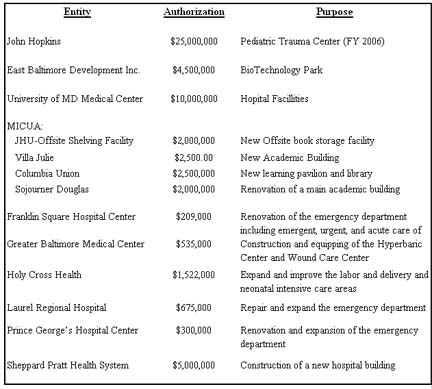
The General Assembly passed a capital budget totaling $848 million for fiscal 2005. Of the total, $1 million is funded with general funds; $107 million with special funds; and $25 million with revenue bonds; and, $655 million is funded with general obligation bonds, including higher education commission bonds totaling $47 million. The capital budget includes $2 million for Off-Site Shelving Facility for Johns Hopkins University, which is part of an $8.5 million grant for the MICUA Capital Projects Grant Program. The General Assembly agreed to provide an extra $500,000 (equally divided between Columbia Union College, and Villa Julie College). This increase will help to better position MICUA and Johns Hopkins for fiscal 2006 capital requests.
Several bond bills seeking to fund hospital renovation and construction initiatives around the state were not passed into law . However, these bond projects were amended on to the capital budget bill and therefore funded. Details on those and other projects of interest are illustrated below:
Operating
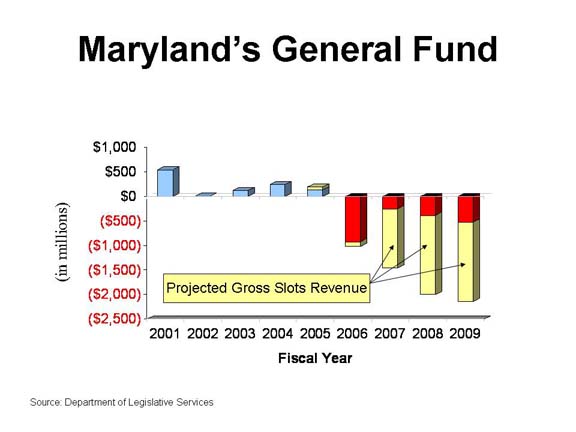
Governor Ehrlich introduced a fiscal 2005 spending plan that relied upon one-time revenue sources, limited ongoing revenues, and contingent budget reductions. To address out-year projected fiscal deficits, the Governor again introduced video lottery terminal (slot machine) legislation. The Senate passed a slot machine bill while the House of Delegates developed an alternative revenue package built chiefly around an increase in the sales tax. The General Assembly and Governor were unable to resolve their differences and neither of these measures passed. In the final days of Session, all the Governor and legislature could do was produce a balanced budget that does not address fiscal deficits in the out years (see chart below).
[ Go to top]
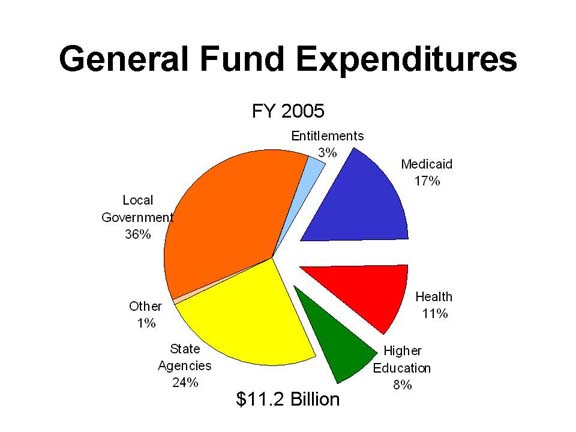
As enacted, the Budget Bill, provides $23.6 billion in appropriations for fiscal 2005, an increase of $710.5 million (3.1%) over fiscal 2004. Slightly less than one-half of the budget is supported by general funds, with lesser proportions supported by special funds, federal aid, and higher education revenues. Funding for local government makes up the largest portion of spending, representing 36% of the general fund budget. Programs of interest to Johns Hopkins � Higher Education, Health and Medicaid - account for almost 30% of the budget (see chart below).
Below are summaries of the major provisions of the FY 2005 operating budget that is of interest to Johns Hopkins.
Sellinger Aid and Higher Education
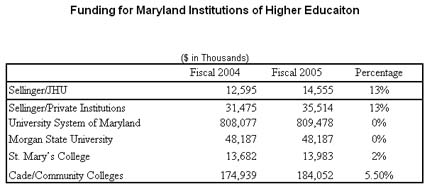
Johns Hopkins, along with other independent colleges and universities, receives operating funds through the Sellinger Aid program. In an effort to balance the FY 2005 budget, the Governor�s budget funded the program at the FY 2004 levels. Additionally, the Department of Legislative Services recommended a further reduction by rebasing the formula indefinitely from 16% per Full Time Equivalent Student (FTES) to 11% per FTES. This proposal was defeated and the General Assembly provided for a 13% increase over FY 2004. As a result, the total appropriation for Johns Hopkins increased by $1.9 million to $14.5 million.
The legislature concurred with the Governor�s allowance for the public higher education (University System of Maryland, Morgan State University, and St. Mary�s College), which provided level funding from FY 2004 to FY 2005. Meanwhile, the budget for community colleges increased 3.3% from FY 2004 to FY 2005. (see chart below)
Medicaid and CHIP
The Medicaid and CHIP appropriation continues to be one of the fastest growing sections of the budget, now consuming almost $4 billion for FY 2005. While the total appropriation for Medicaid only reflects a 3.8% increase from FY 2004, due to one-time funds from the federal government for a temporary enhanced federal match, the General Fund allocation for Medicaid increased 15.1% from FY 2004 to FY 2005. Even with this increase in funding, the Department of Legislative Services projects the Medicaid budget is underfunded by more than $70 million in total funds.
Despite the projection that the Medicaid budget is underfunded, the budget committees adopted several further reductions:
- $7.3 million through implementation of budget bill language requiring the Department to sanction MCOs that fail to meet the 84% medical loss ratio and achieve below average health outcomes (this reduction primarily affects Americaid)
- $5.2 million by increasing hospital day limits for adult Medicaid participants
- $4.6 million by reducing pharmacy dispensing fees from $4.69 for a generic and $3.69 for non-preferred drugs by $1.00
- $1.0 million by charging providers for the cost of recovering inappropriate payments
- $1.0 million by requiring a $10 co-payment for non-emergency use of the emergency room
In addition to the various budget actions, the General Assembly adopted several pieces of budget bill language impacting the Medicaid program. The measures:
- Require the Department to study the relevance of the 85% medical loss ratio, MCO profitability and losses, and the underlying cost structure and efficiency of the MCOs. The study will also include a review of quality measures and an outcome based system of rewards and penalties that equate to at least 1% of total payments to MCOs. The report is due by September 1, 2004
- Require the Department to explore the development of a single preferred drug list for State employees and Medicaid enrollees
- Direct the Department to establish a plan to identify and evaluate individuals at highest risk for chronic kidney disease in order to prolong kidney function and delay disease progression to End Stage Renal Disease
- Direct the Department to develop a pharmacy care management program for nursing home residents similar to a program implemented in North Carolina
- Allow a $4.0 million dental incentive pool to be used for either MCOs that meet the 40% utilization target or a 15% rate of children enrolled who are receiving restorative care
AIDS/HIV
The budget committees added language that requires DHMH and the Maryland Health Insurance Program to establish a pilot program to expand health insurance coverage to persons with HIV/AIDS who are currently disqualified from the program. The language allows DHMH to use up to $250,000 in federal Ryan White funds to cover the costs of the program.
In order to speed up the process of adding new drugs to the AIDS Administration formula, the committees have requested a regulatory change that will allow the Administration to alter the formulary without completing the current regulatory process that results in unnecessary delays in accessing new treatments.
University of Maryland Medical Center
The budget committees reduced State Aid to University of Maryland Medical Center by $108,540 for a final appropriation of $9.68 million for FY 2005. These funds include an operating and equipment grant to support the Shock Trauma Center ($6.9 million) and an operating grant for the Montebello Rehabilitation Center at Kernan Hospital ($2.7 million).
Legislation Passed by the General Assembly
HB 345 - Bridge to Excellence in Public School Acts - Trigger Provision - Repeal is an emergency bill that repeals the �trigger provision� in the Bridge to Excellence in Public Schools Act of 2002. The repeal eliminates the need for the General Assembly to pass a joint resolution in order to continue with full implementation of the funding formulas established in the Bridge to Excellence legislation.
Effective Date: Emergency Measure (Effective upon enactment)
Became law without the Governor's signature per Maryland's constitution; Chapter #6
For more information, please contact: Bret Schreiber
HB 1467 - Transportation Trust Fund - Transportation Financing - Increased Revenues increases the State motor vehicle registration fee and alters the requirements for the level of miscellaneous fees charged by the Motor Vehicle Administration (MVA). It also authorizes a fee for a missed driver's test appointment, and increases the debt limit on consolidated transportation bonds.
The act also creates several options to raise an additional $300 million per year for the Transportation Trust Fund (TTF) to fund road and transit projects, including increasing the gas and titling tax and the vehicle registration fee. House Bill 1467 also permanently extends the Maryland Trauma Physician Services Fund (set to expire July 1, 2005) and the $2.50 annual surcharge on the State vehicle registration.
Effective Date: July 1, 2004
Signed by the Governor on April 13, 2004; Chapter #9
For more information, please contact: Heather Barthel
[ Go to top]
EDUCATION
Financial Aid and Scholarships
The FY 2005 budget includes $83.3 million in general funds for the Maryland Higher Education Scholarship programs, an increase of $7.4 million over the FY 2004 working appropriation. Fiscal 2005 marks the first increase in need-based financial aid since FY 2001 and will help alleviate a current waiting list of over 5,000 students. With this increase, MHEC will award aid to approximately 4,138 additional students over FY 2004 and will help offset the increased tuition and fee rates. The current average award is $2,175 and reflects the most recent tuition and fee increases. The Educational Excellence Award program, the State�s need based aid program, received a $12.2 million increase over FY 2004. The Loan Assistance Repayment program and the part-time grant program increased by 189% and 54%, respectively. The HOPE Scholarship programs received a 26% decrease. All other state scholarship programs were funded at the same level as the FY 2004 appropriation. For the 2003-2004 academic year, Johns Hopkins students received a total of $1.4 million in grants and scholarships from the State of Maryland.
HB 1307 - Higher Education - William Donald Schaefer Scholarship Program establishes the William Donald Schaefer Scholarship Program. It also sets up the William Donald Schaefer Scholarship Advisory Council within the State Higher Education Commission. The chapter authorizes the Commission to make scholarship awards to those students who wish to pursue a career in the State of Maryland in public service.
Effective Date: October 1, 2004
Signed by the Governor on May 11, 2004; Chapter #413
For more information, please contact: Bret Schreiber
[ Go to top]
K-12
The primary focus in education this year was budgetary support to help pay for the Bridge to Excellence In Public Schools Act of 2002, otherwise known as Thornton. FY 2005 marks the second year of the five-year schedule for the State education aid formulas enacted through Thornton. The budget adopted by the General Assembly increased funding for public primary and secondary education by $314.3 million over the FY 2004 appropriation as required by Thornton. The 9.5 percent increase in State education aid was achieved despite the State�s ongoing budget problems. In total, the State will provide more than $3.6 billion for public education in FY 2005.
Mid-way through the legislative session the Governor and leaders of the General Assembly attempted to address the fiscal crisis of the Baltimore City School System through State funding and increased control over the system. After weeks of deliberations, the Mayor ultimately rejected State support and decided to bail the City Schools out by tapping into the City�s rainy day fund, combined with a loan from the Abell Foundation.
On the policy front, Johns Hopkins focused much of its advocacy efforts on measures to help prospective teachers get better and more affordable education and training. Hopkins supported efforts to enhance teacher mentoring and to increase funding for adult education and literacy services. Unfortunately, the bills did not pass the legislature.
Legislation Passed by the General Assembly
SB 1 - Education - Teachers - State and Local Aid Program for Certification repeals the sunset on State and local aid to teachers who pursue certification by the National Board for Professional Teaching Standards. Each school year, the State Board selects a maximum of 500 teachers to participate in the Program. This act will allow the financial aid to continue. As of July 1, 2003, the national board, through its participation in this program, had certified 203 teachers in Maryland.
Effective Date: Emergency Measure (Effective upon enactment)
Signed by the Governor on May 11, 2004; Chapter #240
For more information, please contact: Bret Schreiber
SB 894/HB 1505 - Education Fiscal Accountability and Oversight Act of 2004 prohibits local school systems from carrying budget deficits, requires more reporting on and legislative audit of local school system finances, and provides for changes to the annual comprehensive master plan updates that local school systems are required to submit. The act requires the head of each local school system to file a biannual report on the financial status of the school system with the State Superintendent of Schools and local governing body. The State Superintendent and Maryland State Department of Education must monitor the financial status of each local school system and report their findings biannually to the Governor and the General Assembly.
If a local school system has a deficit, which is defined as a negative fund balance of 1% or more of general fund revenue at the end of a fiscal year, then the State Superintendent must immediately notify the Governor, the General Assembly, the Department of Legislative Services, and the local governing body. The local school system will then be required to:
- Develop and submit for approval a plan of corrective action for fiscal recoveries within 15 days;
- File a monthly status report with the State Superintendent and local governing body that demonstrates actions taken to close the deficit and the effect of the actions taken on the deficit; and
- Include information on the corrective action cost containment plan, actions taken to close the deficit, and status of the deficit in the biannual financial status reports filed with the State Superintendent and local governing body. The State Superintendent must include this information in a quarterly report submitted to the Governor and the General Assembly.
Special provisions dealing only with Baltimore City require the City Board of School Commissioners to eliminate its general fund deficit by the end of FY 2006.
If a local school system fails to comply with the reporting requirements, the State Superintendent must notify the Comptroller, who must withhold 10% of the State aid. The withholding of State aid continues until the State Superintendent notifies the Comptroller that the local school system is in full compliance with the specified requirements. An audit of each local school system to evaluate the effectiveness and efficiency of the system's financial management practices is conducted by an audit team under the direction of the Department of Legislative Services. The audits must be conducted between July 1, 2004, and June 30, 2010. A local school system found to have a negative fund balance in the general fund of 1% or more in either of the prior two fiscal years must be included in the first group of audits. Two school systems Baltimore City and Prince George's County, will meet the criterion and require an audit.
In addition to the financial management practices audits, Office of Legislative Audits must conduct a centralized audit of the master plans to determine the overall compliance with State requirements by December 1, 2004.
Effective Date: July 1, 2004
Signed by the Governor on April 27, 2004; Chapter #148
For more information, please contact: Bret Schreiber
Higher Education
Bills designed to strengthen higher education in Maryland were introduced, including legislation aimed at alleviating the State's shortage of teachers and others lessening the costs of higher education for students. Much of the legislation this year focused on the accessibility and affordability of the State�s higher education institutions, as described below.
Additional legislation was defeated which would have allowed students to receive State scholarship dollars to attend out-of-state higher education institutions in exchange for them coming back to Maryland upon graduation to work in an industry such as nursing, which is experiencing state-wide shortages. Other legislation that did not pass would have required an accredited higher education institution in Maryland to provide reports to their local elected officials if any of their nursing education programs fall below State Testing Standards set by the State Board of Nursing.
Legislation Passed by the General Assembly
HB 641 - Higher Education - Community Colleges � Unrestricted Grants repeals the June 30, 2005, sunset date on the additional small college grants for Allegany College of Maryland and Garrett College. In 2002, legislation was enacted that provided additional small college grants for Allegany College and Garrett College. At that time, funding for these institutions under the Senator John A. Cade funding formula had increased 23 percent and 16 percent, respectively, from fiscal 1998 to 2002. Aid for other community colleges had increased over the same period of time by an average of 61 percent. The additional grants established in 2002 were an attempt to keep increases at these two institutions consistent with the increases at the other colleges. From fiscal 2003 to 2005, unrestricted additional small college grants for Allegany College of Maryland and Garrett College of $360,000 and $240,000, are mandated.
Effective Date: July 1, 2004
Signed by the Governor on April 27, 2004; Chapter #192
For more information, please contact: Bret Schreiber
HB 1167/SB 615 - Higher Education - Maryland Digital Library - Established establishes a Maryland Digital Library (MDL) within MHEC, as well as the MDL Advisory Council. MDL consists of the academic libraries in public and private nonprofit institutions of postsecondary education. After receiving recommendations from the MDL Advisory Council, MHEC may encourage each academic library to:
- increase shared access to critical information in Internet-accessible form;
- optimize funding;
- digitize unique collections;
develop training programs for library users.
MDL is also authorized to develop programs to support Maryland residents in collaboration with county libraries, the Enoch Pratt Free Library, the Maryland State Archives, and elementary and secondary school libraries. The MDL Advisory Council must submit an annual report regarding the financial status and operations of MDL.
Effective Date: October 1, 2004
Signed by the Governor on May 11, 2004; Chapter #402
For more information, please contact: Bret Schreiber
HB 1188 - Higher Education Affordability and Access Act of 2004 - Supplementary Appropriation establishes a special, non-lapsing Higher Education Fund (HEIF) supported by a 10% surcharge on corporate income taxes that will be imposed from calendar 2004 to 2006. Funding from HEIF will provide additional support to the University of Maryland (USM) and Morgan State University (MSU) in exchange for limiting annual tuition increases to five percent for three years. USM�s additional appropriation in FY 2005 will be $2.54 million, and MSU�s will be $1.6 million. In FY 2006 and 2007 the Governor will be required to include an appropriation in the general fund of at least 5% over the previous fiscal year. Funding for the Sellinger and Cade formulas, as well as the Baltimore City Community College, will be based on general fund and HEIF support for the public four-year institutions of higher education.
The General Assembly�s intent that USM and MSU improve their effectiveness and efficiency, as well as reduce their costs, prompted specific requirements. USM is directed to attain effectiveness and efficiency savings of a minimum of $17 million in FY2005, while MSU is required to implement an effectiveness and efficiency initiative. Each institution must submit detailed reports on their efforts. In addition, nonpublic institutions of higher education that receive state funds will be required to report annually to the Maryland Higher Education Commission on the scholarships and grants they award to Maryland students.
Additionally, a commission will be established to study the coordination, funding, educational delivery, and state�s commitment to higher education. The commission�s report on its findings and recommendations will be due by December 1, 2005. The President of Johns Hopkins University, or his designee, will be a member of the commission, as well a representative of MICUA.
Effective Date: July 1, 2004
For more information, please contact: Bret Schreiber
SB 30 - Higher Education - Student Financial Assistance - Service Obligation Requirements eliminates the requirement that recipients of Economic Development Assistance Grants and nonresident nursing students who pay resident tuition rates furnish promissory notes that include cosigners. Economic Development Student Assistance Grants typically include the Sharon Christa McAuliffe Memorial Teacher Education Awards, Physical and Occupational Therapists and Physical and Occupational Therapy Assistants Grants, Child Care Provider Grants, and State Nursing Scholarships. Only students will be required to sign the promissory notes. The promissory notes will state the students' intent to fulfill the service obligations associated with the grants and reduced tuition rates or repay the State in an amount equal to the benefit received if the service obligation is not undertaken or fulfilled.
Effective Date: July 1, 2004
Signed by the Governor April 27, 2004; Chapter #80
For more information, please contact: Bret Schreiber
SB 31 - Higher Education - Graduate and Professional Scholarship Program allows for a Maryland resident attending any institution of higher education in the State that offers a master's degree in social work to be eligible for an award under the Graduate and Professional Scholarship Program.
Effective Date: July 1, 2004
Signed by the Governor on April 13, 2004; Chapter#11
For more information, please contact: Bret Schreiber
SB 430 - Higher Education - Morgan State University -
Coordination and Governance provides additional corporate powers to Morgan State University. This includes the authority to acquire, hold, lease, and use property; borrow money; sue and be sued; and carry liability insurance. The University also is exempted from specified provisions of the State procurement law. Additionally, the act repeals a position cap requirement and clarifies that laws must specifically reference the University in order to be applicable.
Effective Date: July 1, 2004
Signed by the Governor on May 11, 2004; Chapter #273
For more information, please contact: Bret Schreiber
SB 738 - Higher Education - University System of Maryland - Governing Authority
provides that the authority of the Board of Regents of the University System of Maryland may not be superseded by any other State agency or office in management affairs except by provision of law that specifically references the University System. The act allows the System discretion in how it spends its State allowance so long as they do not exceed the maximum amount allowed by the State. Previously, personnel positions had to be identified in the state budget.
Effective: July 1, 2004
Signed by the Governor on May 11,2004; Chapter #239
For more information, please contact: Bret Schreiber
SB 812 - Higher Education - Approval of New Programs streamlines the academic program approval process. Currently, MHEC does not �approve� programs for private institutions. If a MICUA State-aid institution moves ahead with an academic program that MHEC has not recommended, that institution may not claim those FTES in the Sellinger program. SB 812 streamlines that process to allow for only four areas of �objection� for academic program approval. This narrows the scope of MHEC�s approval process and expands the ability to claim FTES as part of the Sellinger Aid program for new academic initiatives
Effective Date: June 1, 2004
Signed by the Governor on may 11, 2004; Chapter #311
For more information, please contact: Bret Schreiber
[ Go to top]
HEALTH
General Health Care
This year the General Assembly passed several bills attempting to address Maryland�s high cancer rates. First, HB 1000 creates the Maryland Cancer Fund to support cancer research, prevention, and treatment that will be supported with a voluntary income tax check off. In addition, HB 1067 creates a Cervical Cancer Committee of the Comprehensive Cancer Control Plan.
Meanwhile, several bills were introduced and defeated during the session. Among them was HB 1384 � Health Care Commission Membership and Duties � that would have altered the commission membership by requiring three additional members, one of which had to be a representative of a regional health care entity that has its headquarters in Maryland. Many saw this bill as an attempt to overturn previous Maryland Health Care Commission decisions related to Open Heart Certificate of Needs. In addition, SB 470 would have allowed providers and hospitals to sue producers of medical supplies for antitrust violations. While the Senate voted the bill favorably, the House Health and Government Operations Committee did not take action on the bill.
Legislation Passed by the General Assembly
HB 207 - Health Care Decisions Act - Appointment of Agent - Prohibition prohibits an owner, operator or employee or the spouse, parent, child or sibling of an owner, operator or employee of a health care facility from which an individual is receiving health care from serving as that individual's health care agent. A disqualified person may serve as a health care agent if the person was appointed by the individual prior to their receiving care from the facility.
Effective Date: October 1, 2004
Signed by the Governor on May 11, 2004; Chapter #327
For more information, please contact: Sheila Higdon
HB 557 - Advance Directive Information Availability Act
requires the Department of Health and Mental Hygiene, in consultation with the Office of the Attorney General, to develop an information sheet that provides information regarding advance directives. The sheet may not contain or promote a specific advance directive. DHMH must develop a plan before June 30, 2005 to make the sheet widely available through distribution to the Motor Vehicle Administration, health insurance carriers, local departments of social services, and community health centers. The chapter requires that an insurance carrier (excluding a managed care organization) provide the advance directive information sheet in its member's publications, on their website, and at the request of their member.
Effective Date: October 1, 2004
Signed by the Governor May 11, 2004; Chapter 356
For more information, please contact: Jim Kaufman
HB 981 - Health and Human Services Referral System creates a statewide information and referral system for health and human services. To access the referral system a person can dial 2-1-1 anywhere in the state. A 15-member board consisting of various state officials, nonprofit organizations, and utility companies will oversee the referral system.
Effective Date: October 1, 2004
Signed by the Governor on May 11, 2004; Chapter #390
For more information, please contact: Jim Kaufman
HB 1000 - Maryland Cancer Fund - Income Tax Checkoff establishes a Maryland Cancer Fund within the Department of Health to provide grants for cancer research, prevention, and treatment. The fund will be supported through voluntary check off on an individual's income tax return. After the Comptroller deducts administrative expenses, the contributions will be credited to the fund and distributed by the Secretary of Health and Mental Hygiene through the annual budget process. DHMH shall use the funds to provide grants to eligible physicians, hospitals, laboratories, educational institutions, and other organizations and persons to conduct cancer research, prevention and treatment. The Secretary is required to report to the General Assembly annually on the administration of the fund.
Effective Date: July 1, 2004 (applies to all tax years beginning after December 31, 2003)
Signed by the Governor on May 11, 2004; Chapter #392
For more information, please contact: Sheila Higdon
SB 499/HB 1067 - State Council on Cancer Control - Cervical Cancer Committee of the Maryland Comprehensive Cancer Control Plan establishes a Cervical Cancer Committee of the Maryland Comprehensive Cancer Control Plan staffed by the DHMH. The committee�s duties include:
- Collaborating with DHMH and the State Council on Cancer Control to promote public awareness on the causes, nature, detection, treatment, and prevention of cervical cancer;
- Identifying and examining the limitations of existing programs, services, laws, and regulations with respect to cervical cancer awareness and the availability of health insurance coverage and public services for cervical cancer diagnosis and treatment;
- Developing a statewide Cervical Cancer Prevention Plan; and
- Facilitating coordination and communication among State and local agencies and organizations to achieve the plan's goals. The committee must present its findings and recommendations to the Governor and the General Assembly by October 1 of each year, beginning in 2004, in the annual report of the State Council on Cancer Control.
Effective Date: July 1, 2004 (Sunsets June 30, 2009)
For more information, please contact: Sheila Higdon
[ Go to top]
Health Care Facilities
A wide variety of bills affecting healthcare facilities were introduced this session ranging from patient safety mandates, to financially distressed hospitals, to Federally Qualified Health Centers.
Multiple pieces of legislation were introduced in an attempt to further regulate abortion clinics as freestanding ambulatory care facilities. At the hearings several pro-choice organizations expressed their concern that this was an attempt by anti-abortion groups to ratchet down on abortion clinics. None of these bills made it past the initial hearings.
Legislation introduced by Delegate Sandy Rosenberg would have superceded the recently adopted regulations by the Maryland Health Care Commission, and would have required that a hospital that performs "advanced cardiac health care services" obtain a Certificate of Need. It defined advanced cardiac health care services as Percutaneous Coronary Intervention (PCI) and Open Heart Surgery, and would have required that a hospital that performs elective PCI must perform on-site open-heart surgery, except for the management of an acute Myocardial Infarction. The legislation was never reported out of committee.
Legislators from Prince Georges County introduced Senate and House bills in an attempt to shore up the financially troubled Prince Georges County Hospital (PGCH). The purpose of the bills were to appropriate multiple funding sources, including monies already allocated from the Cigarette Restitution Fund and the MEMSOF, for the hospital. Although legislators were sympathetic to the plight of PGCH, many recognized that others hospitals who treat a significant number of Medicaid patients and provide millions of dollars in uncompensated care are also fiscally challenged. Therefore, the House bill was significantly amended, with a goal to establish a Task Force to Study Physician Reimbursement at Maryland Hospitals. Although the House passed the bill, it did not move in the Senate.
A bill that would have altered the definition of an ambulatory surgical facility to include healthcare facilities that providing surgical services to patients requiring a period of postoperative observation not exceeding 23 hours was defeated.
Delegate Hurson introduced a bill that would have required each health care facility licensed and regulated by DHMH to establish a patient safety program. This bill was duplicative of current efforts being implemented so it was eventually withdrawn. Another bill, which would have placed additional resident work hour requirements on hospitals, was also defeated.
Two bills that would have impacted facilities that provide maternity and obstetrical services received an unfavorable report. One would have required these facilities to provide written information about postpartum depression to a maternity patient prior to discharge. Another would have required them to provide written information about Shaken Baby Syndrome to a maternity patient prior to discharge, along with a signature from the patient acknowledging receipt of the materials and a copy to be stored on file at the hospital. Several facilities already provide this information and while there was support for providing such education, there was concern that these bills did not address the issues of access and availability of mental health care for patients identified through these venues.
One bill that passed both houses after amendments, HB 556/SB 352, will create the "Patient's Plan of Care" form, to be used voluntarily to summarize the plan of care for an individual including the use of life-sustaining procedures and transfer to a hospital from a non-hospital setting.
HB 556/SB 352 - Health Care Decisions - "Patient's Plan of Care" Form - Communication of Patient Preferences creates a "Patient's Plan of Care" form developed by the Office of the Attorney General. This voluntary form would summarize the plan of care for an individual including the use of life-sustaining procedures and transfer to a hospital from a non-hospital setting. This form will not interfere with the establishment of an advance directive and would be required to be consistent with the decisions of the following: a competent patient or a health care agent or surrogate decision maker and any existing advance directive. A health care provider can complete this form under the direction of an attending physician and a health care provider "shall review" any "patient's plan of care" form received from another health care provider as part of the process of establishing a plan of care for an individual.
Effective Date: October 1, 2004
[ Go to top]
Health Care Practitioners
Again this Session multiple bills were introduced affecting health care practitioners. Among those that passed is one that will allow pharmacists to administer the Influenza Vaccine and another, which authorizes clinical nurse specialists and psychiatric nurse practitioners to file a petition for emergency evaluation. HB 433, which was introduced in an effort to improve patient safety through more legible prescriptions also passed.
Legislation that did not pass includes a bill that would have required physicians to complete a course on Fetal Alcohol Spectrum Disorders as a condition of becoming licensed. A bill that would have allowed an income tax credit for health care professionals who donate their services to community health organizations providing health care to low-income individuals was defeated as well. Also defeated, is a bill that would have eliminated the requirement that physicians include malpractice settlement information in their licensee profiles.
Legislation Passed by the General Assembly
HB 384/SB 389 - Maryland Pharmacy Act - Practice of
Pharmacy - Administration of Medication the Influenza Vaccination allows a licensed pharmacist to administer an influenza vaccination and requires the State Board of Pharmacy to set reasonable fees that a pharmacist can charge for administering the vaccination. The State Board of Physicians and the State Board of Nursing must jointly adopt regulations to provide patient safety in the implementation of this change.
Effective Date: October 1, 2004
Signed by the Governor on May 11, 2004; Chapter #339
For more information, please contact: Sheila Higdon
HB 433 - Prescription Drug Safety Act requires that prescriptions be legible and requires a study of the issue. The Secretary of Health and Mental Hygiene, in conjunction with the Board of Physicians, and the Board of Pharmacy, will convene a workgroup of authorized prescribers (physicians, dentists, podiatrists and nurses), pharmacists, hospitals, long-term care facilities and local health departments to make recommendations for any statutory or regulatory changes needed to improve prescription legibility in order to enhance patient safety. The study will include:
- appropriate content and format of a prescription,
- best means to inform and educate prescribers if changes in prescription format or content are enacted,
- appropriate time frame and procedures for implementation of any changes enacted,
- mechanisms for enforcement of any changes enacted,
- impact of any changes in the content or format of prescriptions on oral prescriptions,
- whether pharmacists should be prohibited by statute from dispensing illegible prescriptions, and
- use and cost of computerized physician order entry and feasibility of eliminating handwritten prescriptions after a specified date.
The workgroup's report will be due on or before November 1, 2004, to the Senate Education, Health and Environmental Affairs Committee and the House Health and Government Operations Committee.
Effective Date: July 1, 2004
For more information, please contact: Sheila Higdon
HB 602/SB 405 - State Board of Nursing - Nursing Assistants and Medication Technicians - Miscellaneous Provisions alters the number of members on the State Board of Nursing Rehabilitation Committee by adding a nurse with experience in pain management. It also requires an individual be certified by the State Board of Nursing before practicing as a medication technician. Following completion of a Board-approved course in medication administration, the individual would become a "certified medication technician (CMT)". The act also authorizes a demonstration study to evaluate proposed changes to regulations regarding nursing practices and nursing assistant or medication technician activities, and also stipulates terms for recertification of the CMT.
Effective Date: October 1, 2004
For more information, please contact: Sheila Higdon
SB 361 - State Board of Dental Examiners - Regulation of Sedation - Issuance of Permits broadens the State Board of Dental Examiners' authority to regulate all sedation used by licensed dentists. The Board may not require a facility or dentist to obtain a permit if a dentist:
- administers nitrous oxide that is not administered with another pain relief method or anxiety-relieving medication; or
- prescribes or administers oral medication to a patient within the maximum recommended dosage for the sole purpose of relieving anxiety when medication is not prescribed with the administration of nitrous oxide or any other pain relief.
The Board must develop regulations concerning the administration of sedation after consulting with a committee of representatives from the Board, pediatric dentistry, periodontal dentistry, oral and maxillofacial surgery, general dentistry, and any other dental specialty affected by sedation regulation.
Effective Date: October 1, 2004
For more information, please contact: Sheila Higdon
SB 406/HB 529 - Board of Nursing - Skilled Nursing Assistants - Establishment and Certification requires the State Board of Nursing to adopt regulations establishing categories of skilled nursing assistants in licensed nursing homes and qualifications for each category. It also provides that skilled nursing assistants meet requirements set by the Board to qualify for certification and renewal of certification.
Effective date: October 1, 2004.
Signed by the Governor May 11, 2004; Chapter # 270
For more information, please contact: Sheila Higdon
SB 550 - Health - General - Nursing Referral Service Agencies - Licensing removes nurse registries that are employment agencies under the provisions of the Maryland Employment Agency Act from the home health agency licensure requirements. It authorizes DHMH to separately regulate nursing referral services agencies and requires that such an agency be licensed in order to practice in Maryland. The act requires nursing referral services to screen licensed health professionals and care providers whom they refer. Screening must include a State criminal history records check, verification of current licensure or certification, a basic health screening, verification of references and employment history.
Effective Date: Emergency Measure (Effective upon enactment)
Signed by the Governor on April 27, 2004; Chapter #132
For more information, please contact: Sheila Higdon
[ Go to top]
Health Insurance
As a result of the proposed conversion of Blue Cross and Blue Shield, SB 4 makes several changes to the State regulation of nonprofit health plans to include requiring that a nonprofit plan act in a manner that is consistent with the plan�s mission and a board member may not use membership for personal or financial enrichment. In addition SB 29 makes changes to legislation passed in 2003, making it consistent with the US District Court of Maryland�s Consent Judgment.
After considering several bills to expand access to healthcare, in the final hours of the 2004 session HB 1271 � Community Health Care Access and Safety Net Act of 2004 was defeated on its final vote in the Senate 22-24. The bill, which used a 2% HMO tax as a funding mechanism, attempted to expand access to health care services by providing operating and capital grants to community health resources that include Federally Qualified Health Centers, community health centers, teaching clinics, and school based clinics. In addition, the bill would have phased in expanded Medicaid eligibility and provided $50 million in total funds to increase select Medicaid specialty reimbursement rates to 80% of Medicare.
HB 1410/SB 769 concerns insurance coverage for surgical treatment for morbid obesity and was found to have been introduced by one insurance carrier concerned about utilization review. Opposition from providers combined with legislative support resulted in an amended bill that creates a task force to study and make recommendations on utilization review of the surgical treatment of morbid obesity.
Legislation Passed by the General Assembly
HB 122 - Health Insurance - Coverage for Young Adults requires health insurers to notify parents at least 60 days prior to any impending loss of the children's health insurance coverage to provide information regarding other policies available and the names of carriers offering individual health benefits.
Effective Date October 1, 2004
Signed by the Governor May 11, 2004; Chapter #321
For more information, please contact: Jim Kaufman
HB 123 - Health Insurance - Prompt Payment of Claims alters the prompt pay statute by deleting the requirement for an insurance company to pay a clean claim within 30 days to requiring the insurance company to mail or otherwise transmit payment of a clean claim within 30 days.
Effective Date: June 1, 2004
Signed by the Governor April 27, 2004; Chapter #155
For more information, please contact: Jim Kaufman
HB 125 - Health Insurance - Medicare Supplement Policies - Individuals Enrolled in the Maryland Health Insurance Plan creates a new section that requires a carrier that sells Medicare supplemental policies to issue any policy that it sells to an individual eligible for Medicare due to age if the enrollee has transferred from the Substantial, Available, and Affordable Coverage Plan to the Maryland Health Insurance Plan (MHIP) by July 1, 2003; and, has been terminated from MHIP, since they are eligible for Medicare, and applies for the Medicare Supplemental Policy within 6-month after being terminate from MHIP. The carrier may not exclude or limit benefits for losses incurred after the effective date of coverage due to losses related to a preexisting condition. The chapter also requires that a carrier make available both Medicare Supplement Policy Plan C and Plan I to an individual who is eligible for Medicare due to disability.
Effective Date: Emergency Measure (Effective upon enactment and remains in effect through 2005)
Signed by the Governor on May 11, 2004; Chapter #322
For more information, please contact: Jim Kaufman
HB 127 - Nonprofit Health Service Plans and Health Maintenance Organizations - Underwriting Standards
requires that HMOs be subject to §27-501(H) of the Insurance Article. This section requires that each insurer, including HMOs and non-profit health plans, file a copy of its underwriting standards and amendments with the Insurance Commissioner.
Effective Date: October 1, 2004
Signed by the Governor May 11, 2004; Chapter #323
For more information, please contact: Jim Kaufman
HB 341/SB 4 - Regulation and Acquisition of Nonprofit Health Entities changes current regulation of nonprofit health service plans. The act specifies that a nonprofit health service plan must recognize a responsibility to contribute to the improvement of the overall health status of residents of the jurisdictions in which the plan operates.
It requires a plan's mission to be in accordance with the plan's charter. To the extent that a plan's legislatively enacted charter or the laws of the plan's home jurisdiction prohibit the plan from complying with the plan's mission, the charter or home jurisdictional laws supercede this act. The Insurance Commissioner, when reviewing a plan's certificate of authority renewal application, must consider the plan's inability to comply with the mission requirements.
The Board must approve in advance any action that materially modifies its business practices or health insurance products sold in the State. The Board members must act in a manner that is consistent with the plan's mission. A board member may not use board membership for personal or financial enrichment to the detriment of the plan or the plan's mission. The Board must ensure that adequate consideration is given to an independent valuation of the plan before considering any bid or offer to acquire the plan and to convert to a for-profit entity.
The act also holds officers to fiduciary standards similar to those to which board members are held. A violation of an officer's fiduciary duties is considered an unsound or unsafe business practice under the Insurance Article. If the Insurance Commissioner has issued a warning to an officer/director in response to an unsound or unsafe business practice and the individual fails to take appropriate action, the act permits the Insurance Commissioner to impose a civil penalty not exceeding $125,000.
The act specifies that an application of a nonprofit health entity acquisition must include:
- an independent valuation of the entity that was obtained prior to the consideration of any bid or offer to acquire it; and
- an antitrust analysis prepared by an appropriate expert. An acquisition is not in the public interest unless appropriate steps have been taken to ensure that the value of public or charitable assets is spent in a manner that corresponds with the potential risk associated with an acquisition.
The act modifies the statute of limitations from one year to three years on the criminal prosecution of a person charged with a misdemeanor offense under Title 14 of the Insurance Article, which governs entities that act as health insurers.
An individual who was reappointed to the Board for a one-year term on January 1, 2004 as the representative of an affiliated out-of-state plan may serve on the Board for an additional one-year term until December 31, 2005. This provision is limited to no more than two of the plan's current board members.
Effective Date: June 1, 2004
Signed by the Governor May 11, 2004; Chapter #257
For more information, please contact: Jim Kaufman
HB 350/SB 29 - Nonprofit Health Service Plans � Compensation of Officers and Executives - Authority of Insurance Commissioner modifies Chapters 365 and 357 of the Acts of 2003, which reformed various statuary requirements for nonprofit health plans. The act eliminates the requirement that a non-profit plan's Board of Directors must develop and submit guidelines regarding compensation to the Insurance Commissioner for review and approval.
Effective Date: Emergency Measure (Effective upon enactment and retroactive to June 6, 2003)
Signed by the Governor on May 11, 2004; Chapter #330
For more information, please contact: Jim Kaufman
HB 411/SB 437 - Health Insurance - Required Reimbursement - Podiatrists requires health insurance plans to reimburse the same amount for a service regardless of whether the service was preformed by a physician or licensed podiatrist.
Effective Date: October 1, 2004
For more information, please contact: Jim Kaufman
HB 574 - Health Insurance - Medicare Supplement Policies - Sale of Offer to Medicaid-Eligible Individual
repeals a prohibition against selling a Medicare supplement policy to an individual eligible for Medicaid benefits. In addition, a carrier may offer a Medicaid supplement in accordance with the provisions of 42 USC Section 1395SS.
Effective Date: Emergency Measure (Effective upon enactment)
Signed by the Governor on April 13, 2004; Chapter #54
For more information, please contact: Jim Kaufman
HB 667 - Maryland Health Insurance Plan - Authority and Composition of Board of Directors - Plan Fund amends the Board composition for the Maryland Health Insurance Plan from 7 members to 9 members by adding a minority business owner and an additional appointee of the Health Education, and Advocacy Unit of the Attorney General's Office. In addition, the Board may adopt regulations to limit enrollment of otherwise eligible individuals when the Board determines that enrollment capacity is adversely impacted, premium rates may be adjusted by geographical location, and the Board may subsidize premiums, deductibles, and other policy expenses based on the member's income.
Effective Date: July 1, 2004
For more information, please contact: Jim Kaufman
HB 670 - Health Insurance - Inducements adds HMOs to the list of entities subject to Section 27-209 of the Insurance Article. This section prohibits the making of payments, promises, offers, favors, agreements, or other inducements with respect to contracts of health insurance.
Effective Date: July 1, 2004
Signed by the Governor on May 11, 2004; Chapter #363
For more information, please contact: Jim Kaufman
HB 1361 - Health Insurance - Hearings on Appeals and Grievances specifies that in circumstances where a consumer files a complaint about a denial of coverage by a health insurer, nonprofit health service plan, or HMO (carrier), the carrier has the burden of persuasion in an administrative hearing that its decision is correct.
Effective Date: July 1, 2004
Signed by the Governor May 11, 2004; Chapter #415
For more information, please contact: Jim Kaufman
SB 131 - Maryland Health Care Commission and Maryland Insurance Administration Affordability of Health Insurance in Maryland - Study and Recommendations requires the Maryland Health Care Commission (MHCC) and the Maryland Insurance Administration (MIA) to study health insurance in the State. The MIA will study the number of regulatory requirements and the rating of health status for carriers in Delaware, the District of Columbia, Pennsylvania, Virginia, and West Virginia. In addition, the MIA must review the role of tax-deferred health savings accounts.
The MHCC shall study factors contributing to increased health care costs, ways to educate consumers about health issues, the impact of disease management programs to promote the appropriate management of chronic disease, ways to encourage strategies to purchase health care that focus on quality, patient safety, and wellness. Finally, the study will include ways to make health insurance more understandable to both employers and consumers.
The MIA and MHCC must use these studies to develop recommendations to make private health insurance more affordable for Maryland residents. The interim report is due January 1, 2005 with the final report due January 1, 2006.
Effective Date: July 1, 2004 (Sunsets January 31, 2006)
Signed by the Governor on April 27, 2004; Chapter #93
For more information, please contact: Jim Kaufman
SB 451/HB 1031 - Health Care Providers - Collection of Medicare Approved or Limiting Amounts authorizes a health care provider to collect Medicare approved or limiting amounts if Medicare is the primary insurer and an HMO is the secondary insurer after the coordination of benefits is completed.
Effective Date: October 1, 2004
Signed by the Governor on May 11, 2004; Chapter #278
For more information, please contact: Jim Kaufman
SB 570 - Health Insurance - Small Group Market - Limited Health Benefit Plan requires the Maryland Health Care Commission to adopt regulations that create a Limited Health Benefit Plan to be offered in the small group health insurance market. The act requires that a carrier may not add additional benefits to the Limited Benefits Plan, and must offer the plan to all employees and their dependents in qualified businesses. The carrier may not offer the Standard Plan for any employees of the business. Businesses that qualify for the Limited Benefits Plan did not offer the Standard Plan during the proceeding 12 months and the average annual wage of the employees does not exceed 75% of the average annual wage in the State.
Effective Date: July 1, 2004 (Sunsets July 1, 2008)
Signed by the Governor on May 11, 2004; Chapter 287
For more information, please contact: Jim Kaufman
[ Go to top]
Long Term Care/Nursing Homes
Early in the session, Department of Health Secretary Sabatini announced his intention to reduce Medicaid�s budget by targeting the spiraling costs associated with the dually eligible population (Medicaid and Medicare eligible), particularly those in nursing homes. A major component of his plan included seeking a waiver from the Centers for Medicare/Medicaid Services to require the dually eligible population to enroll in Medicare and Medicaid managed care. Although legislation is not necessary for the waiver application, members of the General Assembly made it very clear that they expect to have a significant role in the waiver application process, as well as the implementation of any resulting program. Consequently, Senator Hollinger sponsored a bill that specifies the process for and components of the waiver, as well as consumer protections, and legislative oversight.
Attempts to increase oversight of nursing homes precipitated the introduction of multiple pieces of legislation. Among those that passed was a bill that establishes training requirements for assisted living programs (SB 810), and SB 620, that requires nursing facilities to assist residents who desire to live in the community rather than remain in the facility. Legislation that requires nursing homes to notify patients and their families of changes in the patient�s condition (SB 297) passed as well. A bill that specifies the membership and structure of nursing home family councils (HB 484) also passed, while a bill that would have established a Long Term Advisory Committee failed. Defeated again this session was legislation that would have required nursing homes to install video monitoring systems.
Legislation Passed by the General Assembly
HB 484/SB 343 - Health Facilities - Nursing Home � Family Councils specifies the composition and oversight of a family council formed at a nursing home. It stipulates that the owner, operator, or staff may help to facilitate the formation of a family council, but may lead the family council for no longer than six months, at which time the council must be led by a council member. In addition, nursing home must give each new or prospective resident written information about the family council, including:
- the name, address, and phone number of a current family council member;
- a brief description of the council's purpose and function;
- instructions on how to review the public files of a family council; and
- the name, address, and phone number of the State or local ombudsman.
The chapter also requires a nursing home to respond in writing to any written grievance or other written communication from the family council within 14 days; and to create and maintain a public correspondence file and a regulatory correspondence file for communications with a family council. The public file may be reviewed by a resident, prospective resident, or a representative during normal business hours and at any other time the nursing home agrees to make the public file available. A nursing home must also promptly comply with a request by a licensure authority to review the records in either the public or regulatory files. The Maryland Department of Aging must adopt regulations that provide for a process for assisting individuals with organization and operating a family council in a nursing home.
Effective Date: October 1, 2004
Signed by the Governor on May 11,2004; Chapter #349
For more information, please contact: Sheila Higdon
HB 1190/SB 810 - Assisted Living Programs - Assisted Living Managers - Training Requirements requires managers employed by assisted living programs that are licensed for 17 or more beds to completed training course, and requires the Department of Health and Mental Hygiene, in consultation with assisted living managers, health care professionals with expertise in providing assisted living care, Mid-Atlantic LifeSpan, the Health Facilities Association of Maryland, the Alzheimer's Association, and other interested parties, to develop guidelines to assist in the development of an assisted living manager training course and examination.
DHMH, in consultation with assisted living consumers and providers, is required to conduct an evaluation of assisted living services in the state and report their findings to Senate Finance and House Health and Government Operations by January 1, 2005. The report will include recommendations regarding training requirements for assisted living managers not included in this law and quality standards for assisted living programs with fewer than 17 beds, as well as a method for improving the efficiency of the assisted living regulatory process.
Effective Date: October 1, 2004
Both bills were signed by the Governor on May 11, 2004; HB 1190 is Chapter #310 and SB 810 is Chapter #309
For more information, please contact: Sheila Higdon
SB 297 - Nursing Homes - Notice of Change in Condition requires a nursing home to provide written notice to the resident, their family or a representative, if appropriate, in the event of the following:
- change in condition,
- adverse event that may result in a change in condition,
- outcome or care that results in an unanticipated consequence, or
- corrective action, if appropriate.
Change in condition means a significant change in the resident's physical, mental or psychological status. If DHMH determines that the nursing home has not notified the appropriate individuals, DHMH may require the nursing home to do so as part of the corrective action plan.
Effective Date: October 1, 2004
Signed by the Governor on May 11, 2004; Chapter #263
For more information, please contact: Sheila Higdon
[ Go to top]
Medicaid
During the 2004 session, 10 bills were introduced that directly impact the State�s Medicaid and CHIP program. However, only HB 1134, which requires MCOs to work with participating dentists to ensure access to therapeutic treatment, was passed. Meanwhile, several bills that attempted to lower the income requirement for the CHIP program, after receiving initial approval died in the final hours of session. For example, HB 1117 � CHIP Reenrollment, was amended to eliminate the premium requirement for CHIP children to 200% of the federal poverty level. This bill would also have required the Department of Health to develop an outreach program to assist CHIP eligible children in enrolling in the program. SB 360 failed to receive a favorable report in the Senate Finance Committee. This bill would have required individuals who applied for Medical Assistance to identify the employer of the proposed beneficiary or the adult who is financially responsible for the individual. Under SB 360, every year DHMH would have produced a report of all businesses and the number of their employees who received medical assistance.
Legislation Passed by the General Assembly
HB 1134 - Maryland Medical Assistance Program - Managed
Care Organizations - Dental Services amends the requirements of the MCOs to require the plans to coordinate with the participating dentist, family, or enrollee to develop a process to arrange dental therapeutic treatment for individuals under the age of 21.
The process will require a participating dentist to notify the MCO if therapeutic treatment is needed and the dentist is unable to provide the treatment. If the dentist is unable to provide the service, the MCO must provide the enrollee or their family a list of participating providers who can offer the service.
Effective Date: October 1, 2004
Signed by the Governor on May 11, 2004; Chapter #399
For more information, please contact: Jim Kaufman
[ Go to top]
Mental Health
In the past four years, the mental health program has required more than $140 million in supplemental appropriations to cover program deficits. As a result, there has been extensive discussion concerning mental health services being carved into the program as a means of controlling costs. Instead, the General Assembly adopted legislation that will require the Department to seek legislative approval before carving these services into the HealthChoice program. In addition, the budget committees requested a report by December 1, 2004 on how the program will maintain access to care while remaining within its budgetary allotments.
Concerns that access to mental health care will be reduced, stemming from the proposed closure of Crownsville State Hospital, generated a plethora of legislation, the majority of which failed. Several bills were introduced that would establish further study � one of the Crownsville Hospital Center, another of the public mental health system, and another on the rights of the mentally ill individuals. All of the legislation was defeated primarily because multiple studies have already been conducted. Additional legislation attempted to assure community based services and adequate funding, but it did not pass.
Legislation Passed by the General Assembly
HB 946/SB 620 - Money Follows the Individual Accountability Act requires a nursing facility to refer a resident who has expressed interest in or a preference for living in the community to the DHMH or its designee for additional information and possible placement in a community-based residential setting.
For a resident who would qualify for a home- and community-based services waiver slot, DHMH must provide the resident with additional information regarding home- and community-based services, including services available under a Medicaid waiver. DHMH must assist the resident in completing any application forms or processes and assist in moving from a nursing facility to a community-based setting appropriate to the resident's needs and expressed wishes.
By January 1 annually, DHMH must report to the Governor and the General Assembly on:
- DHMH's efforts to promote home-and community-based services;
- the number of nursing facility residents referred or identified as expressing an interest in placement in the community;
- the number of residents who transitioned from nursing facilities to home- and community-based waiver services;
- any obstacles DHMH confronted in facilitating transitions; and
- DHMH's recommendations for removing these obstacles.
In addition, the act modifies current notification requirements imposed on nursing facilities. A nursing facility social worker must provide each resident information on home- and community-based services and how to obtain such services. This information must be provided when a resident indicates a preference for living in the community, either during the resident's quarterly assessment or at any other time.
Effective Date: July 1, 2004
Both bills were signed by the Governor on May 11, 2004; HB 946 is Chapter #427 and SB 620 is Chapter #426
For more information, please contact: Sheila Higdon
SB 756/ HB 943 - Maryland Medical Assistance Program - Carve - Out of Specialty Mental Health Services prohibits the Secretary of Health and Mental Hygiene from ending the exclusion of specialty mental health services from managed care or contract with a behavioral health organization without the approval of the General Assembly.
Effective Date: June 1, 2004
Signed by the Governor on May 11, 2004; Chapter # 305
For more information, please contact: Jim Kaufman
SB 873 - Mental Health � Emergency Evaluation � Psychiatric Nurses authorizes clinical nurse specialists in psychiatric and mental health nursing and psychiatric nurse practitioners to be added to the list of health professionals who may file and present a petition for an emergency evaluation of an individual. The license number of the health professional must be included on the emergency petition.
Effective Date: October 1, 2004
Signed by the Governor on May 11, 2004; Chapter #315
For more information, please contact: Sheila Higdon
[ Go to top]
Public Health
Several pieces of legislation were introduced during the 2004 session that focused on key concerns related to environmental health, gun and tobacco control, obesity, and several miscellaneous topics. However, only a handful of these bills passed the legislature.
Environmental Health / Lead - A couple of bills were aimed at reducing the public�s exposure to toxic materials through better waste management strategies, and on the safe disposal and recycling of products containing mercury and lead-containing cathode ray tubes found in computer monitors and televisions. The Maryland Department of the Environment is required to complete a study on the establishment of an electronic waste collection system in Maryland. HB 136 was aimed at establishing prohibitions and requirements relating to the sale and post-use management of �mercury-added products.� The bill was amended to conform to the Universal Waste Rule, which Hopkins already adheres to (summary below).
Several bills dealing with reducing exposure to lead paint from housing properties did not pass. One bill that passed, HB 1245, makes several changes designed to increase compliance with the reduction of lead risk in housing law and to preserve the stock of available, affordable housing.
Tobacco - Although it did not pass, the Clean Indoor Air Act would have prohibited indoor smoking at all workplaces and protected numerous Maryland citizens from the adverse effects of second-hand smoke. Another bill that received an unfavorable report would have helped reduce the number of minors that smoked by regulating the display and storage of tobacco products. Two bills to increase tobacco tax rates also received unfavorable reports.
Guns - Opponents and proponents of gun control legislation introduced several bills however, none passed out of committee in either chamber. In particular, the assault weapons bill received an unfavorable report from the Senate committee on Judicial Proceedings. The federal ban on assault weapons is due to expire September 13, 2004.
Obesity - Bills addressing the growing epidemic of obesity in children and adolescents by developing programs that affect nutrition and physical activity in the school setting did not pass. One related bill, HB358, passed and will require the State Department of Education to establish procedures for administering the CDC�s Youth Risk Behavior Surveillance System survey (YRBSS).
Other Public Health Actions - The legislature passed two bills that impact Maryland�s minority and disabled populations. The administration initiated the creation of the Department of Disabilities (SB 188) by abolishing the Governor's Office for Individuals with Disabilities (OID). The second bill, HB 86/SB 177, establishes the Maryland Office of Minority Health and Health Disparities in the Department of Health and Mental Hygiene to help address some of the well-documented differences in risks, access to care, treatment options and outcomes experienced by minority groups. SB 611 aimed at providing exceptions to the mandatory motorcycle helmet law came the closest it ever has to being passed. The senate passed it by a close margin but it did not make it out of the House Rules and Executive Nominations committee. Another bill that would have expanded the application of the mandatory seat belt law by requiring motor vehicle passengers 16 years of age and older to be restrained by a seat belt, regardless of where they are seated, also failed.
Legislation Passed by the General Assembly
HB 86/SB 177 - Maryland Office of Minority Health and Health Disparities establishes the Maryland Office of Minority Health and Health Disparities in the Department of Health and Mental Hygiene. This Office will work with public and private organizations to: educate about minority health and health disparities issues; develop programs and initiatives; conduct research; provide grants to Community Based Organizations; make recommendations to DHMH about changes in laws and regulations to facilitate adequate health care for minorities; work with universities and colleges to develop training and courses that address racial and ethnic disparities; and work collaboratively with established initiatives and programs including the Morgan-Hopkins Center for Health Disparities.
Effective Date: October 1, 2004
Signed by the Governor on May 11, 2004; Chapter #319
For more information, please contact: Sheila Higdon
HB 109 - Electronic Waste Collection Systems requires MDE to study, in collaboration with local governments, environmental groups, electronics industry, the solid waste industry and the Maryland General Assembly, the establishment of an electronic waste collection system in the state. As part of the study, MDE will examine: 1) how to fund the system; 2) possible locations for e-waste collection facilities; 3) methods for collecting, packaging, and transporting e-waste; and 4) economic development opportunities surrounding e-waste. The Department will report its recommendations to the General Assembly on or before December 31, 2004 and to the Governor on or before July 1, 2005.
Effective Date: July 1, 2004 (Sunsets - July 31, 2005)
Signed by the Governor on April 27, 2004, Chapter #154
For more information, please contact: Heather Barthel
HB 136 - Environments - Products That Contain Mercury - Labeling and Reclamation or Destination defines a mercury-added product as any of the following products containing elemental mercury or a mercury compound that has been added to the product for any reason: dyes or pigments, electric switches, fluorescent lamps, and thermostats.
Beginning April 1, 2006, unless a mercury-added product is labeled in accordance with the act and regulations adopted by MDE, a manufacturer or wholesaler may not sell the product at a retail store in the State or to a retailer in the State. Unless properly labeled, a retailer may not knowingly sell a new mercury-added product in the State. The manufacturer of a mercury-added product is responsible for affixing the label required under the act on products manufactured beginning January 1, 2006. The act establishes specific requirements relating to the label, and provides that a label that conforms to another state's label requirements for mercury-added products satisfies the act's labeling requirements.
Beginning October 1, 2006, a person who discards 360 or more mercury-added fluorescent lamps in a calendar year must arrange for the final disposition of the lamps at a reclamation facility (recycler) or a destination facility (hazardous waste facility). MDE may delay the disposal requirement under specified conditions.
The act does not apply to prescription drugs; any substance regulated by the federal Food, Drug, and Cosmetic Act; biological products regulated by the federal Food and Drug Administration under the federal Public Health Service Act; medical equipment not intended for use by non-medical personnel; or products that contain mercury-added products labeled in accordance with the act.
Effective Date: October 1, 2004
For more information, please contact: Heather Barthel
HB 358 - Public Schools - Centers for Disease Control and Prevention Youth Risk Behavior Surveillance System requires the State Department of Education (SDE) to establish procedures for administering the Centers for Disease Control Youth Risk Behavior Surveillance System survey. The act will allow the SDE to omit up to a maximum of one-third of the questions if the content is considered inappropriate. The Department will require local school systems to obtain parental consent prior to administering the survey and the consent will provide additional information about the survey including how to obtain a copy of the survey questions.
Effective Date: July 1, 2004
Signed by the Governor on May 11, 2004; Chapter 331
For more information, please contact: Sheila Higdon
HB 1274 - Public Health - Fetal Alcohol Syndrome Prevention - Public Awareness Campaign requires DHMH, in collaboration with other agencies, if funds are available, to establish a public awareness campaign about Fetal Alcohol Syndrome for the general public and subgroups at high risk via mass media venues and distribution of materials to prenatal clinics and establishments that serve alcoholic beverages.
Effective Date: October 1, 2004
Signed by the Governor on May 11, 2004; Chapter #409
For more information, please contact: Sheila Higdon
HB 1410/SB 868 - Health Insurance - Treatment of Morbid Obesity states that payers will provide coverage for surgical treatment of morbid obesity that is recognized by the NIH as effective for long-term reversal of morbid obesity and consistent with guidelines approved by the NIH.
The act also creates a Task Force to Study Utilization Review of the Surgical Treatment of Morbid Obesity consisting of:
- two representatives of MHA
- four members appointed by the MIA
- two representative from HMOs
- one representative of a nonprofit health service plan
- one representative of a health insurer
- five physicians (at least two endocrinologists or internists with expertise in bariatric medicine, one bariatric surgeon)
- one consumer
- one representative of the MHCC
The Task Force will review currently used utilization review procedures and NIH guidelines and any other nationally recognized guidelines and criteria for the surgical treatment of morbid obesity and recommend a set of guidelines or criteria that are appropriate for utilization review and reasonable procedures for documenting patient compliance with the guidelines or criteria.
The MIA is required to report by December 15, 2004 to the Senate Finance and House Health and Government Operations Committees the number of complaints filed with the Administration relating to denial of coverage, the insurance carrier that denied coverage, the reason for the denial, and whether MIA upheld or reversed the denial of coverage.
Effective Date: June 1, 2004
For more information, please contact: Jim Kaufman
SB 188 - State Government - Department of Disabilities creates the Department of Disabilities and abolishes the Governor's Office for Individuals with Disabilities (OID). It also creates the Maryland Commission on Disabilities, and an Interagency Disabilities Board within the new department. The chapter transfers OID's employees, property, funds, and all associated administrative responsibilities to the new department.
This new Department would be the principal agency responsible for developing, maintaining, revising, and enforcing statewide disability policies and standards throughout State government. The chapter creates an Interagency Disabilities Board to: develop the State disabilities plan; examine the State's system of services and support to individuals with disabilities; facilitate the development of performance objectives to create a comprehensive and integrated service delivery system; and develop an interagency funding approach to maximize efficiencies and formulate policies on legislative issues and communicate the policies to the General Assembly.
Effective Date: July 1, 2004
Signed by the Governor on May 11, 2004; Chapter #425
For more information, please contact: Sheila Higdon
[ Go to top]
Research
The 2004 Session saw the introduction of several human cloning and stem cell related pieces of legislation. Delegate Sandy Rosenberg introduced HB 1021 - Human Cloning Ban and Stem Cell Research Protection Act of 2004. The purpose of this bill was to prohibit human cloning while protecting medical research, specifically stem cell research. However, HB 481 & SB 472 - Human Cloning Prohibition Act of 2004 � were also introduced. At first glance these bills appeared to ban only the reproductive cloning of humans, but because of the way "Human Cloning" was defined in the bill it would have banned all human stem cell research and development as well. Both of these bills were heard before the House Health and Government Operations Committee. It was the decision of the committee that this is a serious and complicated issue, which requires further in depth examination. The bills were not passed in lieu of summer study.
Conversely, HB 398 & SB 332 - Hospitals - Umbilical Cord Blood � Donation � were not included for summer study and passed. These bills require hospitals to allow pregnant patients to arrange for the donation of the umbilical cord blood from their newborn child to a certified public cord blood bank, unless it is medically inadvisable. Delegate Carmen Amedori, who also co-sponsored the bill banning human cloning and embryonic stem cell research, testified that umbilical cord blood would provide an ample supply of stem cells to advance medical research and stated it is a �simple solution� to the stem cell controversy. Despite the testimony advancing the bill as stem cell legislation and efforts to summer study the bill, along with the cloning bills, there was no real opposition to the legislation in either chamber and both bills passed by very large margins.
Lastly, Delegate Rosenberg also introduced HB 1043 - Advance Directives - Immunity for Health Care Providers and Facilities. This bill would have provided a health care provider or facility with important immunity from criminal prosecution or civil liability and the facility may not have been deemed to have engaged in unprofessional conduct for disposition of cryopreserved eggs, sperm, or embryos in accordance with an advance directive. The bill passed the House but was never voted on in the Senate.
Legislation Passed by the General Assembly
HB 398/SB 332 -- Hospitals - Umbilical Cord Blood � Donation requires hospitals to allow pregnant patients to arrange for the donation of the umbilical cord blood from their newborn child to a certified public cord blood bank, unless it is medically inadvisable. A patient who agrees to donate cord blood may not be charged for the costs of collecting, storing, or transporting the blood. A hospital is not required to collect cord blood if doing so would threaten the health of the mother or child. A hospital or hospital employee may not be required to collect cord blood if collecting cord blood conflicts with bona fide religious practices and beliefs of the hospital or hospital employee. The chapter does not require a hospital to arrange for cord blood donations.
Effective Date: October 1, 2004
For more information, please contact: Heather Barthel
[ Go to top]
Cigarette Restitution Fund
The Cigarette Restitution Fund Program (CRFP) has remained in the State budget, but funding has been reduced again this year. Some legislators who saw this funding stream as a source for other initiatives challenged Johns Hopkins� allocation of $2.4 million for Cancer Research and $1.2 million for the Public Health Grant. However, key members of the General Assembly reaffirmed their commitment to the CRFP and it was finally approved as requested in the Governor�s proposed budget. There was, though, a modification to the Public Health Grant that Johns Hopkins uses to provide prostate cancer screening, prevention, education and treatment in Baltimore City. Beginning in FY 2006, 60% of the funds must be dedicated to prevention, diagnosis and treatment. State budget constraints also postponed a comprehensive evaluation of the CRFP for one year.
Legislation Passed by the General Assembly
HB 477/SB 240 -- Tobacco Product Manufacturers - Master
Settlement Agreement - Escrow Requirements
changes the formula for the early release of escrow funds deposited by a tobacco product manufacturer that is not participating in the Master Settlement Agreement (MSA) between certain tobacco product manufacturers and the State. It specifies that the escrow payments must be based on the units sold in Maryland. If those escrow payments exceed the amount the manufacturer would be required to pay as a party to MSA, any excess reverts back to the manufacturer.
Effective Date: June 1, 2004
For more information, please contact: Sheila Higdon
[ Go to top]
Tort Reform
Even with 15 bills being introduced, the Governor�s backing, and a special workgroup appointed by the Speaker of the House, no medical malpractice insurance reform legislation passed during the 2004 Legislative Session. The House workgroup did produce HB 1299 � which passed the House but was voted unfavorable by the Senate Judicial Proceedings Committee. After a comprehensive analysis of all the potential solutions to the crisis, House Bill 1299 was weak at best, providing for mandatory arbitration and a task force composed of six senators and six delegates. There have been some rumors that the Governor, through an Executive Order, will appoint a commission to study the issue over the interim. Senate President Mike Miller has appointed a special Senate committee, to be chaired by Senator Brian Frosh, Chairman of the Senate Judicial Proceedings Committee, which will review medical liability reform over the interim.
For more information, please contact: Heather Barthel
[ Go to top]
MISCELLANEOUS
Business Operations
Every year a wide array of legislation is introduced that could impact the Institution's business operations. Legislation was introduced on various business issues such as creating unique opportunities for some of our divisions to become sole sourced contractors with the State, and a bill prohibiting the construction of the Intercounty Connector in Montgomery County; neither bill passed. Other legislative programs such as the Maryland Heritage Structure Rehabilitation Tax Credit provide much needed financial incentives for Johns Hopkins� redevelopment programs in Baltimore City.
Three bills were introduced pertaining to the protection of personal information and in their original forms posed significant concern for Johns Hopkins. One dealt with computerized records of personal information, however, due to significant opposition from various groups, this bill received an unfavorable report. Two other bills that closely resembled each other, sought to protect and regulate the use of social security numbers. One of those bills, SB 117, passed after significant amendments were added to help clarify the intent of the legislation.
Legislation Passed by the General Assembly
HB 679/SB 246 - Maryland Heritage Structure Rehabilitation Tax Credit Program increases the existing total commercial credit cap in calendar 2004 from $15 million to $25 million. The Maryland Historical Trust (MHT) must award $10 million of that on a competitive basis.
To qualify in 2004 for the credit, a commercial project must have approval from MHT by June 30, 2004. The act creates a reserve fund to which funds are to be appropriated each year for fiscal 2006 through 2008 for proposed commercial projects. The amount of credits awarded cannot exceed the amount of money budgeted to the reserve fund for that fiscal year. There is no cap for residential rehabilitations.
The credit allowed equals 20% of the rehabilitation expenditures expended for the rehabilitation of a certified historic structure. The maximum credit allowed cannot exceed $50,000 for noncommercial projects. For commercial projects, the maximum credit allowed is the lesser of $3 million or the maximum amount stated on an initial credit certificate.
The act requires the Governor to appropriate to the reserve fund at least $20 million in fiscal 2006 and $30 million annually in fiscal 2007 and 2008. Not more than 50% of the total initial credit certificates issued in a fiscal year may be allocated for projects in one county or Baltimore City. At least 10% of the total initial credit certificates issued are required to be allocated to commercial rehabilitations by nonprofit organizations.
A credit cannot be claimed if a commercial rehabilitation is not completed by the end of the fiscal year following the fiscal year in which the certificate was issued. MHT can postpone the expiration date indefinitely for reasonable cause.
Effective Date: October 1, 2004
Signed by the Governor on April 27, 2004; Chapter #76
For more information, please contact: Bret Schreiber
SB 117 - Consumer Protection - Privacy of Social Security Numbers applies to all health insurance policies and contracts issued, delivered, or renewed on or after January 1, 2005. Issuers that have health insurance policies or contracts in effect before January 1, 2005, must comply by January 1, 2006. This act prohibits a person (excluding a unit of State or local government) from:
- intentionally communicating or making available to the general public an individual's SSN;
- printing an individual's SSN on a card required to access products or services provided by the person providing the card;
- requiring an individual to transmit their SSN over the Internet without a secure connection or encryption protection;
- requiring an individual to use the individual's SSN to access an Internet website unless a password, unique personal identification, or other authentication device is also required; or
- printing an individual's SSN on any material that is mailed or electronically mailed or is transmitted by facsimile to the individual, unless required by State or federal law.
The above prohibitions do not apply to:
- the collection, release, or use of a SSN as required by State or federal law;
- the inclusion of a SSN in an application, form or document sent by mail for application or enrollment purposes, to establish, amend, or terminate an account, contract, or policy, or to confirm the accuracy of the SSN; or
- the use of a SSN for internal verification or administrative purposes.
A person who uses an individual's SSN prior to January 1, 2005, in a prohibited manner may continue to do so if:
- the use is continuous; and
- the person provides an annual disclosure form stating an individual's right to stop the use of their SSN.
An individual's request to stop using their SSN in a prohibited manner must be honored within 30 days after receiving the request. A person may not deny products or services to an individual because of a request to stop using the individual's SSN.
Effective Date: January 1, 2005 and remain effective for 3 years ending on December 31, 2007.
For more information, please contact: Jim Kaufman
HB 806/SB 323 - Economic Development Financial Assistance - Minority Business Enterprise Procurement Goals specifies that certain procurements by local jurisdictions or private entities using financial assistance from the Economic Development Opportunities Program Fund (Sunny Day Fund) and the Maryland Economic Development Assistance Authority and Fund (MEDAAF) must attempt to meet the goals of the State Minority Business Enterprise (MBE) Program.
Effective Date: January 1, 2005
Signed by the Governor on April 27, 2004; Chapter #206
For more information, please contact: Jim Kaufman
[ Go to top]
Economic Development
Due to the State�s budget shortfall, few bills were introduced to encourage investment in the State business sector. Seven bills introduced that could have benefited Johns Hopkins died. Of particular importance the Biotechnology Tax Credit would have allowed investors to take tax credits up to 33% of the investment made in qualified biotechnology companies. The bill would have allowed a maximum of $12 million in credits annually. Another bill would have allowed up to $20 million annually to be invested in a new Maryland Technology Investment Program from the State�s pension system. While most of the economic development bills introduced this session would have created new programs or tax credits, one was intended to remove the termination date for the State�s research and development tax credit. However, like the other economic development bills, this one also failed, thereby terminating the tax credit.
For more information, please contact: Bret Schreiber
[ Go to top]
Other Actions
Other bills were tracked that affected everything from Baltimore City elections and voting systems to air quality emissions fees. The two most important pieces of legislation monitored in this section were the Flush Tax and a �Living Wage� mandate for state procurement contracts.
The Flush Tax was passed during the final days of the legislative session. A $2.50 surcharged will be levied against all homeowners in the state. Additionally, businesses will be charged based on their consumption capped at $120,000. Johns Hopkins was successful in amending the bill so that our multiple buildings on contiguous properties will be counted as one entity. Prior to the amendment Johns Hopkins was looking at paying in excess of a half million dollars. With the amendment the Institution will be paying roughly $350,000.
The Living Wage bill - SB 621 - defines "Living Wage" as $10.50 per hour and requires contractors or subcontractors with a State procurement contract for services valued greater than $100,000 to pay employees if at least one half of the employee's time during any workweek relates to the contract.
It is important to note that the bill provides that if the employer provides health insurance to workers, the employer may reduce the wages paid under this bill by all or part of the hourly cost of the employer's share of the premium for each employee. Additionally, nonprofits are exempt under the bill.�As has been reported in the papers, it is rumored that this bill is on the Governor's veto list.
Additionally, we monitored HB 1308 � Renewable Energy Portfolio Standards. This bill requires the Public Service Commission (PSC) to establish a Renewable Energy Portfolio Standard that will apply to retail electricity sales in the State beginning in 2006. It also directs the PSC to establish a market-based renewable energy credit system and a Maryland Renewable Energy Fund. There is concern that as energy providers utilize these renewable sources, or fail to find such sources, and have to pay into the fund, the cost of doing so will be passed on to the consumers. Large energy consumers, such as Johns Hopkins, could bear the brunt of these costs being passed on. MHA attempted to have a precautionary amendment added to the bill, which would have reduced this burden if the concerns came to fruition, but the Senate committee resisted all amendments.
Legislation Passed by the General Assembly
HB 666 - Biological Agents Registry Program redefines "Biological agent" by referencing the recently amended Code of Federal Regulations (Title 42, Part 73 and Title 9, Part 121). Currently, DHMH houses the Biological Agents Registry Program, which identifies the biological agents possessed and maintained by any person in this State. This chapter provides that information in the Biological Agents Registry can be released to the Maryland Emergency Management Agency and the Maryland Department of the Environment for the purposes of planning for the protection of the public in relation to the release of a biological agent and the prevention of a release of a biological agent. It also states that the information may be released to the Maryland Institute For Emergency Medical Services Systems for the purposes of providing certain information to police, fire or emergency medical services entity for performing, proceeding, or dispatching a call for emergency services. The chapter also requires local jurisdictions to be informed of the location and nature of each biological agent in the registry that is located within the local jurisdiction. A person or entity to which the information has been released may not release the information to any other party unless the release is approved by the Biological Agents Registry Program.
Effective Date: October 1, 2004
Signed by the Governor on April 13, 2004; Chapter #59
For more information, please contact: Heather Barthel
HB 905 - Department of Housing and Community Development - Neighborhood Business Development Program allows the Department of Housing and Community Development (DHCD) to set aside funds for microenterprises. The chapter defines microenterprises as businesses with five or fewer employees that require no more than $35,000 in start-up capital. Funding can be provided for nonprofits as well and can be seen as a contributor to neighborhood development initiatives.
Effective Date: October 1, 2004
Signed by the Governor on April 27, 2004; Chapter #209
For more information, please contact: Bret Schreiber
HB 1308/SB 869 - Electricity Regulation - Renewable Energy Portfolio Standard and Credit Trading - Maryland Renewable Energy Fund requires the Public Service Commission (PSC) to establish a Renewable Energy Portfolio Standard that applies to retail electricity sales in the State beginning in 2006. It also directs the PSC to establish a market-based renewable energy credit system and a Maryland Renewable Energy Fund. The bill repeals provisions of the State's electricity restructuring law on maintenance of effort in procuring electricity from renewable sources, effective January 1, 2006.
Effective Date: July 1, 2004
For more information, please contact: Heather Barthel
SB 320 - Water Pollution - State Waters - The Bay Restoration Fund establishes the Chesapeake and Atlantic Coastal Bays Restoration Fund as a special, continuing, non-lapsing fund to be administered by the Maryland Water Quality Financing Administration (WQFA) within the Maryland Department of the Environment (MDE). The Bay Restoration Fund will provide grants to owners of wastewater treatment plants (WWTPs) to reduce nutrient pollution to the Chesapeake Bay. As a revenue source for the fund, the act establishes a bay restoration fee on users of wastewater facilities and, beginning in fiscal 2006, on users of septic systems and sewage holding tanks.
Each residential dwelling will pay a surcharge of $2.50 per month. For non-residential users, there is a formula to calculate the monthly charge. The formula is based on the fact that the average residential dwelling uses 250 gallons of water per day. The act equates an average of 250 gallons of wastewater per day to 1 unit. For less than 3,000 units of wastewater the monthly surcharge is $2.50 per unit, for greater than 3,000 units up to 5,000 units the surcharge is $1.25. There is no charge for greater than 5,000 units.
For example:
Average daily use = 2,000,000 gallons of wastewater
2,000,000/250 = 8,000 units
3,000 units * $2.50 = $7,500
2,000 units * $1.25 = $2,500
$7,500 + $2,500 = $10,000 per month
$10,000 * 12 months = $120,000 per year
The surcharge may be adjusted for FY 2008 and subsequent years. The funds collected will be deposited in the Bay Restoration Fund. The Fund will provide financial assistance for projects relating to planning, design, construction, and upgrades of wastewater facilities to achieve enhanced nutrient removal.
The funds may be used to award grants for up to 100% of eligible costs of projects relating to planning, design, construction, and upgrade of a wastewater facility with enhanced nutrient removal technology with a design capacity of 500,000 gallons or more per day. The fund may also be used for a portion of the operation and maintenance costs related to the enhanced nutrient removal technology, and for reasonable administrative costs incurred by a billing authority for a wastewater facility collecting the surcharge.
Of the revenue collected from users of septic systems and holding tanks, 70% will be deposited into a separate account within the Bay Restoration Fund for upgrades of failing septic systems, while 30% will be transferred to the Maryland Agricultural Water Quality Cost Share (MACS) Program within the Maryland Department of Agriculture (MDA) to provide financial assistance to farmers for cover crops.
The act also establishes a Watershed Restoration Fund Advisory Committee. The Committee is charged with performing an analysis of the cost of nutrient removal from wastewater facilities, identifying additional sources for funding, and to make recommendations regarding the appropriate environmental surcharge to be assessed in FY 2008 and subsequent years.
Effective Date: July 1, 2004
For more information, please contact: Heather Barthel
SB 621 - State Procurement Contracts - Living Wage defines the term "living wage" as $10.50 per hour. The Commissioner of Labor and Industry is required to adjust the wage rate annually no later than 90 days after the start of each fiscal year based on the Consumer Price Index for all urban consumers in the Washington-Baltimore metropolitan area. The employers required to pay a living wage are contractors or subcontractors with a State procurement contract for services valued greater than $100,000. However, if the employer provides health insurance to workers, the employer may reduce the wages paid under this chapter by all or part of the hourly cost of the employer's share of the premium for each employee. Nonprofit organizations are exempt from the provisions under this chapter.
Effective Date: October 1, 2004
For more information, please contact: Heather Barthel
[ Go to top]
STAFF CONTACT INFORMATION
Please contact State Government Relations if you have concerns or would like additional information.
Your input assists us greatly in evaluating and formulating the position of Johns Hopkins on all legislation.
Government, Community, and Public Affairs
901 S. Bond St., Suite 540
Baltimore, MD 21231
phone 443-287-9900
fax 443-287-9898
[ Go to top]
ACRONYMS
© 2004 The Johns Hopkins Institutions. Baltimore, Maryland.
Office of Government, Community and Public Affairs.
Last updated 04May17