History
The Goddard Two-Dimensional Chemistry-Transport Model was originally developed in the 1980s by Charles Jackman and Anne Douglass. The original concept was to develop a "fast 2D model" based on family chemistry and sequential solution of the continuity equations for Ox, NOx, HOx, and ClOx species. The sequential solution requires sifnificant care and feeding by the developer to decide the order of solution and whether internal iterations are necessary at each time step. With the limited computer capability of the 1980s, this approximate approach was necessary to enable the use of the model as an experimental research tool. Many model simulations could be made within available computer resources such as the Monte-Carlo uncertainty studies reported in Considine et al. (1999).
The model has continued to be developed over the last two decades or so by Eric Fleming and Charles Jackman. The original chemistry has been replaced by a slower, but more robust solver developed originally at AER in Cambridge, MA. Although this chemistry solver uses more computer time, the faster computers of today allow for the same flexibility in designing and running large numbers of computer experiments using the model. The original fast chemistry integrator was adapted to the GEOSCCM 3-D chemistry climate model by Anne Douglass. This version of GEOSCCM is called "stratchem" and was the basis of model simulations submitted to the CCMVal1 and CCMVal2 model intercomparisons.
Model Description
| Physical Dimensions (2) | Latitude (90oS-90oN) | |
|---|---|---|
| Altitude (1000 hPa - .002 hPa) | ||
| Model Resolution | 4o Latitude Bands or 10o Latitude Bands | |
| 46 Pressure levels at approximately 2 km resolution or 76 Pressure Levels at approximately 1 km resolution | ||
| Time Step | Chemistry integrated with 15-minute time step; dynamics with 1-day time step | |
| Model Domain | 
| |
| Transport Equations | 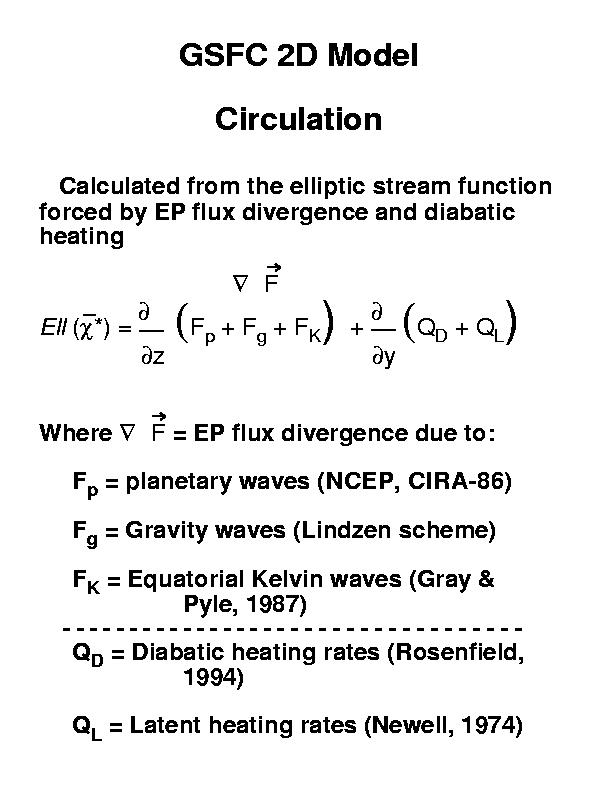
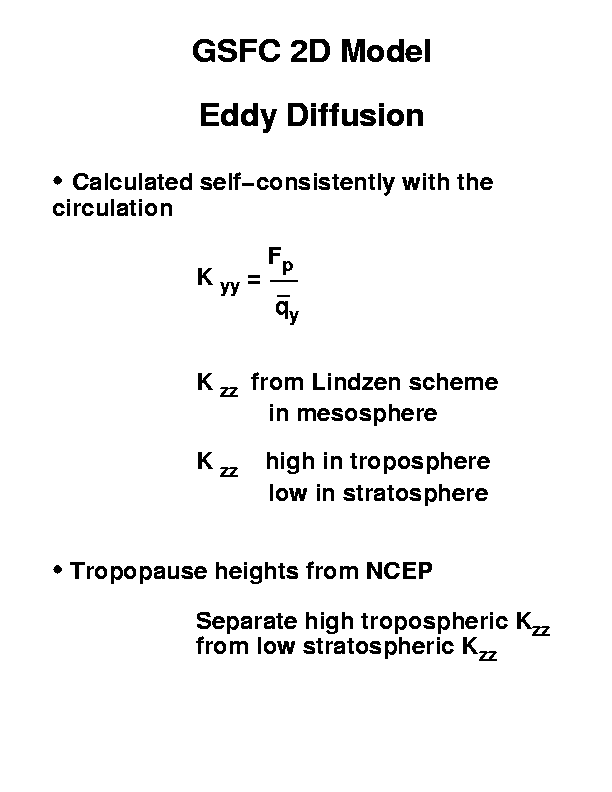
| 
|
| Chemical Constituents | Constituent List | |
Scientific Studies Using 2D Model
Interannual Variability of OzoneOzone History Since 1850