
ANALYSIS:
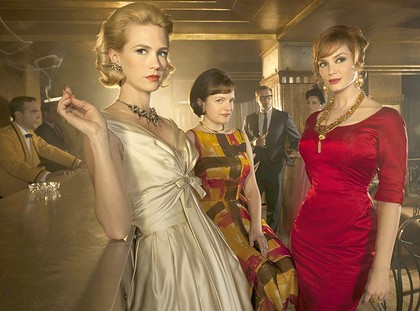
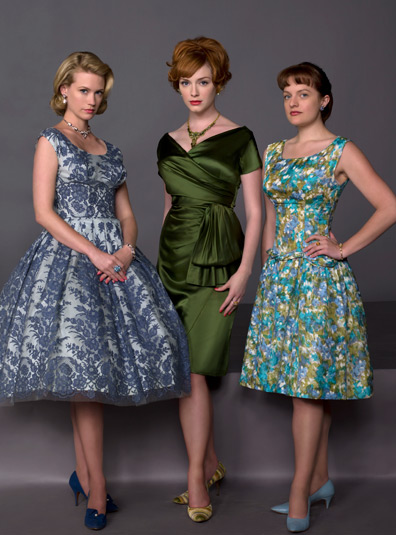
Mad Men provokes the audience with its “truthful” representation of women in their large conflict with gendered roles. Mad men delves into the viewer’s relatedness to the set gendered roles for women, touching female viewers emotionally and mentally. Questions like: How are the viewers intended to feel when seeing these characters’ intimate moments in juxtaposition with the actual behaviors the characters convey to their coworkers in the workplace/ society? How are the female viewers intended to feel when watching this “truthful” portrayal of women in the 1960s? Why do the viewers tend to categorize themselves within the context of the layers of representation fulfilled through the character roles? will be addressed. Through the characters, Peggy Olson, Joan Halloway, and Betty Draper, the viewers’ relatedness and gravitated emotions as well as the perspective during the 60s and today will be analyzed.
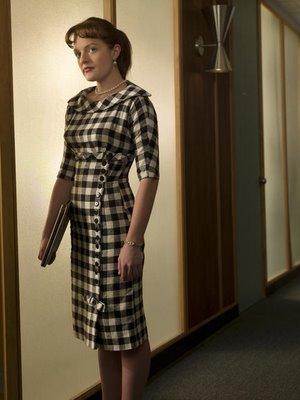
PEGGY OLSON: THE NEW GIRL
In the first episode of Season 1, Smoke gets in your Eyes, Peggy experiences her first day of work in the advertising firm, Sterling Cooper Inc. At first encounter, she immediately finds the organizational environment daunting: secretaries are to be their boss’ mothers/wives/and everything else in between (in other words, sexual favors). It is the extreme definition of gendered roles where the men dominate the system. The organizational culture describes Karen A. Cerulo’s we-ness of a group, where the term “stresses the similarities of shared attributes around which members coalesce” (390 Cerulo). According to Cerulo, “A collective’s members were believed to internalize these qualities, suggesting a unified, singular social experience, a single canvas against which social actors constructed a sense of self” (391 Cerulo). This is the concept that encourages gendered roles. She bases this concept upon social constructionism, a term that describes “gender as an interactional accomplishment, an identity in itself” (393 Cerulo). The maleness and femaleness of an individual shapes the behavior with regards to “gender scripting attitudes, emotions, language, and treating these scripts as natural signals, ensuring that social members both succumb to and recreate the ‘armor’ of gender identity stereotypes” (394 Cerulo) Postmodernists view this in a different way, stating that identity categories are solely created through interactive effort. It is “only after negative reactions from peers, the media, or social intuitions like schools do many of these children begin to like or take on the gender roles” (2 Holt). In this sense, Peggy is paralleled to a child, finding out what the culture is and beginning to take on the gender role to the fullest extent. In this episode, Peggy visits the gynecologist for access to birth control, understanding that she may need to use it in the future for her job. Her gendered role is constructed through the “modeling of appropriate behaviors and the use of systematic rewards and punishments” as she’s kind to the men in the office in the hopes of receiving the ultimate reward, equal treatment (2 Holt).
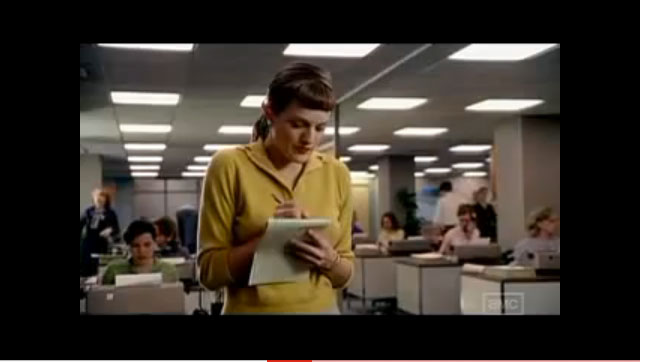
Peggy is also told to cut eyeholes out of a brown paper bag and look at herself in a mirror, to evaluate her “strengths and weaknesses” in terms of external appearance. This addresses the element of dependency on outer appearance of the woman in the workplace that is still apparent today. According to Cerulo, “the style of dress, use of language, and expressions of emotions reinforce representations of what is masculine and feminine, widening further the divisions of gender within the organization” (400 Cerulo). The interactions accumulate to subtle expectations in maleness and femaleness forms, which results to the exclusion of women in the workplace environment. According to Jaime Lester in Performing Gender in the Workplace: Gender Socialization, Power, and Identity Among Women Faculty Members in a 1996 ethnographic case study, Arlene, a female professor, describes her experience with dress:
The first day I went to teach a class I had on some good 3-inch heels, pumps with a suit, Ann Taylor or something. A silk blouse and it was a light silver. My nails were done. It was my first day of class, and I was 21, and the students came in saying, “Where is the instructor?” I said I was the instructor and they said, “You. It is not bad enough that they gave us a lady but you have on heels.” There was this one guy I will never forget when I was at Urban College. He was Hispanic and said, “I know this is…so they just gave us anybody, but it is bad enough that they would go and give us a lady and she has the nerve to have on a skirt” (280 Lester)
Arlene today is a welder; a woman who wears a black, long–sleeve shirt to cover her arms for work, which is a more masculine clothing than what she had worn in the previous occasion. She admits that she puts on a “tough performance” in the workplace while at home she is more “herself,” which leads to the sign of acting like a man to gain respect.
According to Lester in his account of Tierney and Bensimon’s study (1996) of promotion and tenure practices that “women faculty members perceive that they are expected to perform “mom” [behaviors] and “smile” [tendencies at] work, maintaining a caring and nurturing demeanor while also avoiding confrontation (381 Lester). Rosa, another individual in the study, describes how she hides her feminine identity and maintains a tough persona to gain respect among her colleagues and students. Peggy also acts similarly with her feminist ideals when Don tells her to find a way to work with her coworker, Stan who is more experienced and a chauvinist. Stan and Peggy need to complete a project and get locked in a hotel room for a weekend. When Stan expresses his overt masculine tendency about becoming a nudist and reading Playboy, Peggy steps up to the challenge and suggests they work nude.
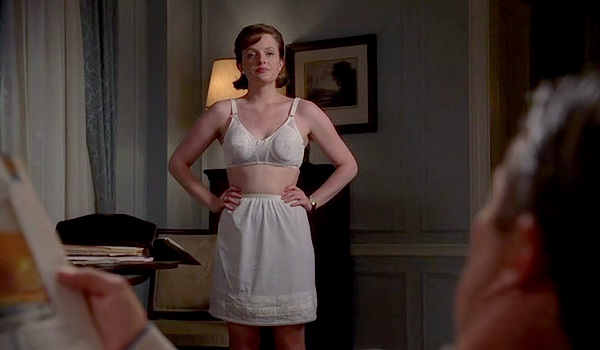 Clip from Season 1, Episode 4
In terms of viewer relatedness to the characters’ roles, many of the viewers feel empathy for Peggy in the sense of the man dominating culture in the workplace.
With Peggy, I can relate to her desire to focus on her creative career instead of raising a family. Unfortunately, I feel like the lesson here is that in order to achieve the coveted male driven focus, we have to act like men. Instead of encouraging Peggy to be an expressive woman in her own way, she is expected to act more like a man. She is scolded for crying and she is encouraged to hide her emotions, which are deemed irrational. While men can be hot-tempered and also irrational, it's seen as a sign of power, not as an abuse of emotion. This is a problem I face a lot in the workforce. I think in general there are differences between how men and women function and unfortunately our differences can be viewed as flaws instead of attributes. (AMCtv Group Forum)
Chloe in the AMCtv group forum states,
I relate to the characteristics displayed through Peggy such as the need to prove yourself as a woman who deserves to be in the workplace through intelligence and creativity, not by using your femininity and sexuality. Although, I've been raised in the third wave of feminism, so I'm proud to be female and it is part of my identity, but I don't see it as a means to an end in the workplace. (AMC Group Forum)
Lorna Moir also states in the forum,
I can relate to Peggy. I also came from a sheltered background, had better manners and was raised with honesty (the lying was rampant and the taking credit for people's work who did not CYA was too...) so when I started my career in NYC I was, like Peggy, bowled over by the behavior of some of the people I was expected to see as being my mentors. Like Peggy, I adjusted as quickly as I could, but in my head I can still recall all of the OMG moments I had! (AMC Group Forum)
Through these posts, the viewers are connected with Peggy’s character through their own recollected experiences. The female viewers understand the situation, how Peggy feels about these issues, and how she handles herself in difficult times.
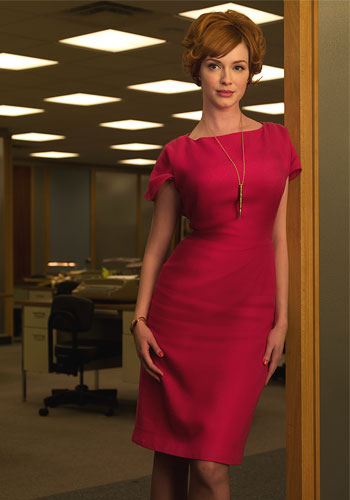 JOAN HALLOWAY: THE MARILYN
Joan Halloway is the Marilyn, a sub categorization of her gendered role in society, created by the men of the advertising industry between the Marilyn and the Jackie. Joan represents herself as a sex symbol, for example in Season 1, Episode 5, while Joan is prepping the lipstick counter for the women during a study for the company, she accentuates her figure by bending over towards the set camera in perfect view for the men in the workplace to admire her form. The men salute her through the “invisible” mirror as they conduct this study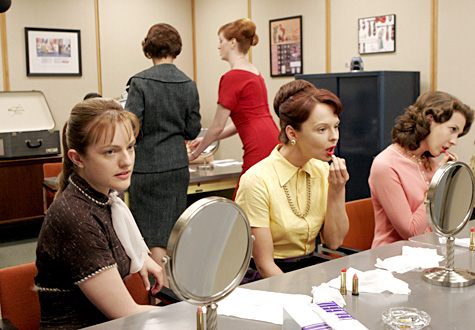
Female viewers relate to Joan in various ways: for example, one username relates to her in her bodily form as well as the need to present herself in an attractive manner.
With Joan, I can absolutely understand the want to evoke power through sexuality. My figure matches Joan's pretty well and I have often felt a hidden desire to "cheat" my way into a better life using my physical "assets". The problem of course with this is perpetuating the idea of woman as a sexual fantasy. We've learned to accept this of men, the realness of being flesh and blood. But we remain in the fantasy and I have to say, by going to the salon once a week to get our nails done, by wearing uncomfortable heels to make our legs look long and lean, and by giving in to the fashion and diet fads, we are constantly perpetuating this idea of woman as the mythical fantasy creature we see in the magazines. (AMCtv Group Forum)
Another female viewer understands Joan’s maternal side conflicting with her workplace persona and the difficult solution of having both worlds.
I feel most drawn to Joan because I loved, in the early seasons, her confidence. It's intriguing watching her now, as the world shifts and her base of power (her sexuality) is diminishing due to her age and being married, and due to changing attitudes about women in the workplace. Watching her struggle with desiring the pattern of leaving work to be a wife and mother and not getting that opportunity resonates, because I and most of the women I admire and work with, when we have kids, we don't really have the option of not working - it takes mom and dad BOTH bringing money into the household to keep everything going. And sometimes it just frustrates us. (AMCtv Group Forum)
“Wasthere,” a participant in the forum, relates to Joan in the bodily and symbolic sense. She placed herself as the equivalent if not parallel to Joan in terms of appearance, authority in the workplace, and issues with sexual harassment.
I definitely identify myself with Joan, as I looked like her and was built like her in the 1960's, except my hair was dark. I also had a similar position in the corporate world: Executive Secretary while being supervisor over several secretaries and file clerks. I got a lot of wolf whistles and crazy nicknames, but unlike today (sexual harassment) I didn't mind it. I did, however, have one real case of sexual harassment by a boss, and when I asked HR to give me a transfer, they pumped me into telling why, saying it would be confidential. Then I was fired soon after. This, of course, was before it was illegal. (AMCtv Group Forum)
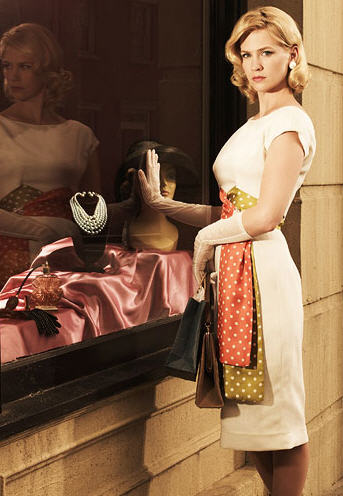 BETTY DRAPER: PERFECT HOUSEWIFE
According to Jennifer Holt in Ideal Woman, the suburb domestic caregiver was “a tenacious stereotype that conjures mythic images of culture icons- June Cleaver, Donna, Reed, Harriet Nelson- the quintessential white, middle class housewives who stayed at home to rear children, clean house and bake cookies” (2 Holt). This stereotype was considered to be the proper gender role in society. Again, gender was “constructed through the modeling of appropriate behaviors and the use of systematic rewards and punishments” (2 Holt). Betty, throughout her life, was modeling this stereotype. She is the southern belle who graduated from a prestigious university then went straight into modeling as a profession where she met Don Draper, her husband. She received rewards in the form of security from Don, while she received punishment in the form of absence at the house from her husband. Either way, her gendered role was doomed from the very start. She is depicted in Mad Men as the unhappy housewife who frequently goes to the therapist for her depression.
The viewers relate to her in complete empathy. Jacquelyn1111 states,
“I empathize with Betty's mistrust of men and the emptiness she seems to carry with her. In fact, it seems her liveliest (I wonder if even the most fulfilling) moments were when she was helping to organize the women in a political stance (where she met her soon to be hubby). But instead of continuing on this driven political path, she remarries and finds herself lost again, no longer having a philandering man to blame for her depression.” (AMCtv Group Forum)
Another viewer relates to Betty’s character in the sense of the utmost importance of appearance,
“I was born around the time of Bobby Draper but I most closely identify with Betty. My mother was very similar to Betty until she finally divorced my dog of a dad in the 60's. Unlike Betty, my mom went to work and supported us. Like Betty my mom had been brought up to believe that her looks were of the utmost importance and she had been taught to properly run her household. So I understand Betty's beauty and perfectionism............and her sadness.” (Trish, AMCtv Group Forum)
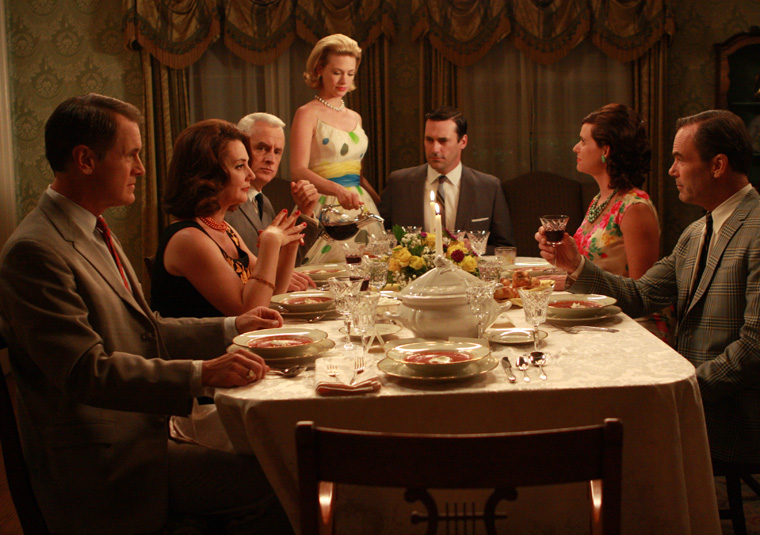
In all these accounts, one single viewer relates to the characters’ roles in terms of their experiences and past situations. However, it is important to note the collective identity of the audience in relation to the television series. The AMCtv forums and blogs show the encouragement and differing opinions among the viewers in terms of sharing past experiences, whether they are skimming the surface anecdotes or deep personal stories. The viewers, as a group, try to understand these characters and their layers of representation. For example: Betty’s condition is not specifically understood. Is she depressed? Did a traumatic incident happen during her childhood period? Why is she acting in a certain manner? These mysteries about the characters roles’ themselves encourage the viewers to group together in the attempt to understand the characters.
CONCLUSION:
Fridan states in the Feminine Mystique, that the “feminine mystique held that women could find fulfillment only in sexual passivity, male domination, and nurturing maternal love. It denied women a career or any commitment outside the home and narrowed woman’s world down to the home, cut her role back to the housewife” (124 Peltola). In this sense, the “sexual passivity” refers to Joan’s situation, the “male domination” in the workplace for Peggy’s issue, and “maternal love” in terms of Betty’s conflict. This gendered role conflict is still present today as Katherine from the AMCtv blog states,
“We have been told we can have it all and do it all and anything less indicates some sort of failure. It is not enough to be "just" a mother or "just" have a career, not enough to be nurturing or professional or great in the sack. To be a true modern woman, you have to be all of the above.” (AMCtv Group Forum)
Mad Men provokes the female viewer in the sense that the viewer still encounters situations that have the same basis and premise to their meaning. The television series allows the female viewer to reflect and interlink her life with the lives of the characters’ roles as well as the situations that seem to conform them.