
ETHNOGRAPHY:
Mad Men reflects upon the large theme of gender roles, between the men and women, within the environment set in the 1960s. The television series expresses the different roles women are expected to fulfill, in respect to “The Perfect Housewife/Mother,” “The Perfect Secretary,” and “The New Girl,” with subcategories such as, “The Marilyn” or the “Jackie.” (Reference to Marilyn Monroe and Jacqueline Kennedy, the two largest icons of the times.) Women in the 1960s and even the women of today are struggling to keep afloat in a man-dominated world. With information from the producer’s perspective, personal accounts from selected viewers of the show, social networks and bloggers (discussants) participating in the official Mad Men forums, and multiple journals and case studies about feminism and identity issues, the theme of female viewers’ identity in relation to the women characters in Mad Men set in the 1960s will be analyzed.
The producer and editor, Michael Weiner, intended to captivate the audience with the true historical precedents of the 1960s, specifically the attention to racism and gender roles. Delving into gender roles, he categorized the differing women’s roles in terms of the “Perfect Housewife/Mother,” the “Perfect Secretary,” “The New Girl,” and added iconic figures, “The Marilyn” and “The Jackie.” In doing so, he utilized the television series in a matter-of-factly distance, however at the same time allowing the spectator to view intimate moments of these characters’ lives. Character by character, and scene by scene, we are allowed to look at different angles and sides of their personalities, which were cultured and transformed within their gender boundaries. However, the lines of these boundaries are tested as the women characters face difficult and situational challenges that occurred during the 1960s: abortion, birth control, increasing educational opportunities for women, concept of divorce, knowledge of smoking hazards, politics, wars, and the influence of pop culture. Weinar allows us to sift the theme over in our minds, almost forcing us to reflect and feel empathy for the characters for we, the female viewers of the 21st century, understand similar situations and realize paralleled approaches and thought processes in regard to ours. This generalization is based upon the assumption that American women in the contemporary have lived through the second-wave feminism and in addition, the modern day “comical” attitude on gendered roles. When asked about how Weinar is describing women in his series, “I think of a man and then take away reason and accountability.” In terms of personal narratives of the other side, I will interview various viewers of Mad Men in their perspective of the theme.
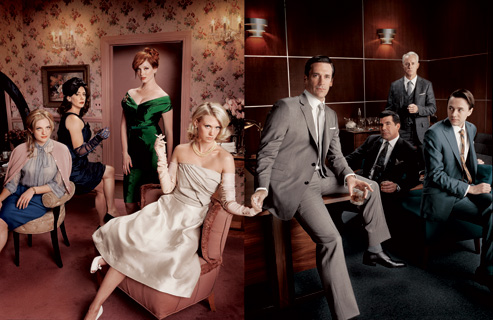
There is an apparent group identity with Mad Men, evidence from the blog discussions and open forums on the AMCtv website. The forum users express the following: understanding the identities of each character (placing themselves in these categories), exchanging ideas of the themes of each episode, and planning future posts. The site encourages a more group-oriented image of Mad Men in the presentation of themes, paradoxical in a sense because one could argue that Mad Men has created an almost pop culture but at the same time separating different class in the way they relate to each character. The show allows the viewers to pinpoint the many layers of representation and symbolism that becomes too complex to describe. In addition, the older viewers may feel a certain nostalgia in the times due to the accurate settings. In terms of the younger generations, the series creates nostalgia, rather a longing, for a “simpler” time where everything was black and white, instead of shades of grey. Another group identity noted is the effort to understand Betty Draper’s character, the “Perfect Housewife/Mother” who is always anxious and depressed throughout the show.
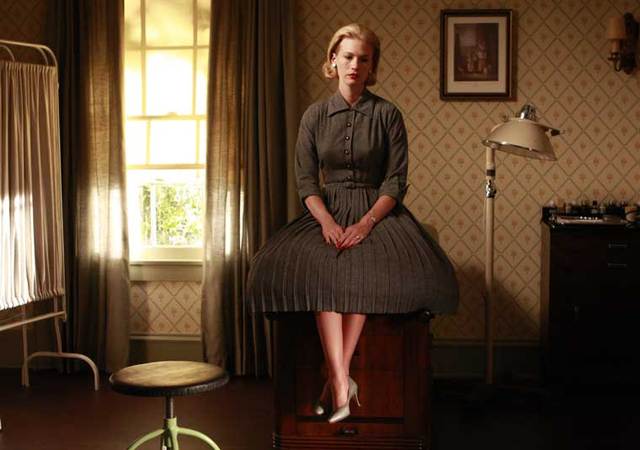
In Season 2, Betty is shown wearing a two-piece bathing suit as she makes breakfast for the children before going to the pool. Don Draper, the husband and the protagonist of the show, orders her to change immediately into “something more modest,” confused and angry. The frame shifts to Betty as she is left standing in the middle of the kitchen, hurt and ashamed. She is not allowed to be the “Marilyn,” because she was already categorized as the “Jackie.” “Her role was much too narrow to allow such breadth of expression” (1 Elise). This leads to Thomas D. Kennedy’s Curiosity and the Integrated Self: A PostModern Vice in his example of Kenneth Gergen’s anecdote where Gergen describes a friend’s experience while shopping with her daughter. The daughter wants the friend to buy a certain dress but the friend decides not to buy it because it wasn’t her. The daughter’s response was, “but mom that isn’t the point. With that dress you would really be somebody.” The mother already knew her category and was already conditioned to not wear a certain piece of clothing, while the daughter who was about to go to college was in the process of finding her identity. Kennedy theorizes that there is a difference between the postmodern self and the premodern/modern self,
“…what premodern and modern selves take to be inconsistencies and incoherencies of character, conduct, and belief, the postmodern self takes to be adaptations, alterations, and additions to the bricollage we each are.”
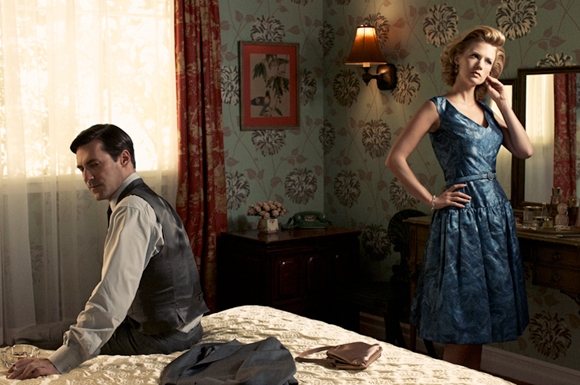
This is the reason why Don was so angry; he is in the premodern/modern era while Betty is trying to convert to the postmodern era. Betty’s feelings and external stature seem to be mediated by Don, a common theme of the Mad Men series; men mediating women.
In Gender Socialization, Power, and Identity Among Women Faculty Members, Jaime Lester conducts an ethnography case study on three different women in the academic workforce with high female representatives as well as women from lower vocational departments. Utilizing data reduction and interpretation analysis, she theorizes, “the participants actively managed their gender performance to suit the gender roles while maintaining and hiding their gender identity. At other times, the participants adopted those roles as identities, thus constructing new, complex gender identities.” Rosa, an architecture professor states,
“Yes, I get a lot of people from industry, and they need to understand that I take my job seriously. It is unfortunate, but automatically when they see you are a woman, they don’t take you seriously. There’s a certain seriousness and distance that you need to keep…. I can be more compassionate and loving at home.”
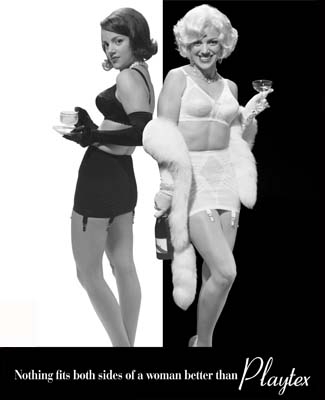
This parallels with Peggy Olson, the “New Girl” who tries to set herself equal to the advertising men. In Season 2, the “Maidenform” episode, Peggy is left out of the creative process in the Playtex campaign. She was told by Joan to “stop dressing like a little girl” if she wanted to live in “their” world. Peggy, trying to receive an equal treatment like the rest of the boys, shows up inadvisably for celebratory drinks at a strip club. In this episode, the women’s underwear manufacturer proposes, “there are two kinds of women- Marilyns and Jackies.” Peggy internally asks, “Which category do I fit into?” which becomes an issue as she is the only female “ad man” (AMCtv) in the agency. Iin one episode, Don states that Peggy is the “Irene Dunn,” a “long suffering, reliable, all American, girl next door who has found some success.” Peggy expresses her frustration to Don as she says, “I want what you have,” in the sense of established family, job, connections, and friends. However, it is apparent that this idea is not feasible because she is a woman. She is the complex character who becomes a feminist in the progression of the seasons, between Joan Harris and Betty Draper.
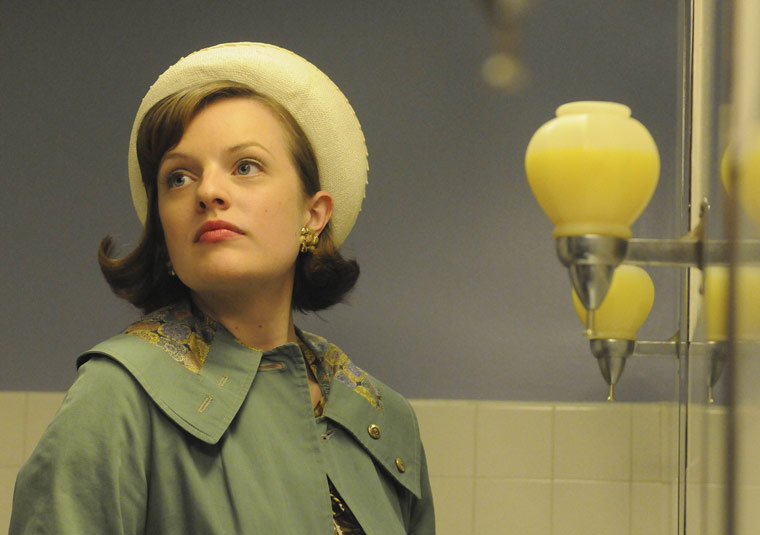
In terms of the identification with the characters, interlinking the modern times to the 1960s, AMCtv forums provide much research. For example, Chloe states,
I relate to the characteristics displayed through Peggy such as the need to prove yourself as a woman who deserves to be in the workplace through intelligence and creativity, not by using your femininity and sexuality. Although, I've been raised in the third wave of feminism, so I'm proud to be female and it is part of my identity, but I don't see it as a means to an end in the workplace.
For some women, they relate to each character, taking their bits and parts to achieve a holistic complex identity. Jacquelyn111 says,
“I empathize with Betty's mistrust of men and the emptiness she seems to carry with her. In fact, it seems her liveliest (I wonder if even the most fulfilling) moments were when she was helping to organize the women in a political stance (where she met her soon to be hubby). But instead of continuing on this driven political path, she remarries and finds herself lost again, no longer having a philandering man to blame for her depression..”
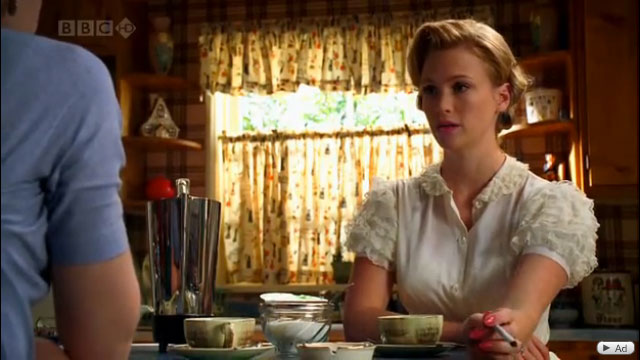 Season 1, Episode 2.
For Peggy,
“I can relate to her desire to focus on her creative career instead of raising a family. Unfortunately, I feel like the lesson here is that in order to achieve the coveted male driven focus, we have to act like men. Instead of encouraging Peggy to be an expressive woman in her own way, she is expected to act more like a man. She is scolded for crying and she is encouraged to hide her emotions, which are deemed irrational. While men can be hot tempered and also irrational, it's seen as a sign of power, not as an abuse of emotion. This is a problem I face a lot in the workforce. I think in general there are differences between how men and women function and unfortunately our differences can be viewed as flaws instead of attributes.
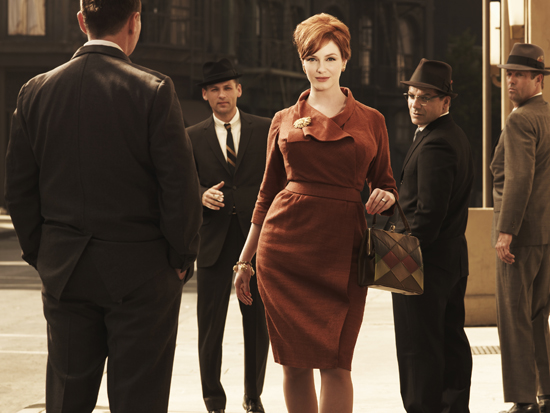
With Joan,
“I can absolutely understand the want to evoke power through sexuality. My figure matches Joan's pretty well and I have often felt a hidden desire to "cheat" my way into a better life using my physical "assets". The problem of course with this is perpetuating the idea of woman as a sexual fantasy.”
There is much to be said about the theme of women segregation in all aspects and categories. Through shared experience, viewers are more open to state their opinions and express their stories through the forums and through articles/anthropological and ethnographical journals, the basic aspects of identity will be revealed. In addition, through personal accounts, the intentions and the effects of these intentions will also be analyzed.