
Ethnography
In describing the ideological premise behind the Sesame Street project, co-founder Joan Ganz Cooney emphasizes that the crucial issue to consider is “not whether children learn from television. It’s what children learn from television.”1 I would like to take this conception of television as a starting point for my analysis of how international development is understood through the Sesame Street model. However, before any attempt is made to understand the grander processes behind this public television venture, it is important to understand what exactly is at work within the production of a specific country’s program. As I mentioned previously, I will be presenting case studies of the South African and Israeli models of Sesame Street for the purposes of illuminating these processes.
The “Takalani Sesame” theme song, shown in the adjacent video, opens with a whimsical cartoon train soaring past a local village and rural landscapes. A cast of children of mixed ethnicities jump and play together, and images of adults in traditional garb and brightly colored Muppets in a local marketplace set the scene for a diverse and joyful episode. While only 45 seconds long, this clip is in many ways representative of the entire process of production involved in the South African program. Most importantly, scenes like this video were designed, scripted, and produced through the efforts of local educators, actors, and innovators (as seen in the picture below).2 A key element to the adaptation of the Sesame Street model, the collaboration between Sesame Street executives and local team members is designed to produce a culturally relevant and socially contextualized program that is representative of the issues that local children face.3 This intention has been made evident in the production of “Takalani Sesame,” and local producers of the show like Seipati Bulani-Hopa feel that the program “show[s] children the different images, the different visuals that go with South Africa…[and] Takalani Sesame gave us an opportunity to create a bigger presence for an African vision.4
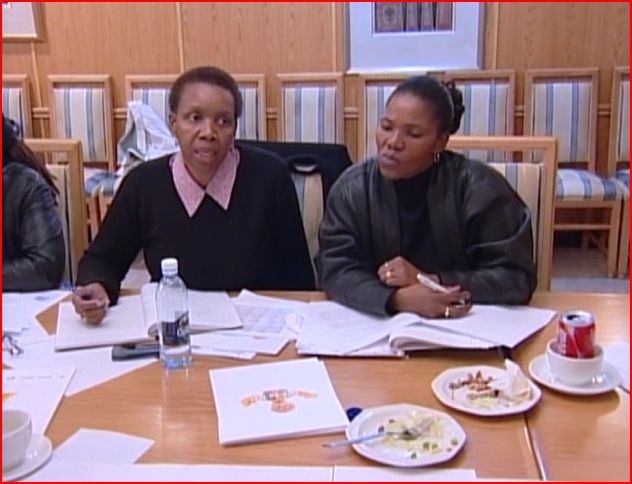
South African educators develop program.
(Screenshot: The World According to Sesame Street)
The efficacy of the intervention by local workers is made clear not only through the formatting of the show (as evidenced by factors of visuality and design within scenes like the opening song), but also through the elements of South Africa’s reality that are mediated through the child-friendly episodes of “Takalani”. Perhaps the most profound example of this is the inclusion of Kami, an HIV-positive Muppet, whose entrance into the show was not without controversy. However, despite these trepidations, the project manager for Takalani Sesame claims that “ultimately, the decision was made to do this to respond to the needs of the local community, and we implemented our Sesame process of bringing together educators…people who work in this area, and creating what was in essence the first preschool HIV/AIDS curriculum.”5 The creation of Kami, however, is representative of something much larger than the ability of the show to address pressing issues of a local community; it is a symbol of the utilization of the standardized Sesame Street model for local purposes. As Yvonne Kagame from the South African Broadcasting Company points out, “the question for me at a professional level was, here’s a vehicle that is tested, that has a history of success…why not then use that…to address what is very critical for the country , and at this particular time is issues of HIV and AIDS.”6 I will address this understanding of how the international model for a Sesame Street program is conceptualized as a medium through which a television show is able to address local issues further in my analysis.
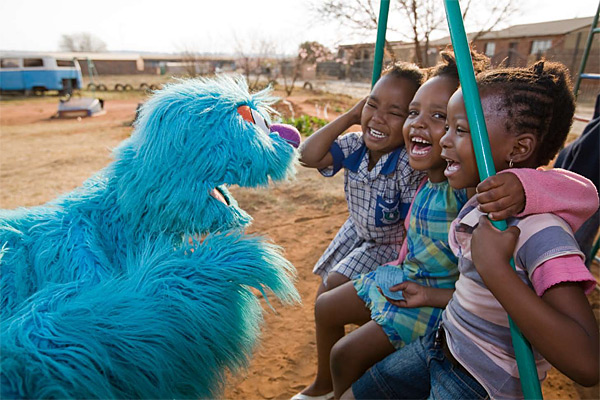
Credit: Sesame Workshop
Beyond the efficacy of local producers in impacting the development of the program, it is also crucial to understand the effects of the program on its target audience; without results, international development is merely theoretical optimism. Studies tracking the educational development of South African children after immersion in the “Takalani Sesame” program noted significant gains in literacy, life skills, HIV/AIDS knowledge, and self-esteem.7 Beyond these statistical improvements, “Takalani Sesame” has garnered international praise, with Kami the Muppet even being awarded the title of “Champion for Children” by UNICEF.8 I would like to pursue the significance of this international award in the context of the mediation of international development later; however, for the moment, an understanding of the impact “Takalani Sesame” has had upon South Africa and the world is sufficient.
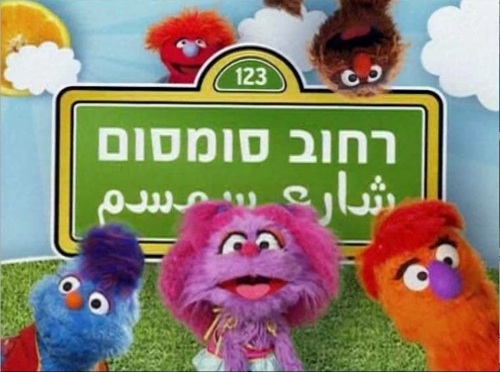
In contrast to the relatively localized focus of “Takalani Sesame”, the Israeli development and production of “Rechov Sumsum” is a testament to the inherent political and international nature of attempting to produce a localized show based on a global model. Faced with the daily violence and discrimination inherent in Israel’s existence, the producers of the show initially attempted to produce “Rechov Sumsum” jointly with a Palestinian program in an attempt to begin the healing process for these two countries.9 While “Rechov Sumsum” made a concerted effort to inspire tolerance of Palestinians, it became clear that the Palestinian producers were unwilling to do the same. While the original intent of this collaboration was to create a program that promoted cross-cultural tolerance and understanding, in the end the Palestinian and Israeli team members were unable to effectively overcome their own issues with each other, and the programs suffered.10 Unfortunately for the television model of Sesame Street that holds its apolitical status in high esteem, the case of Israeli-Palestinian conflict and its effects on the programs represent an inability for politics to be absent from the arena of international mediation.
However, while this co-production was unsuccessful, “Rechov Sumsum” continued to develop and adapt the Sesame Street model to introduce tolerance of diversity and sensitivity towards political conflict in a localized context. The adjacent video portraying the opening theme song of “Rechov Sumsum” depicts Arab-Israeli and Jewish-Israeli children playing together, and the wording of the song is representative of the local culture and values of tolerance and peace. The show itself celebrates the broad diversity of Israel’s population by incorporating Arab, Jewish, Russian-Israeli, and Bedouin characters, often working together in scenes of conflict resolution.11 This programming content has resulted in palpable developments within the viewer population; in a study established to analyze the effects of “Rechov Sumsum”, “Israeli children (both Jewish Israeli and Arab-Israeli children) displayed an increase in the use of positive attributes toward children from the other culture,” after immersion in the television program.12
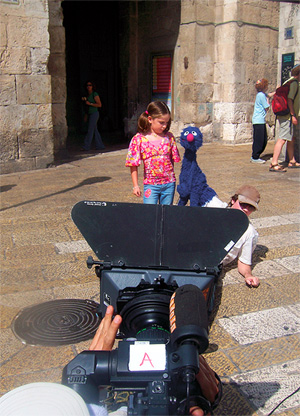
Credit: Nathan Jeffay, Jewish Daily Forward
This societal impact finds its roots in the collaboration between the Sesame Street staff and local television executives like Alona Abt, who claims that “on Rechov Sumsum, we present children with reality as it can be. Reality as we aspire for it to be.”13 Actor Dror Keren, who plays a neighborhood resident on the show, also emphasizes that “we’re living in an extreme period. We deal [on the show] with sensitive issues like tolerance, and we say our lines with warmth and caring for one another . . . It’s beyond politics.”14 While I am inclined to contest Keren’s claim of the transcendence of “Rechov Sumsum” beyond the realm of politics, it is clear that the production of this television series is both representative of the wishes of local producers and efficacious in producing educational and social development among its viewership. (Picture to right: filming episode of Rechov Sumsum in front of Jaffa Gate)
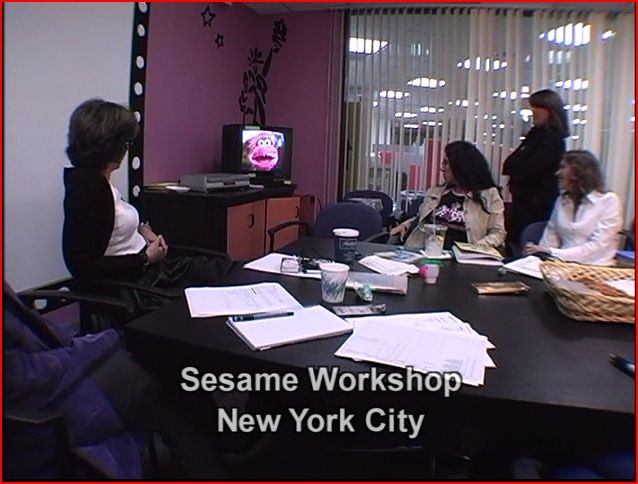
Sesame Street executives edit and develop program.
Screenshot: The World According to Sesame Street
“These aren’t American values. These could be African values. These could be Indian values…”15 This praise of the international malleability of this program by a Sesame Workshop executive is in my opinion highly indicative of the conception of the mediation of international development as represented by the Sesame Street model. While I make no claims about the direction which Sesame Street should take in its future endeavors based upon these local examples, it is crucial to contextualize “Takalani Sesame” and “Rechov Sumsum” within an understanding of international mediation, which I will pursue further in my analysis.
Ethnography
In describing the ideological premise behind the Sesame Street project, co-founder Joan Ganz Cooney emphasizes that the crucial issue to consider is “not whether children learn from television. It’s what children learn from television.”1 I would like to take this conception of television as a starting point for my analysis of how international development is understood through the Sesame Street model. However, before any attempt is made to understand the grander processes behind this public television venture, it is important to understand what exactly is at work within the production of a specific country’s program. As I mentioned previously, I will be presenting case studies of the South African and Israeli models of Sesame Street for the purposes of illuminating these processes.
The “Takalani Sesame” theme song, shown in the adjacent video, opens with a whimsical cartoon train soaring past a local village and rural landscapes. A cast of children of mixed ethnicities jump and play together, and images of adults in traditional garb and brightly colored Muppets in a local marketplace set the scene for a diverse and joyful episode. While only 45 seconds long, this clip is in many ways representative of the entire process of production involved in the South African program. Most importantly, scenes like this video were designed, scripted, and produced through the efforts of local educators, actors, and innovators (as seen in the picture below).2 A key element to the adaptation of the Sesame Street model, the collaboration between Sesame Street executives and local team members is designed to produce a culturally relevant and socially contextualized program that is representative of the issues that local children face.3 This intention has been made evident in the production of “Takalani Sesame,” and local producers of the show like Seipati Bulani-Hopa feel that the program “show[s] children the different images, the different visuals that go with South Africa…[and] Takalani Sesame gave us an opportunity to create a bigger presence for an African vision.4
|
| South African educators develop program. |
| (Screenshot: The World According to Sesame Street) |
The efficacy of the intervention by local workers is made clear not only through the formatting of the show (as evidenced by factors of visuality and design within scenes like the opening song), but also through the elements of South Africa’s reality that are mediated through the child-friendly episodes of “Takalani”. Perhaps the most profound example of this is the inclusion of Kami, an HIV-positive Muppet, whose entrance into the show was not without controversy. However, despite these trepidations, the project manager for Takalani Sesame claims that “ultimately, the decision was made to do this to respond to the needs of the local community, and we implemented our Sesame process of bringing together educators…people who work in this area, and creating what was in essence the first preschool HIV/AIDS curriculum.”5 The creation of Kami, however, is representative of something much larger than the ability of the show to address pressing issues of a local community; it is a symbol of the utilization of the standardized Sesame Street model for local purposes. As Yvonne Kagame from the South African Broadcasting Company points out, “the question for me at a professional level was, here’s a vehicle that is tested, that has a history of success…why not then use that…to address what is very critical for the country , and at this particular time is issues of HIV and AIDS.”6 I will address this understanding of how the international model for a Sesame Street program is conceptualized as a medium through which a television show is able to address local issues further in my analysis.
|
| Credit: Sesame Workshop |
Beyond the efficacy of local producers in impacting the development of the program, it is also crucial to understand the effects of the program on its target audience; without results, international development is merely theoretical optimism. Studies tracking the educational development of South African children after immersion in the “Takalani Sesame” program noted significant gains in literacy, life skills, HIV/AIDS knowledge, and self-esteem.7 Beyond these statistical improvements, “Takalani Sesame” has garnered international praise, with Kami the Muppet even being awarded the title of “Champion for Children” by UNICEF.8 I would like to pursue the significance of this international award in the context of the mediation of international development later; however, for the moment, an understanding of the impact “Takalani Sesame” has had upon South Africa and the world is sufficient.
In contrast to the relatively localized focus of “Takalani Sesame”, the Israeli development and production of “Rechov Sumsum” is a testament to the inherent political and international nature of attempting to produce a localized show based on a global model. Faced with the daily violence and discrimination inherent in Israel’s existence, the producers of the show initially attempted to produce “Rechov Sumsum” jointly with a Palestinian program in an attempt to begin the healing process for these two countries.9 While “Rechov Sumsum” made a concerted effort to inspire tolerance of Palestinians, it became clear that the Palestinian producers were unwilling to do the same. While the original intent of this collaboration was to create a program that promoted cross-cultural tolerance and understanding, in the end the Palestinian and Israeli team members were unable to effectively overcome their own issues with each other, and the programs suffered.10 Unfortunately for the television model of Sesame Street that holds its apolitical status in high esteem, the case of Israeli-Palestinian conflict and its effects on the programs represent an inability for politics to be absent from the arena of international mediation. However, while this co-production was unsuccessful, “Rechov Sumsum” continued to develop and adapt the Sesame Street model to introduce tolerance of diversity and sensitivity towards political conflict in a localized context. The adjacent video portraying the opening theme song of “Rechov Sumsum” depicts Arab-Israeli and Jewish-Israeli children playing together, and the wording of the song is representative of the local culture and values of tolerance and peace. The show itself celebrates the broad diversity of Israel’s population by incorporating Arab, Jewish, Russian-Israeli, and Bedouin characters, often working together in scenes of conflict resolution.11 This programming content has resulted in palpable developments within the viewer population; in a study established to analyze the effects of “Rechov Sumsum”, “Israeli children (both Jewish Israeli and Arab-Israeli children) displayed an increase in the use of positive attributes toward children from the other culture,” after immersion in the television program.12
|
| Credit: Nathan Jeffay, Jewish Daily Forward |
This societal impact finds its roots in the collaboration between the Sesame Street staff and local television executives like Alona Abt, who claims that “on Rechov Sumsum, we present children with reality as it can be. Reality as we aspire for it to be.”13 Actor Dror Keren, who plays a neighborhood resident on the show, also emphasizes that “we’re living in an extreme period. We deal [on the show] with sensitive issues like tolerance, and we say our lines with warmth and caring for one another . . . It’s beyond politics.”14 While I am inclined to contest Keren’s claim of the transcendence of “Rechov Sumsum” beyond the realm of politics, it is clear that the production of this television series is both representative of the wishes of local producers and efficacious in producing educational and social development among its viewership. (Picture to right: filming episode of Rechov Sumsum in front of Jaffa Gate)
|
| Sesame Street executives edit and develop program. |
| Screenshot: The World According to Sesame Street |
“These aren’t American values. These could be African values. These could be Indian values…”15 This praise of the international malleability of this program by a Sesame Workshop executive is in my opinion highly indicative of the conception of the mediation of international development as represented by the Sesame Street model. While I make no claims about the direction which Sesame Street should take in its future endeavors based upon these local examples, it is crucial to contextualize “Takalani Sesame” and “Rechov Sumsum” within an understanding of international mediation, which I will pursue further in my analysis.