There are lots of events these days to celebrate the ten-year anniversary of the discovery of gravitational waves. The LIGO Magazine has a wonderful special issue on the topic.
I just came back from the XXVI SIGRAV Conference on General Relativity and Gravitation (SIGRAV2025), that was held at the University of Milano-Bicocca in Italy. Together with Marco Drago (the first person to report the GW150914 signal) and Fulvio Ricci (who at the time was the spokesperson of the Virgo Collaboration), I took part in a public event to celebrate the discovery.

I also wrote up some of my thoughts for an upcoming special edition of the Portuguese Physical Society’s Gazeta de Física dedicated to gravitational waves.
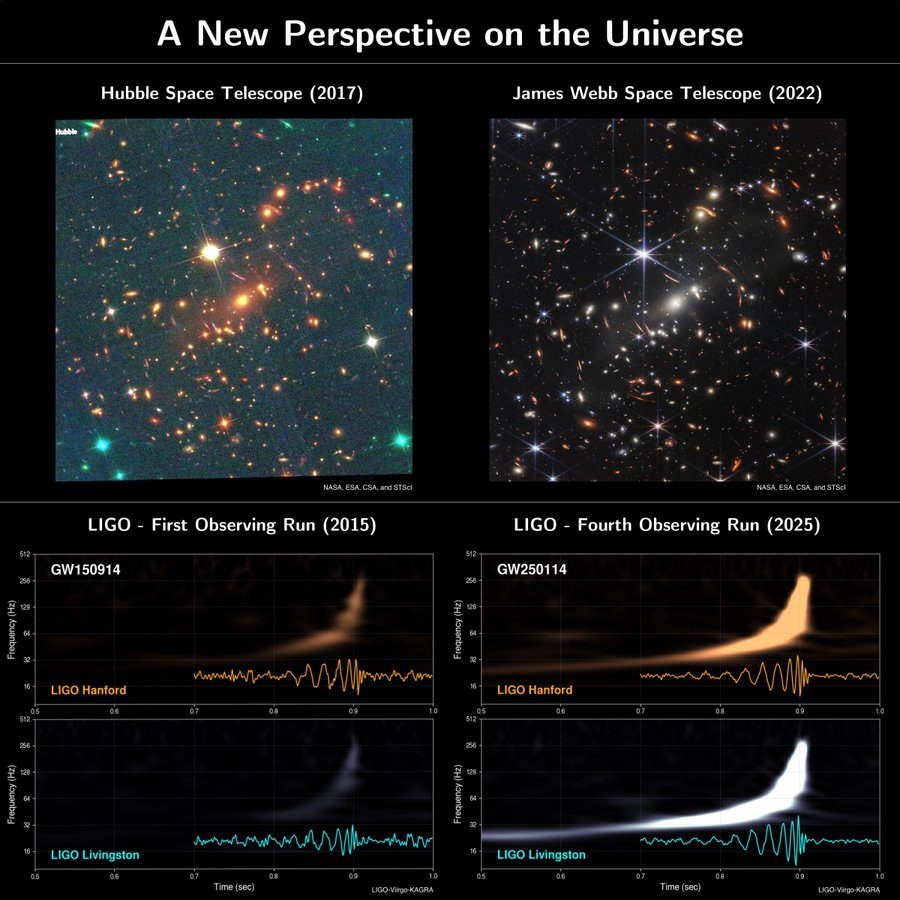
The best birthday gift for the ten years of gravitational wave astronomy was a stunning event, GW250114, that was announced last week. GW250114 is a “twin” of the original GW150914 event, but because the detectors got so much better, we can now verify for the first time two key predictions of Einstein’s general relativity: (1) we can use black hole spectroscopy to test that the merger remnant is compatible with a rotating (Kerr) black hole, and (2) we can observe that the Bekenstein-Hawking “area theorem” holds: entropy increases during the merger. The event was covered by the press: see for example this article in CNN where I have a little quote, and Chiara Mingarelli’s nice Physics Viewpoint.